|

Elliott Wave forecast: Gold impulsive structure supports bullish continuation [Video]

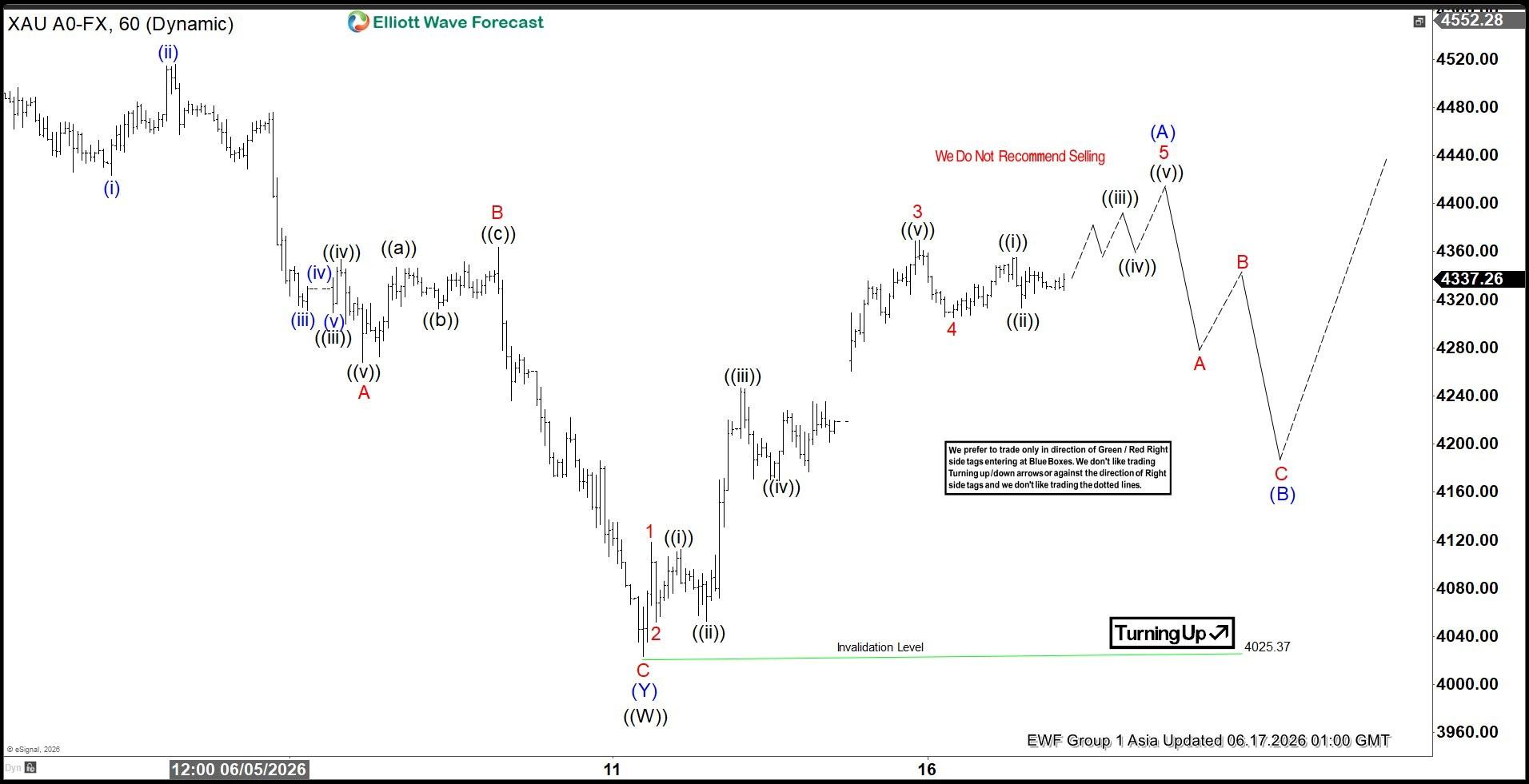
Gold (XAU/USD) has completed its cycle from the April 17 peak and is now positioned for a corrective rally in three waves. The decline from that peak ended at $4025, which marked the completion of wave ((W)). From this low, the market began a corrective phase in wave ((X)), unfolding as a zigzag structure. Within this formation, wave (A) is developing as a five‑wave impulse, providing the initial leg of the correction.

From the June 11 low at wave ((W)), the first impulse wave advanced to $4118.14. A pullback in wave 2 followed, reaching $4051.88. The metal then resumed its upward trajectory, with wave 3 extending sharply to $4369.45. A subsequent retracement in wave 4 found support at $4305.21. The expectation is for gold to continue higher in wave 5, thereby completing wave (A) of the zigzag. Once this advance is complete, the market should enter wave (B), correcting the cycle from the June 11 low before resuming its rally in wave (C).

In the near term, the structural pivot at $4025 remains critical. As long as this level holds, dips are anticipated to find support within the typical three, seven, or eleven swing sequences. This framework suggests that corrective pullbacks will likely provide opportunities for renewed strength. The overall pattern highlights resilience above the $4025 low and maintains a constructive outlook for gold in the short to medium term. The sequence of waves continues to reinforce the bullish bias, with each retracement offering potential for continuation.

Spot Gold (XAU/USD) 60-minute Elliott Wave chart
XAUUSD

XAU/USD Elliott Wave [Video]

Youtube preview

Author

Erste Bank Research Team

At Erste Group we greatly value transparency. Our Investor Relations team strives to provide comprehensive information with frequent updates to ensure that the details on these pages are always current.


More from Erste Bank Research Team
Share:

Editor's Picks

Japanese Yen gains ground as traders await Fed rate decision

The USD/JPY pair loses ground to near 160.25 during the early European trading hours. Traders prefer to wait on the sidelines ahead of the US Federal Reserve interest rate decision under new Chair Kevin Warsh later on Wednesday.

AUD/USD holds steady above 0.7050; looks to Fed for fresh impetus

AUD/USD is consolidating above mid-0.7000s in the Asian session on Wednesday as traders await the outcome of a two-day FOMC meeting due later in the day. In the meantime, the optimism over an interim peace deal between the US and Iran keeps the US Dollar bulls on the defensive. This, along with the RBA's hawkish pause on Tuesday, acts as a tailwind for the pair.

Gold consolidates above $4,300 as traders look to Fed rate decision for fresh impetus

Gold struggles to capitalize on its weekly gains, though it holds above the $4,300 mark through the Asian session. The latest optimism over an interim US-Iran peace deal keeps the US Dollar on the defensive, which is seen supporting the bullion. The commodity remains below the weekly swing high set on Monday and a technically significant 200-day SMA level.

Bitcoin holds $65,000 as Uniswap and Worldcoin extend rally
Bitcoin (BTC) is experiencing headwinds above $65,000 following the Bank of Japan’s rate hike to 1% on Tuesday. Still, Uniswap (UNI) and Worldcoin (WLD) continue to rally amid rising retail interest, while Bitcoin’s recovery grows heavy. Bitcoin edges higher at press time on Wednesday, inching closer to $66,000 as it maintains a mixed near-term tone following the recent rebound from $60,000.
The most important event will be the Fed meeting with Mr. Warsh now in charge

The most important event will be the Fed meeting on Wednesday, with Mr. Warsh now in charge. As more than one analyst points out, the case for holding rates the same is strengthened by the Iran deal and the prospect of the Strait re-opening, although nobody thinks Warsh can marshal enough doves to do a cut this time.

Why a hawkish RBA is no longer enough to lift the Australian Dollar

The Reserve Bank of Australia delivered more than what markets expected: a hawkish hold that should have supported the Aussie. But markets widely ignored it, focusing instead on slowing economic growth and proving that central bank messaging alone isn’t always enough to drive currencies.