ECB signals a June rate cut as the Euro sinks

The ECB held interest rates on Thursday, as expected, however, there was a notable dovish shift in communication from the governing council and from Christine Lagarde. This suggests that the ECB is priming the market an interest rate cut in June. The ECB said that the current interest rate is ‘making a substantial contribution to the ongoing disinflation process’. This is a long-winded way of saying that the disinflation trend remains in play in the Eurozone, regardless of what inflation is doing in the US. If inflation continues to fall, then it ‘would be appropriate to reduce the current level of monetary policy restriction.’ This is a statement of clear intent from the ECB: they will cut rates, however, they will remain data dependent.
The ECB vs. the Fed
The tone at the next Fed meeting at the end of this month is likely to be very different to the tone at today’s ECB meeting. The ECB stands ready to cut rates, yet it seems increasingly likely that the Fed will need to delay cutting interest rates and make some readjustments to its Dot Plot, as the US economy remains resilient and the inflation rate remains hot.
Christine Lagarde was asked as many questions about Fed rate cut expectations as she was about the ECB’s future intentions. This was to be expected, since interest rate expectations across the world have shifted in the 24 hours since the hot CPI print from the US. Bond yields have risen across the West in the last 24 hours. The market has also pared expectations for ECB rate cuts this year to 75bps, the Bank of England are now expected to cut rates just twice this year.
Central bankers’ Oil problem
How does a hot inflation print in the US, where the economy is strong, impact rate cut expectations in the Eurozone and the UK where the economic outlook is murkier? It seems logical that there should be some divergence in monetary policy so that central banks with weaker economies to manage cut rates faster than those with stronger economies. However, what unifies the ECB, the Fed and the BOE is the potential for the oil price to get to $100, triggering another uptick in inflation.
ECB sinks the Euro
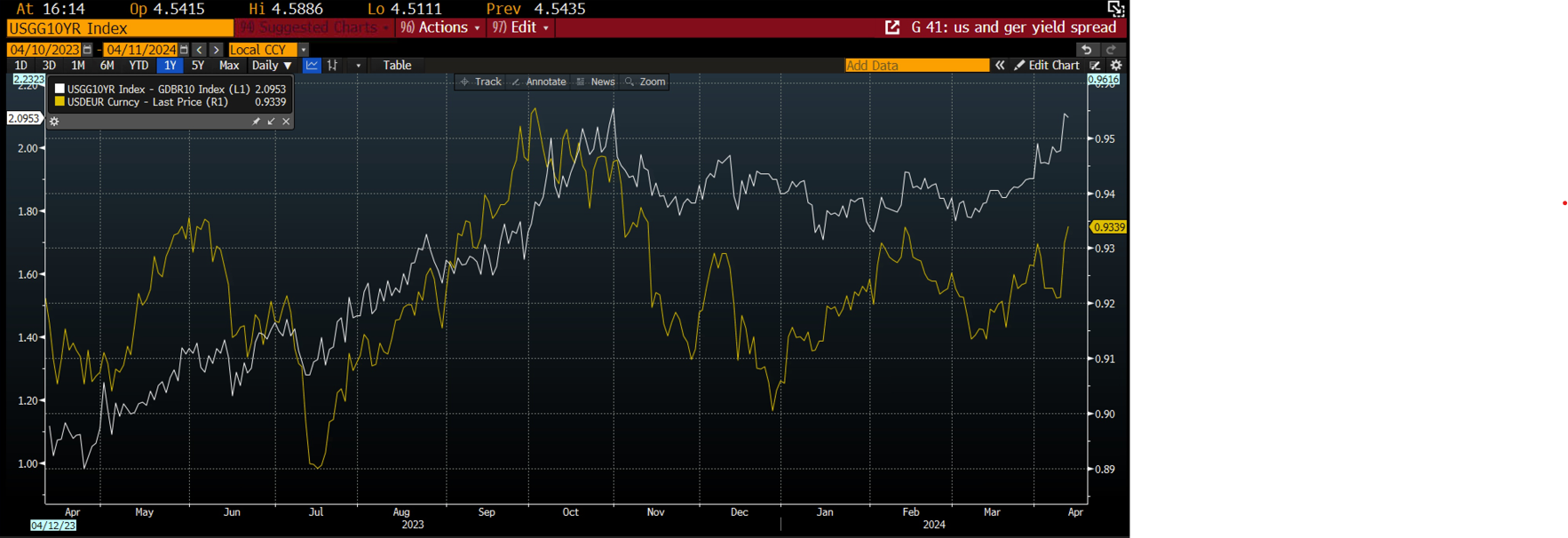
It is this fear that inflation could spread, that is causing German bond yields to move higher by 13 basis points in the last two sessions, even though the ECB was dovish at today’s meeting. Still, the decline in the euro is notable, even with the rise in German bond yields. This is down to interest rate differentials. The ECB is still expected to cut quickly and more frequently than the Fed, which is weighing on the euro and the US 10-year Treasury yield spread with Germany is more than 2%, and is close to its highest level since late October, as you can see in the chart below. The interest rate differential is on the side of the dollar, and EUR/USD continues to decline as we move through Thursday. It is currently testing the $1.07 handle, having dropped nearly 60 pips on the back of the ECB meeting. The next key level below $1.07 is $1.05. If we get to this level, then we could hear talk about parity.
The dollar’s ascendency in recent weeks means that it is now the best performing currency in the G10 so far this year. It is hard to stand in front of the dollar juggernaut, and this is also impacting equities. Although interest rate cuts are now on the horizon in the currency bloc, European stocks are lower. The Eurostoxx index is lower by 1.1%, led by big declines in German, Spanish and Italian stocks. European stocks are following US equities lower on Thursday even though the prospect of a rate cut from the ECB is in play. The weak euro might be good for exports, but it could also make raw materials more expensive, especially commodities that are priced in dollars. This is why the prospect of the euro reaching parity with the dollar is such a threat to European equities.
ECB remains data dependent
While the ECB statement does lean towards a dovish stance, it is still vague and shows a reluctance on the part of the ECB to commit to rate cuts. Christine Lagarde was been clear that the ECB remains data dependent. This means that volatility will increase ahead of the April and May CPI prints for the currency bloc, as they will determine if the ECB does actually cut in two months’ time. Lagarde is also clear that she will not pre-commit to a rate path. This means that even if the ECB does cut rates in June, it does not necessarily mean that they will continue to cut rates throughout the year. This makes pricing in future ECB policy an almost impossible task.
Monetary policy in 2024 is not a pre-planned formula, it is bespoke and dependent not just on economic data, but on geopolitics and supply dynamics for the global economy, which is a recipe for volatility.
Author
Kathleen Brooks
XTB UK
Kathleen has nearly 15 years’ experience working with some of the leading retail trading and investment companies in the City of London.

















