ECB set to face a US dollar weakness problem in 2021

Some 21 years on from its launch in 1999, the euro should have found its feet by now as a credible reserve currency to challenge the dominance of the US dollar.
Its failure to do so has as much to do with its intrinsic weaknesses, as yet unaddressed, than anything US authorities have done in looking to preserve the US dollar's unique dominance. If anything, the Trump administration has weaponised the dollar to such an extent that if a credible alternative had been available, the dollar's days could have been numbered. Unfortunately for international investors, the dollar continues to remain unchallenged as the one universal safe haven of choice, due to the depth of its liquidity pool.
Pandemic amplifies euro flaws
EU leaders have so far done little to correct the inherent flaws in the construction of the single currency, flaws that have become ever more evident as a result of the coronavirus pandemic, which has burnt a trail of economic destruction across the entire continent, causing huge amounts of economic distress in the weaker parts of the EU, notably in Italy, Spain and Greece.
The inability of EU leaders to coalesce around a single fiscal response to help the weaker members is no better illustrated by the time it took to pass the €750bn pandemic recovery fund agreed by EU leaders in the summer. The agreement was lauded as a ‘Hamilton moment' for the EU, with President Macron of France saying that the agreement was a major step forward and a "deep transformation", and exactly what the EU and single market needed to remain coherent. It certainly would have been if the deal had been passed into law in a speedy and timely manner, and was also a lot larger in size given the scale of the economic recovery task facing countries like Italy, Spain and Greece.
We hear a lot about the shared values and unity of the European project; however, these types of self-congratulatory statements probably seem rather hollow to the millions of unemployed people both old and young in southern Europe, who want something more than soundbites from their elected politicians, particularly now in the wake of a second wave of virus cases, hospitalisations and deaths. Sadly, statements such as these are all too typical of the myopia surrounding EU policymakers as they continue to show little appetite for the types of reforms needed to make the euro work like a proper currency zone should.
While a change of US president may signal a change of US policy in using the greenback as a lever in its foreign and trade policy, it has never been more important that EU policymakers shore up confidence in the single currency, at a time when China continues to look to assert its economic dominance. As a result of this inability to reform the euro currency's fiscal framework, there has been a reluctance on the part of international investors to use the euro in preference to the US dollar, meaning that despite being in use for over 21 years, it still only accounts for 21% of global foreign exchange reserves, compared with 60% for US dollars. This is actually lower than its peak in 2009 when it made up over 27% of global FX reserves, which is hardly a vote of confidence.
This still makes it the second most-used currency in the world, but until it irons out its flaws of having 19 different countries using the same interest rate, without a single fiscal policy, it will continue to have doubts cast upon its sustainability. This would require EU leaders to force closer economic integration in a period where populism is rising and more and more people are unhappy about the effects of globalisation.
The rise of populism across the bloc continues to be an enormous challenge, however this pales into insignificance to the challenges being posed by Covid-19. The limitations of delivering large-scale fiscal support at an EU level has caused resentment in the countries worst hit by the virus, as Italy and Spain grapple with soaring death rates, while EU leaders bicker about differentials of grants versus loans. With no single political authority or treasury, the euro is likely to continue to cause difficulties, particularly when it comes to driving reform, something which a number of EU politicians have belatedly started to acknowledge, but have so far been completely unable to deliver.
New ECB president needs creative solutions
The appointment of Christine Lagarde as European Central Bank president appears to be part and parcel of a new strategy to help drive closer fiscal integration, however even before she took up her post, battle lines were being drawn by France, Germany and the Netherlands on the harmonisation front. It is quite apparent that the policy of negative rates has caused more harm than good, and as such the ECB will need to be even more creative than it already has been this year to help any economic recovery in 2021, as well as making sure it doesn't damage banking system margins any further.
It certainly isn't going anywhere on the monetary policy front, and has restarted its asset purchase programme, expanding it to €1.35trn until the middle of next year in June, and then extending it again by another €500bn to €1.85trn this month, until March 2022.
While this helps buy time, along with new loan programs in the form of TLTRO's the ECB can't act alone. It needs help on a much bigger fiscal scale, which at the moment is only just coming in a fairly limited form in the form of the EU recovery fund, and only €390bn of the €750bn of that fund, in the form of grants, far too low to really make much of a difference.
We are now finally seeing fiscal stimulus on a large scale on a country level with Germany leading the way in that regard, with the temporary suspension of the fiscal compact, however this stimulus is being delivered very much on a localised basis, as opposed to being on a pan-European level, with Italy, Spain and Greece in the most economic need. With the damage from the pandemic likely to extend into 2021, Europe really needs to get its act together, otherwise further economic schisms could open up further over the next 12 months.
Euro needs to ‘grow ‘up'
Quite simply the euro should have grown up by now and while very few expect it to come apart at the seams, there is a risk in the absence of some significant reforms that it will struggle to even get close to the US dollar in the years ahead, unless doubts about its sustainability are put to bed once and for all.
In terms of monetary policy, the ECB is already close to the lower bound given concerns about the effects of negative rates. That doesn't mean that rates can't go much lower, or the ECB can't do more quantitative easing, despite the prospect of lower US rates, but it does limit the upside. And the last thing Europe needs now is a stronger currency, given it has risen against the dollar over the last 12 months, from 1.0700, and inflation has slipped even lower.
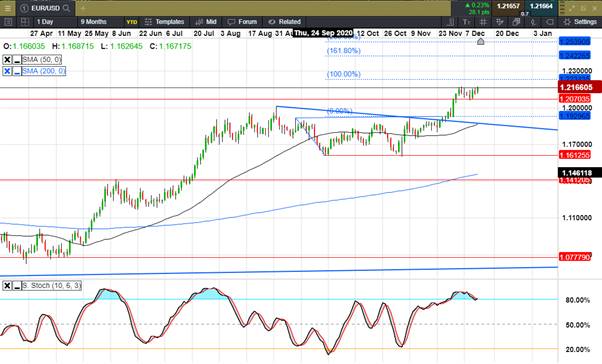
EUR/USD 2020, year to date
Source: CMC Markets
In the last 12 months, we've gone from 1.1100 and have now moved above the 1.2000 level, and though we did see a brief and welcome dip to 1.0700 in April, that didn't last, and since then the weakness of the US dollar has seen the euro gain steadily over the past nine months.
To be clear, this hasn't been a euro strength story but more a US dollar weakness one. If this continues then the ECB will find it very difficult to push back against that, and get inflation back to target, from zero where it is now.
We can already tell that ECB policymakers are nervous about this, with ECB chief economist, Philip Lane, consistently talking it lower every time it gets near to the 1.2000 level, however all they can do is slow any advance down, not stop it completely, with the recent move above 1.2000 testament to that fact.
The real concern now is that further gains towards 1.2500 will make the ECB's task even more difficult than it already is, and the lack of political ability to aid in this will only likely make matters worse.
Over 10 years on from the financial crisis, there is still no banking union, no treaty on the European Stability Mechanism, and the EU is now having to contend with a new economic and health crisis, the likes of which will test its cohesion even further in the weeks and months to come.
Author

Michael Hewson MSTA CFTe
Independent Analyst
Award winning technical analyst, trader and market commentator. In my many years in the business I’ve been passionate about delivering education to retail traders, as well as other financial professionals. Visit my Substack here.