ECB Preview: Will tough times call for tough measures?
- The ECB is expected to hike rates by 75 bps in its September meeting.
- Markets are wagering a 75 bps rate hike amid surging energy costs.
- The bank’s staff projections are in focus, with no respite seen for the EUR.

After raising interest rates for the first time in over a decade in July, the European Central Bank (ECB) is set for another rate increase this Thursday, although the big question is whether the central bank will opt for 50 basis points (bps) or 75 bps hike amid record-high inflation and recession risks.
The ECB will announce the interest rate decision at 1215 GMT, which will be followed by President Christine Lagarde’s press conference at 1245 GMT.
The ECB remains in a tough spot
The ECB finds itself in a tough spot in the last leg of the European summer. The old continent sees desperate times, in the face of rising inflation and an imminent recession. The central bank maintains its resolve to prioritize the taming of inflation even if it could mean some pain for the economy, and, therefore, is set to hike its three key interest rates by 75 bps at this month’s monetary policy meeting.
Following the Fed’s Jackson Hole Symposium and a record high annualized inflation of 9.1% for the Eurozone last month, markets priced in an 80% probability of a 75 bps increment in September. Top ECB policymakers also joined the Fed’s chorus of going in for an outsized rate hike to control raging inflation.
Over the past week, however, the Russian giant Gazprom’s gas cut-off to Europe from its Nord Stream 1 pipeline has complicated the situation for the ECB. Gas prices have soared 255% in 2022 and on Monday jumped roughly 30% following the Nord Stream 1 shutdown news. The euro area is bearing the brunt of a protracted Russia-Ukraine war and the Western sanctions against Moscow. The German economy is the worst affected, with a recession imminent.
Source: Reuters
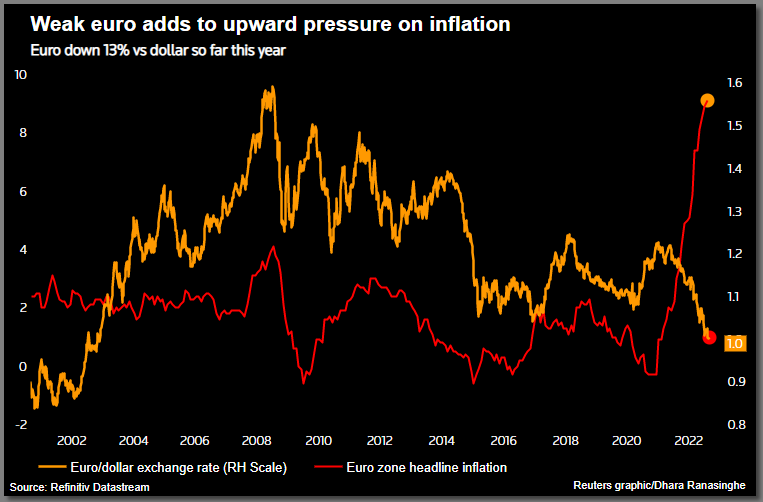
Amidst the deepening European gas crisis and mounting recession fears, the euro has tumbled to fresh two-decade lows below 0.9900 against the US dollar, down 13% so far this year. The rapid depreciation of the shared currency is amplifying the effects of soaring energy costs, accentuating concerns over already record-high inflation.
Against this backdrop, markets remain in favor of an outsized rate hike, as bringing down inflation is likely to be of utmost priority even though controlling energy costs is out of the purview of the central bank. Markets are now wagering around a 68 bps rate hike on Thursday, given that the peripheral yields have surged this week after euro area economies issued a huge amount of bonds this week.
But earlier this week, during the so-called ‘blackout period’ for the ECB, a bunch of the central bank policymakers talked up the ‘slow normalization’ process. Governing Council member Mario Centeno said that “the ECB may achieve inflation goal with slow normalization.” His colleague, Martins Kazaks, said a broad and protracted recession could slow rate hikes. Meanwhile, fellow policymaker Yannis Stournaras noted that “Eurozone inflation is close to its peak,” hinting at a slow down in the bank’s tightening path.
The ECB commentary could be seen as a deliberate attempt to temper the aggressive ECB tightening expectations. The officials spoke just a couple of days ahead of the policy announcement, implying a 50 bps hike.
Investors will also closely examine the staff projections, as the ECB said that it remains data-dependent on its future rate hike outlook. The central bank’s forecast on the growth and inflation outlook will have a significant impact on the common currency.
Trading EURUSD price with the ECB
EUR traders are bracing for high volatility and big market impact from the upcoming ECB policy announcements, with EUR/USD meandering near 20-year troughs on the 0.9800 level.
A 75 bps rate hike by the ECB could offer a temporary respite to EUR/USD, as such a move is not fully priced in yet. The pair could recover the parity mark and beyond on a super-sized rate increase. Although the renewed upside in the euro is likely to remain short-lived amid the dire Eurozone economic outlook.
However, if the ECB projects a recession in early 2023, then it could take the wind out of the EUR/USD recovery, smashing the price back towards the two-decade lows. The previous forecasts showed that the bank expected a 2.1% growth for this year but this is likely to be revised downward this time.
Meanwhile, a 50 bps rate hike could question the central bank’s commitment to fighting inflation. It could also highlight the ECB’s concerns about the risks of a deep recession. In such a case, the pair could extend the downtrend towards 0.9700, as it would widen the Fed-ECB monetary policy divergence. At the moment, the Fed Funds futures imply a 75% chance of a 75 bps Fed hike in September.
Author

Dhwani Mehta
FXStreet
Residing in Mumbai (India), Dhwani is a Senior Analyst and Manager of the Asian session at FXStreet. She has over 10 years of experience in analyzing and covering the global financial markets, with specialization in Forex and commodities markets.
















