ECB December Preview: How will ECB replace PEPP?
- ECB plans to start policy normalization by reducing PEPP purchases.
- Investors want to know how the ECB will continue to support the economy.
- A dovish policy outlook could cause EUR/USD to turn south.

The European Central Bank (ECB) is widely expected to leave the interest rates on the main refinancing operations, the marginal lending facility and the deposit facility unchanged at 0.00%, 0.25% and -0.50%, at the December policy meeting. More importantly, the ECB is set to take a step toward policy normalization and unveil its plan to retire the Pandemic Emergency Purchase Program (PEPP). Additionally, the bank will release the updated macro projections.
Several ECB policymakers, including President Christine Lagarde, noted in the previous weeks that it would be appropriate to conclude the PEPP by March. Similarly, "the view was held that judging on the basis of the current developments, net purchases under the PEPP could be expected to come to an end by March 2022." the accounts of the ECB’s October meeting read.
As it currently stands, the ECB’s quantitative easing program runs at around €80 billion per month, €20 billion of which is via the Asset Purchase Programme (APP). With European economies struggling to preserve the growth momentum amid the Omicron variant, the ECB will have to reassure markets that they will continue to support the economy even if they decide to end the PEPP at the end of the first quarter of 2022.
Hawkish scenario
The ECB could decide to end the PEPP in March and refrain from adjusting its other tools or introducing another one to ease the normalisation process due to inflation fears. The last ECB projections published in September showed that inflation was forecast at 2.2%, 1.7% and 1.5% in 2021, 2022 and 2021, respectively. In case the ECB were to adopt a hawkish stance, the euro is likely to gather strength against its rivals and trigger a sharp rebound in EUR/USD.
This is the least likely scenario because ECB Governing Council members said numerous times that they were expecting factors ramping up inflation to start to dissipate in the second half of 2022. Moreover, Lagarde mentioned that the ECB has other tools that it can use to replace the PEPP.
Dovish scenario
The ECB could extend the PEPP to the end of the second quarter and cause the shared currency to suffer heavy losses against its major rivals. If the ECB were to do that, however, it would lose its credibility after communicating that the program would end in March.
Instead, it may be more plausible for the ECB to increase the amount of purchases in the APP in March. If the APP purchases are raised to €40 billion from March, the euro’s losses are likely to remain limited following an immediate reaction. A bigger-than-€40 billion APP from March would also be considered as a dovish stance and hurt the common currency.
There is also the possibility of the ECB introducing a brand new tool to substitute the PEPP. No matter what the new tool looks like, markets will assess the total amount of QE.
EUR/USD technical outlook
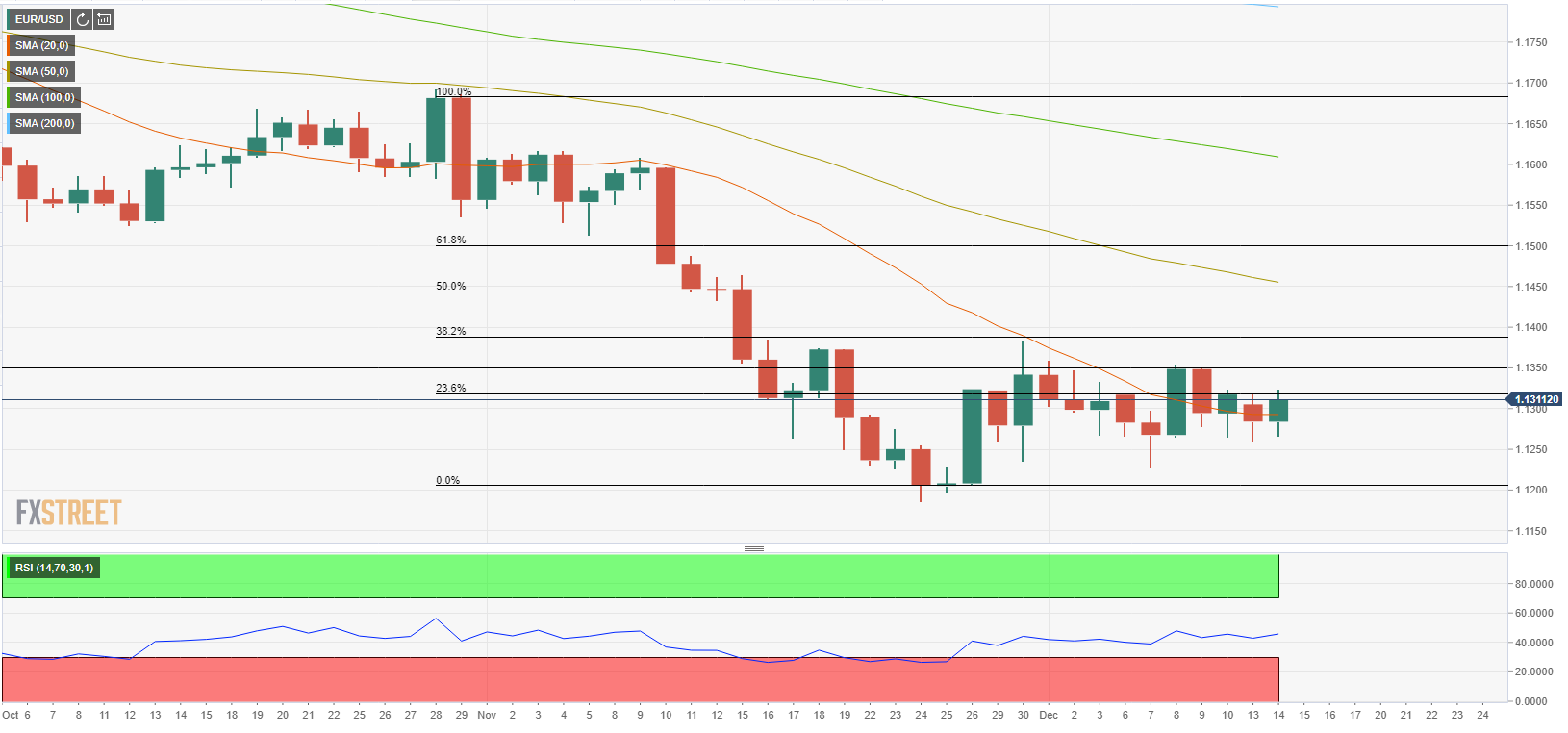
EUR/USD has been fluctuating between 1.1250 and 1.1350 since the beginning of the month. The pair’s next decisive move is likely to occur outside of that channel. On the daily chart, the Relative Strength Index (RSI) indicator is moving sideways a little below 50, confirming the view that the pair is in a consolidation phase.
A dovish ECB outcome could drag EUR/USD below 1.1250 (static support) and open the door for additional losses toward 1.1200 (psychological level) and 1.1185 (2021 low).
On the other hand, the pair could target 1.1400 (psychological level, Fibonacci 38.2% retracement of November downtrend) if it manages to clear 1.1350 on a hawkish surprise. 1.1450 (50-day SMA) and 1.1500 (psychological level, Fibonacci 61.8% retracement) align as next resistances.
Author

Eren Sengezer
FXStreet
As an economist at heart, Eren Sengezer specializes in the assessment of the short-term and long-term impacts of macroeconomic data, central bank policies and political developments on financial assets.