Durable goods orders slip, downside risk to Q1 equipment spending

Summary
Durable goods orders slipped again in February, and the trend in core capital goods orders is growing less favorable. Rapid Fed tightening, the pull back in lending standards and increased economic uncertainty are unfavorable conditions for new capital investment.
Conditions growing less favorable for new cap-ex
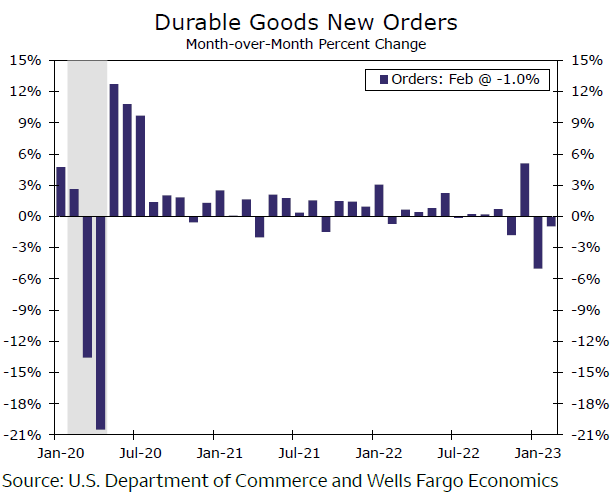
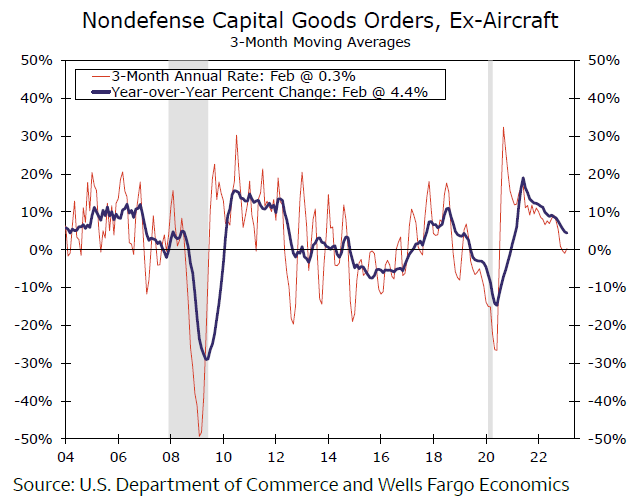
New orders for durable goods slipped again in February, declining 1% after a 5% drop a month earlier (chart). While most weakness can be traced to aircraft and defense orders specifically, demand for new capital expenditures is losing momentum. That is, even discounting some of the transportation related volatility on the headline orders data, the modest 0.2% rise in core capital goods orders (which are non-defense and exclude aircraft) comes after January's stout 0.8% gain was revised to just 0.3%. The recent run-rate for core orders is thus less encouraging but still positive; core capital goods orders are up at a 0.3% annualized rate over the past three months (chart).
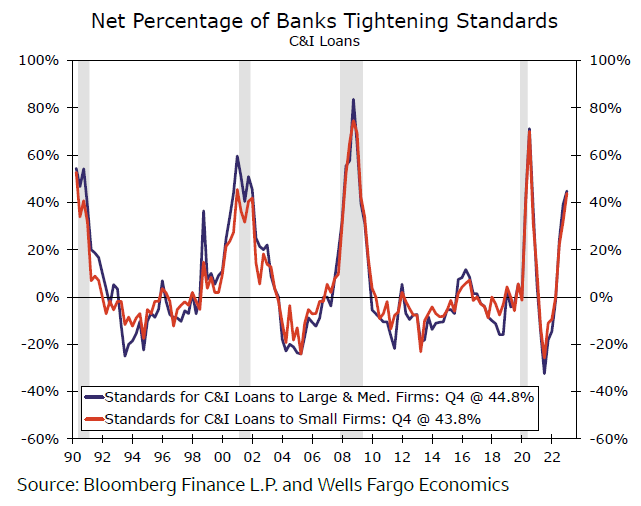
Beyond transportation the orders data were a bit mixed. Orders for new machinery and computers also slipped, but metals and electrical equipment orders rose. Considering the durables data with other measures on manufacturing activity, we see demand for private capital equipment gradually losing momentum. For instance, the Institute for Supply Management's manufacturing measure of new orders rose in February but remained in contraction territory with 12 industries reporting a decline in orders. We suspect that the combination of higher borrowing costs from the Fed's tightening cycle and growing uncertainty of what's in store for the economy later this year is eroding businesses' willingness to make new capital expenditures. The recent flare-up in the banking sector only adds to concern. Tighter financial conditions may lead banks to tighten lending standards further and will thus dent firms ability to borrow. The net percentage of banks tightening standards to firms has already risen sharply in recent quarters (chart).
Downside risk to Q1 equipment spending
The February durable goods report also leaves some bad news for the near-term trajectory of economic growth. When it comes to GDP accounting, it is shipments rather than orders that matters. Non-defense capital goods shipments flows into the calculation of equipment spending in the GDP accounting by the Bureau of Economic Analysis, and these data suggest downside risk to our estimate for equipment spending to decline at a 3.4% annualized rate in the first quarter.
Non-defense capital goods shipments slid 0.6% in February, and January's 1.0% decline was revised lower to -1.7%. Since the durables data are nominal, real non-defense shipments were even weaker when factoring in the continued uptick in prices for private equipment. Shipments of private equipment (nominal) are tracking to decline at a near 7% annualized clip through the first quarter.
Author
Wells Fargo Research Team
Wells Fargo