Does the market see the economy more clearly than the Fed?

Outlook:
In addition to Fed chief Powell at the Economic Club of Washington, we have no fewer than five regional Feds on the speaking circuit today. Okay, we get it—the Fed is pulling in its horns, largely because it fears a self-fulfilling recession. The economy still ahs plenty of forward momentum, as Powell says, but the fraidy-cats in the executive suites and bond desks are not convinced the Fed is entirely sincere.
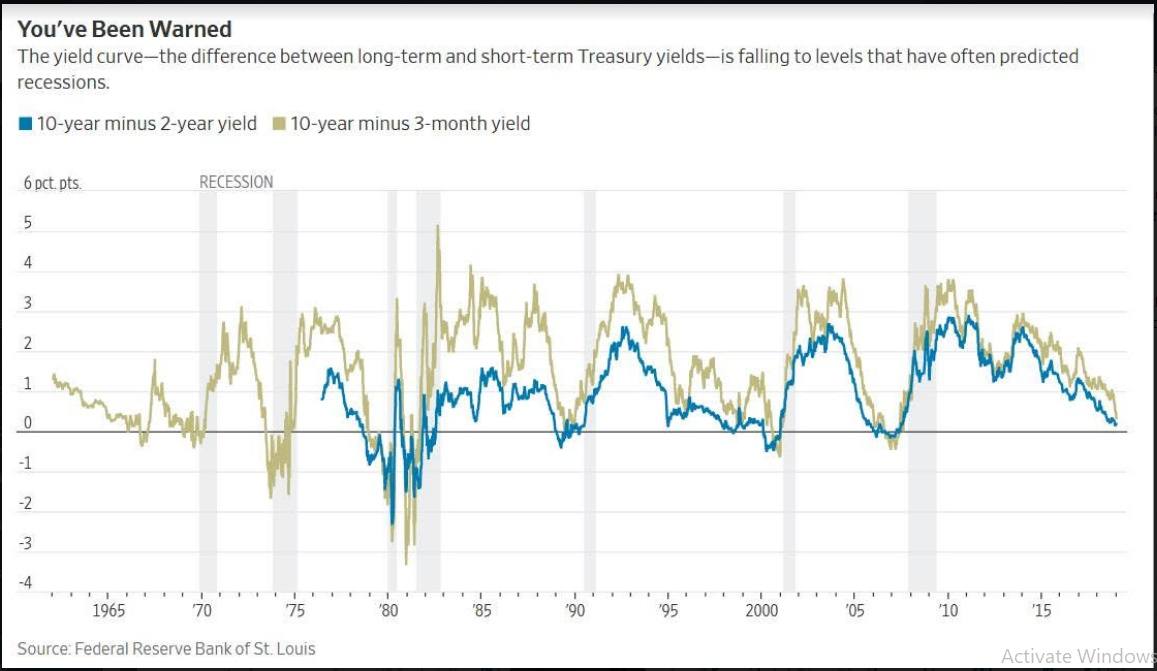
The former WSJ Fed-watcher Greg Ip has a dandy story today that starts out with this: “There’s a new horror show coming to your screens: Set on Wall Street, it’s called ‘Inversion of the Yield Curve’ and features a chilling, disembodied force that seeps into the minds of the public, triggering panic in markets and hand-wringing on cable news.
The inverting yield curve “is being mentioned increasingly on corporate conference calls, especially of financial companies, according to an analysis by Prattle, which studies language for investment clues. But how much you should worry depends crucially on whether an inverted yield curve predicts a recession, or causes a recession, or both.”
Ip notes that yields reflect supply and demand, too. The saving glut in foreign countries, the Greenspan conundrum, contributed mightily to lower yields. “Fed economists estimate those purchases were holding yields down by about 0.85 percentage point at the end of 2017.” Even so, we should exclude supply and demand when reading the curve. Taking expectations 18 month out and comparing them to actual yields, the Fed finds investors really do forecast recession. Does the market see the economy more clearly than the Fed? According to a JP Morgan study, yes.
Does expecting a recession cause a recession? Also yes. “For example, by narrowing the spread between loan rates (which are tied to bond yields) and deposits (which are tied to short-term rates), it makes lending less profitable.” An inverted yield curve makes bankers tighten credit standards and reduce lending. “If all that mattered were the economic fundamentals, the Fed could ignore the yield curve movie now playing on Wall Street. But as long as recessions can be self-fulfilling prophesies, it needs to stay to the end.”
Ip is well-noted as a Fed critic. In years past, we used to give him a hard time when he wandered into FX forecasting from Fed analysis. (And he was usually wrong on that score.) But this time we think he has the situation spot-on right. We can’t stop worrying about the inversion. See the chart. The possibility of a cut is not a remote one.
What does this mean for the dollar? It ain’t good. We may be seeing seismic shift in sentiment to the usual dollar-negative stance that prevails most of the time, and never mind that Europe is seeing actual signs of contraction while the US still has momentum. And Japan soldiers on but authentic tapering not even close and a sales tax looming (what year is this?).
This is an excerpt from “The Rockefeller Morning Briefing,” which is far larger (about 10 pages). The Briefing has been published every day for over 25 years and represents experienced analysis and insight. The report offers deep background and is not intended to guide FX trading. Rockefeller produces other reports (in spot and futures) for trading purposes.
To get a free trial, please write to [email protected] and you will be added to the mailing list..
This is an excerpt from “The Rockefeller Morning Briefing,” which is far larger (about 10 pages). The Briefing has been published every day for over 25 years and represents experienced analysis and insight. The report offers deep background and is not intended to guide FX trading. Rockefeller produces other reports (in spot and futures) for trading purposes.
To get a two-week trial of the full reports plus traders advice for only $3.95. Click here!
Author
Barbara Rockefeller
Rockefeller Treasury Services, Inc.
Experience Before founding Rockefeller Treasury, Barbara worked at Citibank and other banks as a risk manager, new product developer (Cititrend), FX trader, advisor and loan officer. Miss Rockefeller is engaged to perform FX-relat