|

Diverse productivity growth amid demographic challenges

  • In this next part of our series on demographics, we dive deeper into global production and productivity, both from a per capita and per worker standpoint.

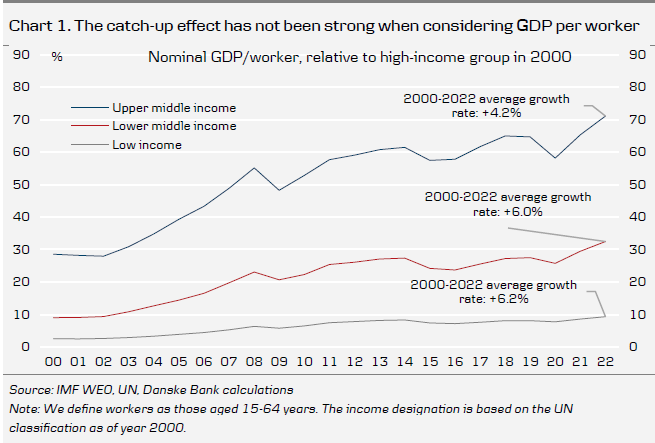
  • Worker productivity for low-income economies has almost quadrupled since 2000, but rapid population growth has also played a large role for GDP growth.

  • High-income countries have seen steady productivity growth in recent decades. This holds also for the Nordic countries.

  • There is a large disparity in productivity growth in all income groups, but in particular in middle-income- and low-income countries.

  • High-income countries face growth headwinds from changing demographics but might be able to make up for it through productivity growth.

How much have low-income economies caught up?

Typically, we anticipate economies with lower productivity to outpace their higher productivity counterparts in growth, as they adopt knowledge and technology from more advanced economies. This phenomenon, frequently analysed on a per capita basis, gains relevance when considered in terms of per worker growth, particularly considering diverging workforce sizes - a perspective we adopt in this paper.

In Chart 1, we average GDP per worker, measured in USD, across various country income groups and divide it by the level of the high-income group in the year 2000. Countries are categorized based on their income classification at the onset of our sample period, the year 2000. Our definition of the working-age population includes individuals aged from 15 to 64 years.
Chart

Download The Full Research Global

Author

Danske Research Team

Danske Research Team

Danske Bank A/S

Research is part of Danske Bank Markets and operate as Danske Bank's research department. The department monitors financial markets and economic trends of relevance to Danske Bank Markets and its clients.


More from Danske Research Team
Share:

Editor's Picks

EUR/USD weakens to near 1.1900 as traders eye US data

The EUR/USD pair loses ground to around 1.1905, snapping the two-day winning streak during the early European trading hours on Tuesday. Markets might turn cautious ahead of the release of key US economic data, including US employment and inflation reports that were pushed back slightly due to the recently ended four-day government shutdown.

GBP/USD edges lower below 1.3700 on UK political risks, BoE rate cut bets

The GBP/USD pair trades on a weaker note around 1.3685 during the European session on Tuesday. The Pound Sterling edges lower against the US Dollar amid political risk in the United Kingdom and rising expectations of near-term Bank of England rate cuts. 

Gold drifts lower as positive risk tone tempers safe-haven demand; downside seems limited

Gold drifts lower during the Asian session on Tuesday and snaps a two-day winning streak, though it lacks strong follow-through selling and shows some resilience below the $5,000 psychological mark amid mixed cues. The outcome of Japan's snap election on Sunday removes political uncertainty, which, along with signs of easing tensions in the Middle East, remains supportive of the upbeat market mood.

Bitcoin Cash trades lower, risks dead-cat bounce amid bearish signals

Bitcoin Cash trades in the red below $522 at the time of writing on Tuesday, after multiple rejections at key resistance. BCH’s derivatives and on-chain indicators point to growing bearish sentiment and raise the risk of a dead-cat bounce toward lower support levels.

Follow the money, what USD/JPY in Tokyo is really telling you

Over the past two Tokyo sessions, this has not been a rate story. Not even close. Interest rate differentials have been spectators, not drivers. What has moved USD/JPY in local hours has been flow and flow alone.

Bitcoin Cash trades lower, risks dead-cat bounce amid bearish signals

Bitcoin Cash (BCH) trades in the red below $522 at the time of writing on Tuesday, after multiple rejections at key resistance. BCH’s derivatives and on-chain indicators point to growing bearish sentiment and raise the risk of a dead-cat bounce toward lower support levels.