Defense spending boom meets market complacency: What US30 vs XAU is telling traders right now

Back in January, the market treated every geopolitical headline as a reason to buy gold.
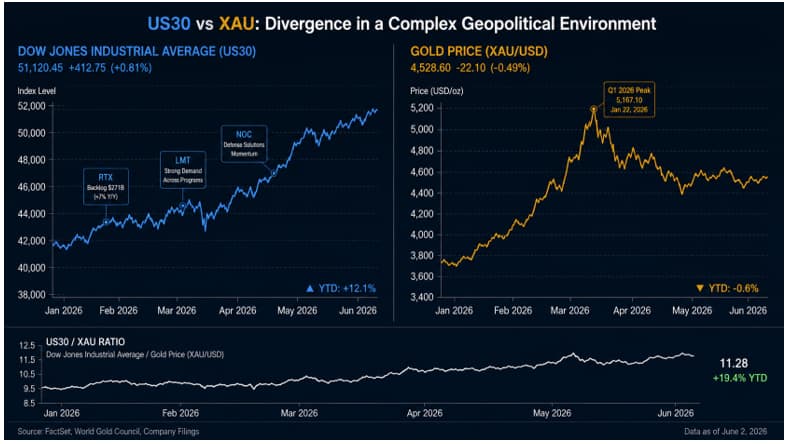
By June, the reaction looked very different.
Military tensions remain elevated across the Middle East. Central banks are still adding to gold reserves. Oil traders continue watching shipping routes and regional security developments. Yet the Dow Jones Industrial Average is sitting near record highs while gold trades well below its first-quarter peak.
That disconnect sits at the center of the US30 vs. XAU debate.
The traditional script says rising geopolitical risk should push investors toward defensive assets. What has unfolded in 2026 is more complicated. Traders appear willing to tolerate a significant amount of uncertainty as long as they believe conflicts remain regional rather than systemic.
Why stocks are ignoring part of the risk story
The strength of U.S. equities has surprised plenty of market participants this year.
At first glance, that resilience seems difficult to reconcile with the geopolitical backdrop. A closer look suggests investors are not dismissing risk entirely. Instead, they are becoming more selective about where that risk matters.
One clue comes from aerospace and defense.
RTX reported a backlog of roughly $271 billion at the end of the first quarter, underscoring how much future revenue is already locked into existing programs. The company's order pipeline spans both commercial aviation and military contracts, giving investors visibility that many sectors currently lack.
Meanwhile, the iShares U.S. Aerospace & Defense ETF gained around 10% year-to-date through late May, outperforming a number of broader industrial benchmarks.
That helps explain the broader defense sector stocks' performance 2026 narrative. Investors have been willing to pay for earnings visibility tied to government spending. In practical terms, defense exposure has become one way of expressing a geopolitical view without abandoning equities altogether.
The result is a more nuanced version of the geopolitical tensions impact markets theme than traders saw during previous crises.
Not every conflict triggers a flight from stocks. Sometimes it redirects capital within the equity market itself.
Gold is still supported, just not urgent
Gold tells a different story.
The metal exploded higher during the first quarter before giving back part of those gains in the spring. Prices around $4,500 per ounce remain historically elevated, yet the market no longer behaves as though a major global shock is imminent.
That shift has led some traders to question whether safe haven gold demand is fading.
The underlying numbers suggest otherwise.
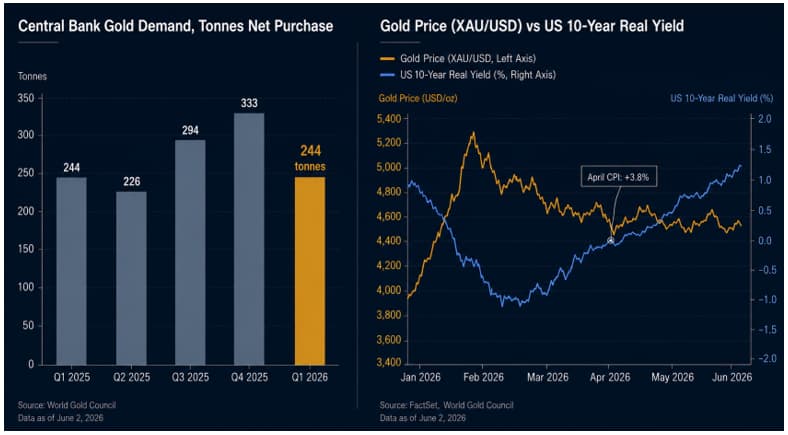
According to the World Gold Council, central banks bought a net 244 tonnes during the first quarter of 2026. Investment demand remained supported by ETF inflows, particularly in Asia.
For traders following gold safe haven demand, central banks are buying in 2026, those purchases matter because central banks operate on a very different timetable from speculative investors. They are not trading headlines. They are adjusting reserve allocations.
That distinction helps explain why geopolitical tensions and safe haven gold demand remain relevant even after the spring correction.
The market has clearly become less aggressive, but gold safe haven demand has not disappeared. Nor has gold safe-haven demand stopped influencing longer-term positioning decisions.
A better way to describe the current environment is that investors have become less concerned about immediate escalation and more focused on monetary policy. Hot inflation prints and higher real yields have competed directly with safe haven demand for gold and silver flows for attention.
The same dynamic has affected discussions around safe-haven demand for gold and silver, safe-haven demand for gold, and safe-haven demand for gold across institutional research desks.
Reading what the ratio is actually saying
This is where the US30/XAU comparison becomes useful.
Many traders treat the ratio as a rough measure of confidence. When equities outperform gold, markets are generally pricing economic resilience. When gold starts outperforming stocks, concern about growth or financial stability tends to rise.
At the moment, the ratio remains tilted toward risk assets.
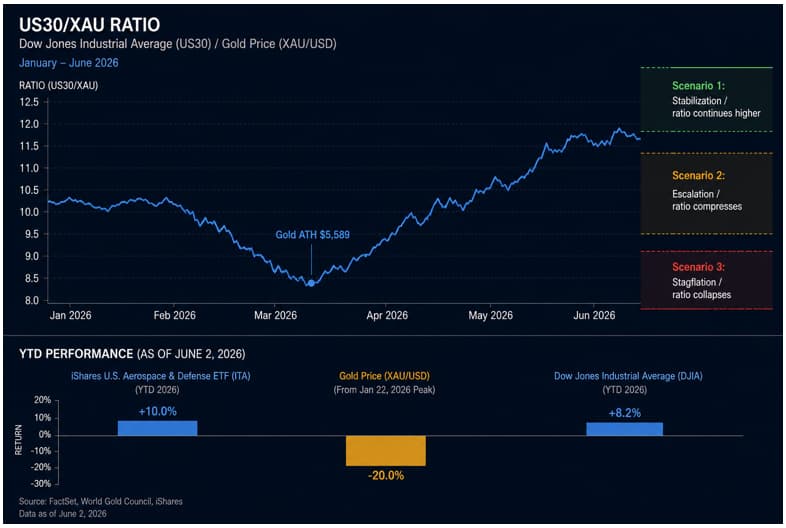
Supporters of the Versus Trade US30 XAU framework argue that investors continue to see earnings growth and government spending as more important drivers than geopolitical uncertainty.
The chart itself tells the story. A typical Dow Jones vs. gold chart now looks very different from what traders saw in January. Gold surged first. Equities caught up later.
That divergence has created fresh debate around gold vs. Dow Jones positioning.
A meaningful deterioration in economic data could quickly change the equation. So could another inflation surprise. Either scenario would likely strengthen gold price safe haven demand and challenge the current market consensus.
For now, however, traders appear comfortable with the assumption that current conflicts remain contained.
That assumption has supported the Dow Jones vs. gold performance through much of the second quarter. It is also visible on almost any gold vs. Dow Jones chart tracking the period since gold's first-quarter peak.
Investors watching the gold safe haven demand chart should focus on three variables over the coming months: real yields, central bank purchases, and energy markets.
The market is still acknowledging risk. It is simply choosing not to pay the same premium for it that it paid six months ago — and that distinction may be the most important takeaway from the current US30 vs. XAU setup.
Author

Amir Razak
Versus Trade
Malaysian-born market analyst Amir Razak cuts through the noise every week, breaking down Versus Pairs and explaining what is really driving one asset ahead of another.