Czechia and Poland on hold?


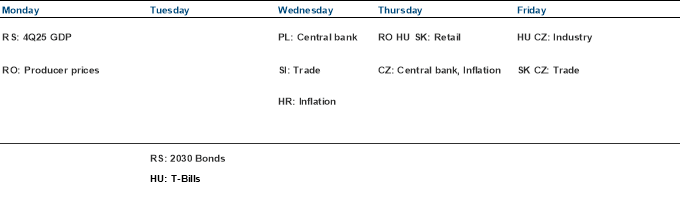
Following Czechia, Hungary and Poland, Serbia will publish 4Q25 data on Monday. Other than that, central banks in Czechia and Poland will be in the spotlight. While in Czechia, no change in the interest rate is broadly expected, in Poland, expectations are mixed (a 25 basis point cut vs. stability). We will get to see the flash inflation in Czechia as well as some Eurozone countries (Croatia, Slovenia and Slovakia). Poland is not publishing flash inflation in January, due to adjustments in the inflation basket. Finally, data on the performance of the retail and industry sectors in December will flow in for Romania, Hungary, Slovakia and Czechia. Trade data is due in Slovenia, Slovakia and Czechia. Additionally, on Friday, after the market closes, Fitch will issue its review of Czechia’s rating and outlook.
FX market developments
CEE currencies began the week on a relatively strong note, but over the week, a depreciation trend has prevailed. The EURCZK moved toward 24.34, the EURHUF to 381 and EURPLN to 4.21. Last week, Hungary left the policy rate flat at 6.50% and communications shifted to underline cautiousness. Bottom line: the probability of a rate cut in February has diminished significantly. Such a development is supportive for the Hungarian forint. The monetary easing question remains open, however. On one hand, lower inflation will favor interest rate cuts; on the other, the political situation and proximity of the election may influence the central bank’s decision to some extent. This week, central banks in Czechia and Poland hold rate-setting meetings. In Czechia, stability of rates is broadly expected. Nevertheless, it is worth noting that some of the central bankers are raising the question of whether there is space for interest rate cuts this year. Most recently, central bankers Frait and Prochazka suggested the possibility of such a scenario. At this point, domestic developments are seen as inflationary, but the external environment may justify monetary easing in the case of any shock. In Poland, the outcome of the central bank meeting is a bit more blurred, as expectations on the market are divided between an interest rate cut and no change.
Bond market developments
CEE government bonds benefited from the decline in Eurozone yields (10Y down about 5bp w/w), with Czech and Hungarian papers performing particularly well. Hungarian 10Y yields fell roughly 10bp w/w, reaching a one year low, despite the central bank’s decision to keep rates unchanged. Markets remain almost certain, however, that the central bank will resume its easing cycle by April, at the latest. In Czechia, the mid segment of the yield curve led the rally, dropping around 15bp w/w, supported by comments from Vice Governor Frait, who acknowledged that a rate cut could already be discussed at the next MPC meeting, driven primarily by external rather than domestic factors. Romania’s Ministry of Finance confirmed plans to issue EUR 10bn in Eurobonds this year and to rely on RRF and SAFE loans to finance the majority of the planned EUR 21bn external borrowing this year. Slovakia’s Ministry of Finance announced two new retail bond issues (2Y and 4Y) to be offered in March, targeting to raise EUR 400–500mn. Both issues are expected to carry yields roughly 30bp below similar bonds sold last year, yet remain about 40–50bp more expensive for the ministry than wholesale borrowing.
Author
Erste Bank Research Team
Erste Bank
At Erste Group we greatly value transparency. Our Investor Relations team strives to provide comprehensive information with frequent updates to ensure that the details on these pages are always current.