Crude Oil snaps back as Iran digs in and the Strait stays shut
- WTI climbed back above the $100 mark, recovering most of the prior session's slide after reports claimed Iran will keep its enriched uranium at home, reigniting supply fears.
- The bid is geopolitical, not fundamental. Inventories have fallen for four straight weeks, but the real floor under prices is the Strait of Hormuz, still largely closed to tanker traffic.
- Momentum is not confirming the bounce, leaving Oil hostage to the next headline out of Tehran or Washington.
Oil traders have stopped pretending this is a fundamentals market. WTI spent Wednesday sliding below $100 on deal optimism, then spent Thursday clawing all of it back after reports claimed Iran's supreme leader had ordered the country's near-weapons-grade uranium to stay inside its borders. Subsequent reporting questioned whether the order was real, but by then crude had already done its work for the day, trading back above $100 and up close to 3% at the time of writing. The headline that lit the fuse barely survived the morning. The price held anyway, which tells you most of what you need to know about what is actually driving this tape.
A ceasefire on paper, a blockade in practice
There is a truce, technically. There is also a waterway that carries close to a fifth of the world's oil that has been throttled since late February, a new Iranian body positioning itself as the gatekeeper for transit, and an open dispute over whether Tehran can charge tolls for passage. Washington's position is that any tolling system would make a peace deal unworkable, which is another way of saying the two sides remain miles apart on the one issue that matters most for crude. Tanker flows have resumed in a trickle, with satellite data catching a handful of supertankers slipping out this week, but "largely restricted" is doing heavy lifting in the official language. As long as the strait stays choked, the downside in Oil is capped no matter how many optimistic soundbites leak out of the negotiating table.
Price recovers, momentum doesn't
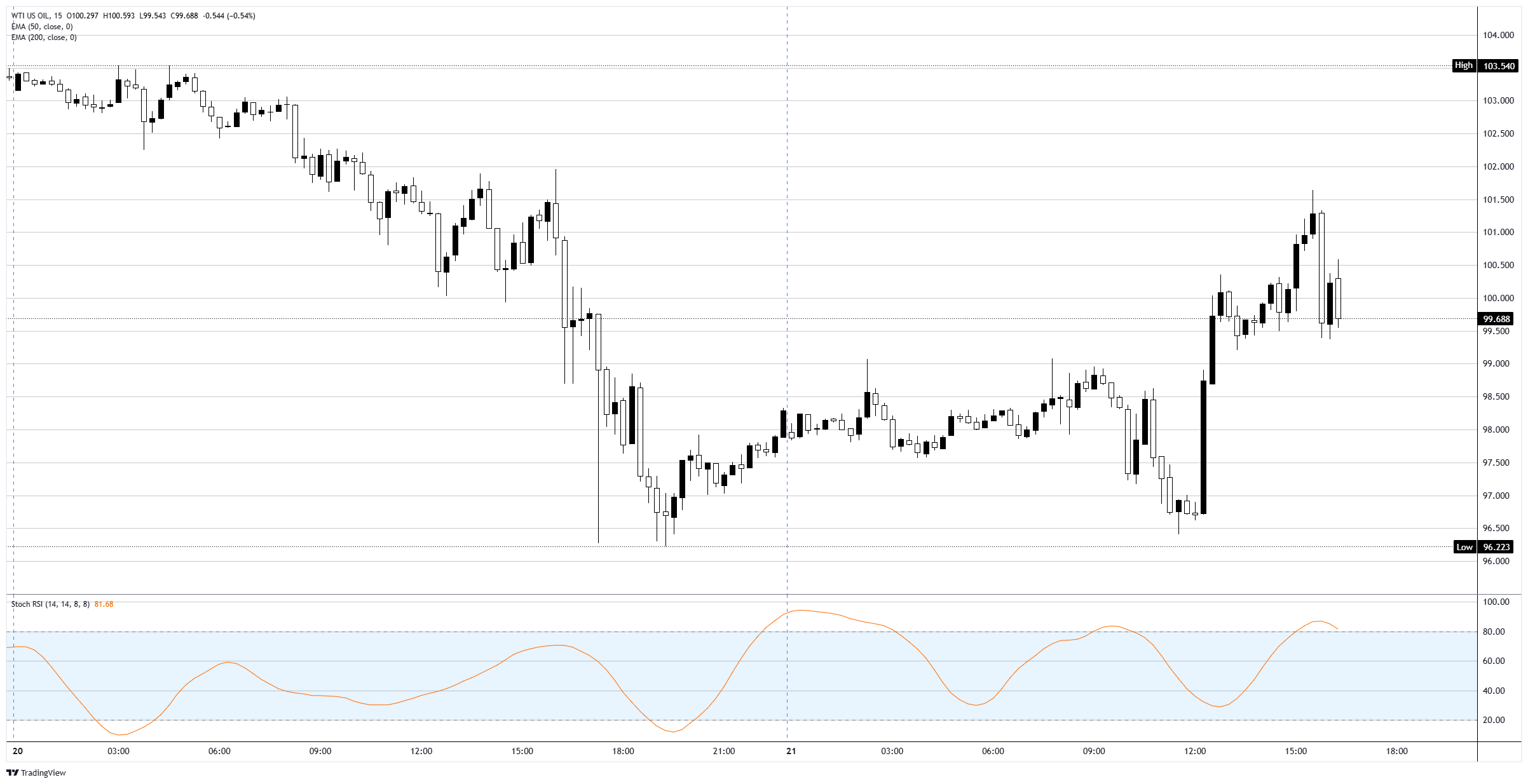
On the 4-hour chart, WTI has spent May oscillating in a wide band, repeatedly leaning on the rising 200-period exponential moving average near the $95 to $96 region as a floor on dips and stalling out around the $104 to $105 swing highs. Thursday's bounce reclaimed the $100 handle, but it did so with momentum readings still pinned near oversold, a divergence that smells more like a headline-driven pop than a fresh leg higher. The range top near $107 from late April is the line that matters on the upside, while the March spike toward $120 is a reminder of how violently this market repriced when the strait first shut. The chart, in short, is a hostage to the newswire, and the newswire is binary.
How to trade a setup you can't price
The discomfort here is that the dominant catalyst, a Hormuz reopening, is a step-function rather than a trend. A genuine deal that frees tanker traffic could drag crude toward the $90 area or lower in short order, with some forecasters flagging $80 by year-end if the chokepoint clears cleanly. Absent that, the path of least resistance stays sideways to higher, with the $95 to $96 zone the level bulls need to defend and the $104 to $105 band the cap until the next escalation. Watch the wires, not the indicators. Uranium, tolls, and tanker counts are moving this market, and any one of them can gap the price overnight. The skeptic's base case is simple: the frozen conflict persists, which keeps a floor under Oil that no chart can draw. Until the strait actually reopens, every dip is just the market betting on a deal it has been wrong about for three months running.
WTI 15-minute chart
WTI Oil FAQs
WTI Oil is a type of Crude Oil sold on international markets. The WTI stands for West Texas Intermediate, one of three major types including Brent and Dubai Crude. WTI is also referred to as “light” and “sweet” because of its relatively low gravity and sulfur content respectively. It is considered a high quality Oil that is easily refined. It is sourced in the United States and distributed via the Cushing hub, which is considered “The Pipeline Crossroads of the World”. It is a benchmark for the Oil market and WTI price is frequently quoted in the media.
Like all assets, supply and demand are the key drivers of WTI Oil price. As such, global growth can be a driver of increased demand and vice versa for weak global growth. Political instability, wars, and sanctions can disrupt supply and impact prices. The decisions of OPEC, a group of major Oil-producing countries, is another key driver of price. The value of the US Dollar influences the price of WTI Crude Oil, since Oil is predominantly traded in US Dollars, thus a weaker US Dollar can make Oil more affordable and vice versa.
The weekly Oil inventory reports published by the American Petroleum Institute (API) and the Energy Information Agency (EIA) impact the price of WTI Oil. Changes in inventories reflect fluctuating supply and demand. If the data shows a drop in inventories it can indicate increased demand, pushing up Oil price. Higher inventories can reflect increased supply, pushing down prices. API’s report is published every Tuesday and EIA’s the day after. Their results are usually similar, falling within 1% of each other 75% of the time. The EIA data is considered more reliable, since it is a government agency.
OPEC (Organization of the Petroleum Exporting Countries) is a group of 12 Oil-producing nations who collectively decide production quotas for member countries at twice-yearly meetings. Their decisions often impact WTI Oil prices. When OPEC decides to lower quotas, it can tighten supply, pushing up Oil prices. When OPEC increases production, it has the opposite effect. OPEC+ refers to an expanded group that includes ten extra non-OPEC members, the most notable of which is Russia.
Author

Joshua Gibson
FXStreet
Joshua joins the FXStreet team as an Economics and Finance double major from Vancouver Island University with twelve years' experience as an independent trader focusing on technical analysis.

















