Credit and Growth: A Partnership Not Opposition


Recent policy initiatives have focused on the implementation of fiscal policy to promote economic growth. Looking at the history of real growth, credit growth has been a solid, necessary partner.
Growth and Debt Finance
As illustrated in the top graph, there is a close link between economic growth and domestic nonfinancial debt growth. This pattern reflects an interaction that works both ways. Economic growth prompts creditors and debtors to accept more debt as the expectation of growth, and thereby the increased financial rewards to creditors and debtors, improves. In turn, the availability of credit opens up opportunities for entrepreneurs to pursue prospects for growth.
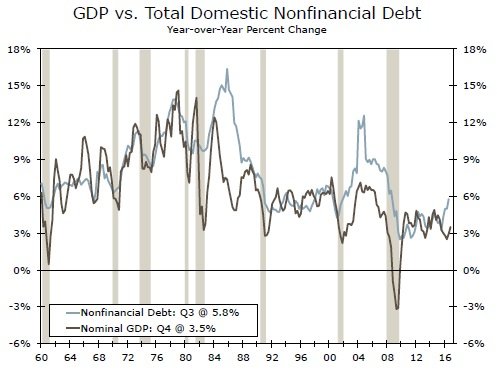
During the most recent economic expansion, the very modest pace of debt growth has been associated with a period of subpar real economic growth. In part, this pattern may reflect the emphasis on financial regulation to avoid risk-taking that may have put a damper on financing any idea that carried a perception of risk.
The Specific Issue of Private Credit
During the current economic expansion, the pace of private credit growth to the consumer and business sectors has been particularly weak relative to prior economic expansions (middle graph). Since both the business and consumer sectors are major contributors to economic growth and job gains, then it is not a surprise that the overall pace of economic growth and job gains have been modest, at best, during the current cycle. This is particularly apparent by the big drag of credit during the first few years of this expansion.
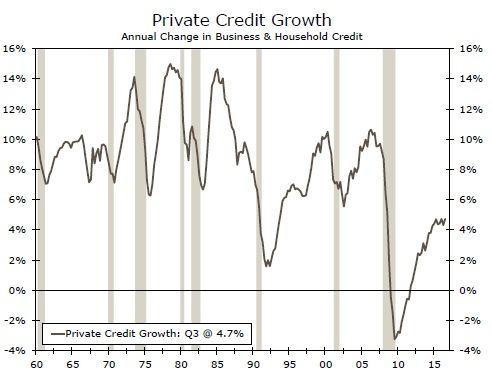
This interaction of private credit and spending imparts a pro-cyclical pattern to both economic activities which, if not carefully monitored, creates an abrupt halt to both when perceptions of risk and economic growth opportunities are altered.
Household Net Worth: A Balancing Act
During the latest downturn, the hit to real estate values was very evident in the steep drop off in household net worth as illustrated in the bottom graph. Each prior recession (1981-1982, 1990-1991, 2001) was associated with a decline in the growth of net worth but not to the extent experienced in the 2007-2009 period. Each recession, including 2007-2009, was associated with a decline in the growth rate of consumer spending.
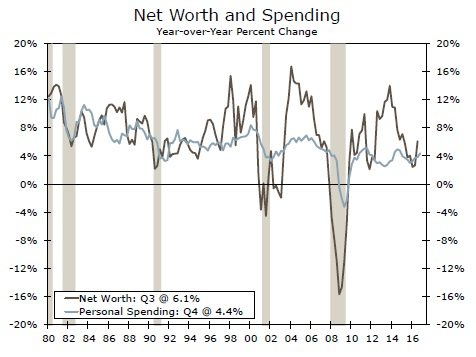
Once again the link between financial/real asset values and consumer spending emphasizes our view that credit growth and economic growth are closely linked and that this link must be considered by public policymakers. Current economic policy proposals favor faster growth and easier financial regulation. If thoughtful actions are taken, then faster growth can be achieved within a reasonable risk-taking environment.
Author
Wells Fargo Research Team
Wells Fargo