CPI came in better than forecast but is still in its fifth year over the Fed target

Outlook
We were taken aback when the big-picture rise in US yields and war escalation had only a one-day effect. Yesterday the currencies resumed their upside breakouts and even new Fed chair Warsh’s statement of commitment to ending 5 years of missing inflation targets did not sway the crowd.
Apparently the driving sentiment was the dip in inflation, even though everyone knows it won’t be lasting, and getting rid of the idea of a hike at the July meeting, which was also not going to happen.
The change in yields was tiny but apparently enough to harm the dollar. The 10-year gave back 3 bp but got over half of it back so far today. The 2-year shed as much as 9 bp but is almost halfway to recovering it. See the 5-day chart of the 2-year.
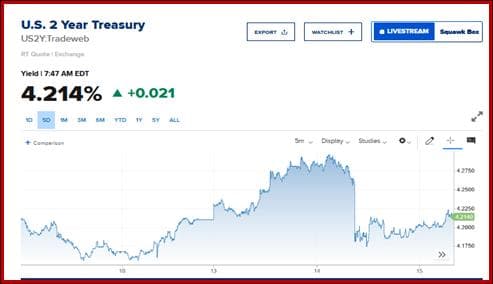
This is one of those loopy developments that always mystify us and come along in FX every once in a while. We like to make sarcastic comments about logic, short-term thinking and the absence of “let us deduce” using information older than a few hours.
CPI came in better than forecast but is still in its 5th year over the Fed target. For the markets to have let up the pressure on the rate hike idea is foolish. Besides, you’d think the on-going war in Iran and resulting oil price increases would be more than an offset. The energy sector economists are not wrong. The market just doesn’t like the implications of oil prices going/remaining higher for longer. It’s a hard pill to swallow.
Forecast
The war is escalating with the addition of the Houthi threat to the Red Sea outlet. Tomorrow Trump will give a speech to the world and let’s hope he is briefed, for one, by the military and whatever diplomacy is left at the State Dept. Everyone expects to have to unpack the lies and bravado from whatever germs of truth and sensibility might in there.
We still say “watch the oil price.” It lies behind any reasonable inflation forecast. At the moment it has only one direction, but as pointed out before, the market is reluctant to accept such a horrible and huge change to the world order in oil.
Any war victory for the US, such as Iran coming back to the table, would be seen as likely lowering oil prices. Wishful thinking abounds. That would in turn drive inflation expectations down and do some damage to the dollar.
The alternative scenario, escalation up the wazoo and serious damage to Iran, still depends on defeating the Revolutionary Guard and that’s a Herculean task that could take years.
Some third middle way is usually the outcome, but we won’t know its terms and conditions given that both parties are dishonest and untrustworthy. For all we know, Trump will announce tomorrow that he will seek war powers from Congress and then we will be in the soup.
The big picture charts indicate the dollar “should” continue its trend higher against just about everything. The breakout may turn out to be false, if we evaluate rightly the fundamentals as pointing to more war, more inflation, higher yields. But this has been wrong for much of the last few weeks, so grain of salt.
Addendum: We often do not cover the TICS reports (Treasury International Capital) because you need two PhD’s to understand the clumsy, ornate formatting. This time we have a decent summary from Reuters.
The bottom line—the world may dislike and distrust Trump, but they still like the US markets. Wolf points out that a great deal of the “foreign” buyers are actually US entities operating abroad.
Foreign investors bought a net $132 billion of US.securities in May, bringing the total to $1.33 trillion over the last 12 months. They bought $134billion in equities, for $909 billion over the year.
They dumped Treasury bills by $43.5 billion, but added $56.6 billion in longer dated paper. For the last 12 months, this came to $290 billion. Notice that foreigners bought three times the equities as longer Treasuries.
Food for Thought:Talk is now getting louder about bypassing the Strait of Hormuz with alternate routes using pipelines, locating refineries closer to other ports, and building other ports. This is"Zero Hormuz Dependency" and on a par, historically, with the Suez Canal. JC Parets at TrendLabs likes this idea and names some winners in the newly forming infrastructure buildout (Cheniere, Williams Companies). Note this adds to capital spending in infrastructure in the data center story.
Also note that the SPDR S&P Global Infrastructure ETF GLL has yet to reach its recent high on Feb 27, 2026—the day before Trump started the war. You have to choose carefully.
We await the effect on green energy initiatives. It may be a long wait. Germany, for example, just cut €30 billion from its green energy spending to 2030.
This is an excerpt from “The Rockefeller Morning Briefing,” which is far larger (about 10 pages). The Briefing has been published every day for over 25 years and represents experienced analysis and insight. The report offers deep background and is not intended to guide FX trading. Rockefeller produces other reports (in spot and futures) for trading purposes.
To get a two-week trial of the full reports plus traders advice for only $3.95. Click here!
Author

Barbara Rockefeller
Rockefeller Treasury Services, Inc.
Experience Before founding Rockefeller Treasury, Barbara worked at Citibank and other banks as a risk manager, new product developer (Cititrend), FX trader, advisor and loan officer. Miss Rockefeller is engaged to perform FX-relat