Coup d'État That May Shake the World

Everyone focuses now on the chemical attack in Syria. Meanwhile, the most important turnover in the world remains mostly unnoticed. But we’re on guard. Let’s read our analysis of the key revolution of 2018 and find out the implications for the gold market.
Hawks Take Over the Fed
Are we going to write about Syria? North Korea? China? No. You already know everything you should about these geopolitical threats. The media bomb you with news about bombings, trade wars, nuclear trials, etc. But the key upheaval is taking place in silence, in the cool marble rooms of the Federal Reserve Banks. ‘The Hawkish Revolution’ – this is how the future historians will call it.
What is going on? We will tell you – but first read the key paragraph of the minutes from the recent FOMC meeting the Fed published yesterday.
Some participants suggested that, at some point, it might become necessary to revise statement language to acknowledge that, in pursuit of the Committee's statutory mandate and consistent with the median of participants' policy rate projections in the SEP, monetary policy eventually would likely gradually move from an accommodative stance to being a neutral or restraining factor for economic activity.
What does it mean? The FOMC members have started to consider the end of its accommodative stance. This is a real revolution, as the U.S. central bank has been supporting growth since the outbreak of the financial crisis. Now, for the first time since the Great Recession ended a decade ago, the Fed is talking about adopting a neutral or even tight stance. The possible consequences are enormous. More interest rate hikes are up ahead. Gold investors, be prepared!
Before we discuss the conclusions for gold, let’s analyze the rest of the latest minutes. Generally speaking, even without the remarks about possibly dropping the accommodative bias, the minutes had a hawkish tone. Why? Well, the FOMC members agreed that the nation’s economic outlook had recently strengthened:
All participants agreed that the outlook for the economy beyond the current quarter had strengthened in recent months. In addition, all participants expected inflation on a 12-month basis to move up in coming months.
Have you noticed something interesting? Look carefully. “All” – isn’t this a rare show of unity? We are all hawks now. Indeed:
Most participants commented that the stronger economic outlook and the somewhat higher inflation readings in recent months had increased the likelihood of progress toward the Committee's 2 percent inflation objective.
And another hawkish strike:
A number of participants indicated that the stronger outlook for economic activity, along with their increased confidence that inflation would return to 2 percent over the medium term, implied that the appropriate path for the federal funds rate over the next few years would likely be slightly steeper than they had previously expected.
Brace yourself for further hikes.
Fed Comments Trade Wars
Interestingly, the FOMC members discussed the potential impact of Trump’s trade wars. Although they downplayed the importance of U.S. tariffs, the central bankers worried about retaliatory trade actions:
A number of participants reported concern among their business contacts about the possible ramifications of the recent imposition of tariffs on imported steel and aluminum. Participants did not see the steel and aluminum tariffs, by themselves, as likely to have a significant effect on the national economic outlook, but a strong majority of participants viewed the prospect of retaliatory trade actions by other countries, as well as other issues and uncertainties associated with trade policies, as downside risks for the U.S. economy.
The Fed officials were also uncertain about the impact of the American fiscal policy. Generally, they believed that it should boost growth, but some question marks remained.
Tax changes enacted late last year and the recent federal budget agreement, taken together, were expected to provide a significant boost to output over the next few years. However, participants generally regarded the magnitude and timing of the economic effects of the fiscal policy changes as uncertain, partly because there have been few historical examples of expansionary fiscal policy being implemented when the economy was operating at a high level of resource utilization. A number of participants also suggested that uncertainty about whether all elements of the tax cuts would be made permanent, or about the implications of higher budget deficits for fiscal sustainability and real interest rates, represented sources of downside risk to the economic outlook.
Implications for Gold
Is gold doomed after the hawkish revolution? Well, the price of gold has indeed declined after the minutes were released, as one can see in the chart below.
Chart 1: Gold prices from April 9 to April 11, 2018.
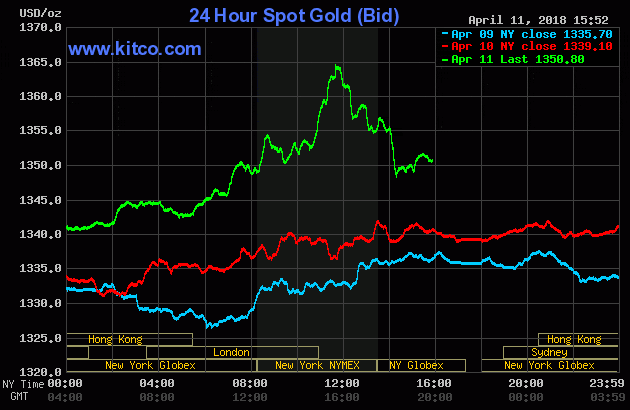
It makes sense, as higher interest rates are bearish for gold, which doesn’t bear any yield. The hawkish revolution would lead to the normalization of monetary policy – which is bad for gold. The yellow metal shines the brightest during crazy times and irresponsible policies, not during normal periods and a neutral policy stance.
However, usually when the Fed presses the brakes as it fears overheating, it triggers recession after some time. Revolutions often lead to crises. The current gradual approach reduces such a risk – but it doesn’t eliminate it. Gold should shine in the recessionary scenario.
And monetary policy is only one part of the equation. The fiscal and trade policies are the other – and they are likely to lift gold prices. Another issue is that a more hawkish Fed has been already priced in, at least partially. Last but not least, the elevated anxiety about a military conflict about Syria could provide a short-term – let’s emphasize it: short-term – support for the price of gold. So, the ongoing coup d’état at the Fed may shake the gold market, but its impact will be neutralized by other factors. Always take a broader perspective – and stay tuned!
Want free follow-ups to the above article and details not available to 99%+ investors? Sign up to our free newsletter today!
Author
Arkadiusz Sieroń
Sunshine Profits
Arkadiusz Sieroń received his Ph.D. in economics in 2016 (his doctoral thesis was about Cantillon effects), and has been an assistant professor at the Institute of Economic Sciences at the University of Wrocław since 2017.
















