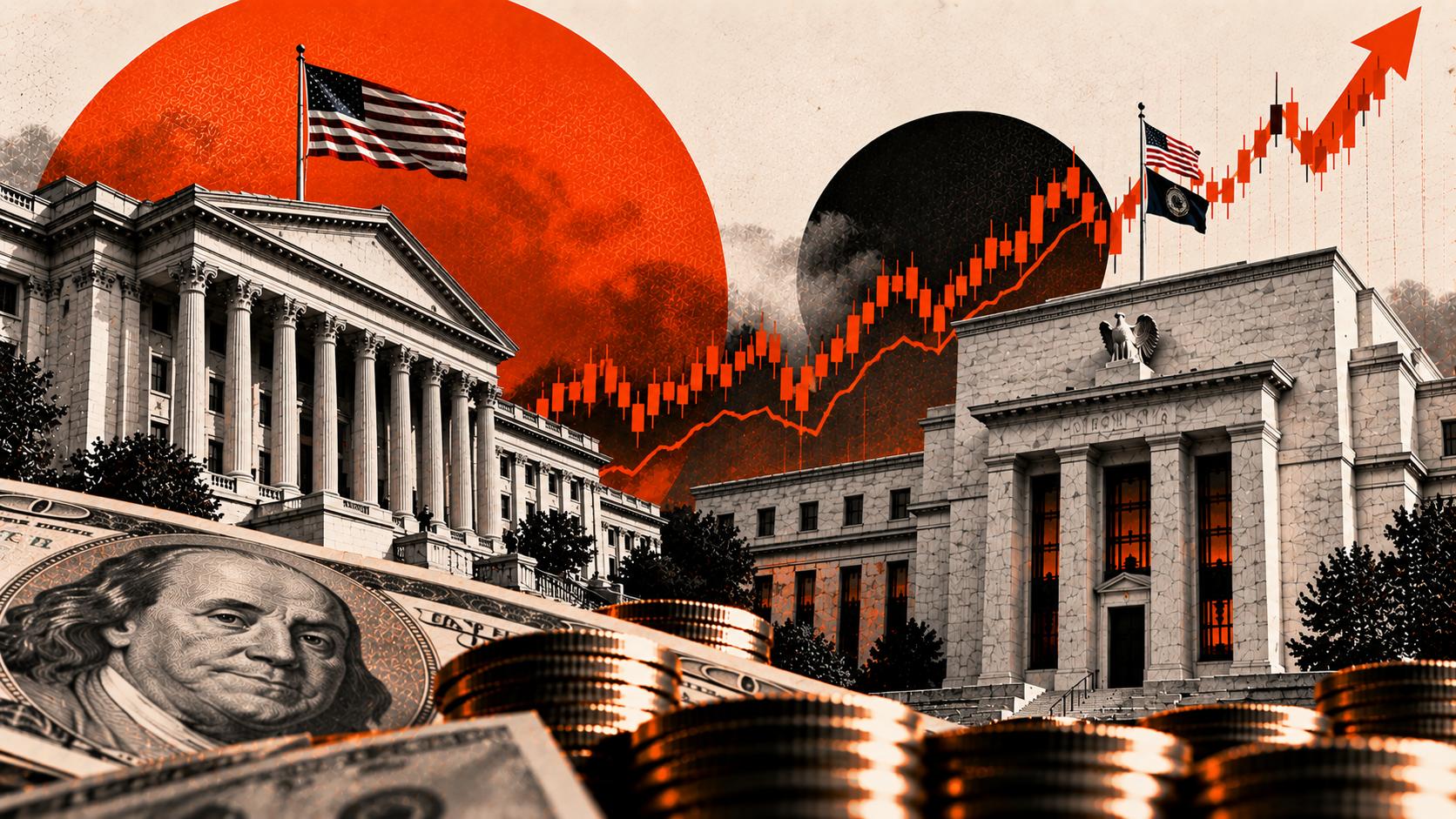
Cooking the books. How government data makes things seem better than they are

The government spits out all kinds of economic data. Policymakers use it to make policy.
But is it good data?
Not so much.
In this episode of the Midweek Memo podcast, Mike Maharrey explains how the government cooks the books using biased data, highlighting a recent revision to the Fed's "favorite" inflation measure.
These formulas matter because the government can use the cooked data to make things seem better (or worse) than they actually are.
In this episode, Mike also offers "a nickel's worth of free advice" to help you avoid gold and silver scams.
Mike opens the show with a story he ran across on Facebook.
"A zookeeper had a medical emergency and collapsed next to the tiger enclosure. The tiger essentially called for help, saving the man’s life. There were a couple of surveillance camera photos from the incident. In the first, the tiger was reaching through the bars of the enclosure, resting his paw on the unconscious man. In the second, the tiger watched quietly as medics loaded the man on a stretcher.
"It was a moving story.
"And it was all made up – including the photos. They were the product of AI."
Mike admits the AI photos were pretty believable, but his wife spotted details that proved the photos were fake.
"There were things in both the background and foreground that were missing or moved. That said, we’ve come a long way from the days of quickly identifying AI images because the person had six fingers and an extra arm. It’s honestly a little concerning. People are sharing this story, fully convinced it happened. It just goes to show how easy it is to manipulate people’s perception of reality. A photo that looks real becomes reality."
Mike notes that you can also distort reality using data. He points out that it became "common knowledge" that there were 40 million homeless people in the U.S. back in the 80s and early 90s.
"I think that was the number. I could be wrong. That was a minute ago. But whatever the number was, it was completely made up by some advocacy group. It became a fact merely with repetition.
"That’s why the horrible data promulgated by government agencies is so problematic. It creates a distorted vision of reality that people can easily buy into. After all, we’re told to trust the data. And the government would never lie to us, right?
"Yeah. Maybe we should rethink that.
"So, Today, I’m going to explain how the government is manipulating your perception of reality with sketchy inflation data."
Mike uses the job data released by the Bureau of Labor Statistics as an example of "questionable data." Using the September numbers, Mike explains how the BLS constantly revises the data, and revisions are almost always downward.
"To be fair, compiling employment data is no simple task. Revisions should be expected. But why do the updates almost always remove jobs from the economy? One would think you’d see upward revisions nearly as often as downward, right?
"Nope.
"Between 2003 and 2024, the final annual BLS numbers were lower than the initial report 14 times, compared to seven upward revisions."
Mike then asks a rhetorical question: if the labor data is that bad, what about the other numbers cranked out every month by government agencies?
Mike notes that the government changed the CPI data in the 90s because they thought it was "overstating" inflation. If we were still using the 1970s formula, CPI would be in the 6 percent range right now, about double the official numbers.
Of course, the CPI isn't the Fed's favorite inflation measure. That honor goes to the Bureau of Economic Analysis’ (BEA) Personal Consumption Expenditures Index, commonly referred to as the PCE.
And why does the Fed love the PCE?
Because it understates price inflation more than the CPI.
"And now it is going to understate it just a little more. Apparently, the government’s strategy is, if their policy can’t drive inflation down, they’ll just revise the methodology to make it seem lower.
"Yes, ladies and gentlemen, the BEA has revised the PCE."
Mike explains the difference between the CPI and the PCE, how the number-crunchers come up with the data, and how they recently changed the formula. He also notes that the changes appear to have lowered core PCE by about 0.1 percent.
"PCE generally runs 0.2 to 0.4 percentage points lower than CPI over longer periods. With the new adjustment, it will presumably run even lower moving forward."
Mike notes that this is par for the course.
"Both the CPI and PCE formulas create multiple opportunities to skew the numbers lower. Each assumption built into the formula was made up by a government functionary with a bias and agenda.
"The PCE’s substitution metrics provide a powerful avenue for number crunchers to skew the data and make price inflation look tamer than it is.
"Never forget that government people have a vested interest in making inflation look as tame as possible. In their minds, inflation isn’t a bug. It’s a feature. Their ability to inflate the money supply lays the foundation for big government borrowing and spending. But monetary inflation comes with a nasty side effect – price inflation. The better they can hide this monetary debasement, the longer they can get away with it without unpleasant political backlash from the citizenry."
Of course, there are ramifications.
"Remember that even when inflation appears to be cooling, it’s always worse than you think. And never forget, inflation is the plan. They want to devalue your dollar by 2 percent every year. With these revised formulas, they can inflate even faster and swear to you they’re not.
"They are – that’s why you need real money – gold and silver."
Mike closes the show, highlighting a recent gold scam in Illinois.
"To wrap things up, I want to offer you a nickel’s worth of free advice.
"Don’t give gold to a stranger in a Walmart parking lot, even if they say, “black bug!”
"Yes, this happened.
"In real life."
Mike highlights the scam and how authorities eventually caught up with the scammers. Along the way, he offers advice on how to avoid getting scammed yourself.
Mike wraps up the show by urging folks to do business with trusted companies such as Money Metals, and he urges listeners to call 800-800-1865 to talk with a precious metals specialist today.
To receive free commentary and analysis on the gold and silver markets, click here to be added to the Money Metals news service.
Author

Money Metals Exchange
Money Metals Exchange
Now you can safeguard your assets from financial turmoil and the devaluing dollar – without paying costly middleman mark-ups or fending off high pressure, bait-and-switch sales tactics.