Consumers Are Resilient Even in Challenging Times


Rising tensions from the U.S. killing of Iranian General Soleimani had all the hallmarks of the sort of crisis that could weigh on financial markets.
But, with both sides acknowledging no plans for further escalation, what seemed like a crisis in the immediate aftermath of Soleimani’s killing has already moved to the back burner.
The direct effects of the Iranian crisis on the U.S. economy appeared to be rather small. However, the uncertainty that the crisis imparts could potentially be more meaningful.
In this report, we analyze to what extent consumer spending might potentially take a more meaningful dive if a marked cycle of violence were to take hold.
Our take: Consumer spending is actually remarkably resilient even in the midst of challenging times.
What Do Uncertain Times Mean for Consumer Spending?
What just days ago felt like a crisis has already moved to the back burner. Rising tensions from the U.S. killing of Iranian General Soleimani earlier this month had all the hallmarks of the sort of crisis that could weigh on financial markets and heap-on additional uncertainty in times that were already far from settled. Iran responded this week with non-lethal airstrikes on U.S. facilities, but President Trump has said the U.S. has no plans to escalate further and the Iranians appear to have concluded their response for now.
Financial markets have more or less settled back to where they were prior to the start of recent hostilities a week ago. Oil prices spiked on the initial news, but quickly settled down and as of this writing the price for crude oil is actually lower than it was prior to the U.S. drone strike that killed the Iranian general. However, if tensions flare again, investors instinctively turn to oil prices as a risk barometer raising questions about potential knock-on effects for the economy.
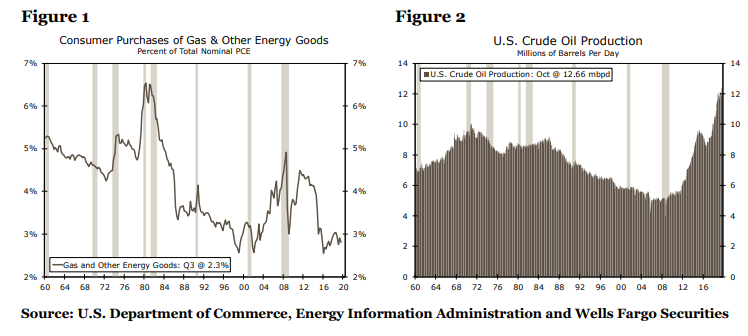
We have already written about how consumer purchases of gasoline and other energy goods today account for only about half the share of consumer spending that it did at the time of the oil price shocks in the 1970s (Figure 1). Also because American production of crude oil has increased over the past decade (Figure 2), higher oil prices could actually encourage more investment in the energy sector. What’s more, other industries are not as dependent on oil as an energy source as they were in the 1970s. So the direct effects of the Iranian crisis on the U.S. economy appear to be rather small.
However, the uncertainty that the crisis imparts could potentially be more material. To what extent might consumer spending potentially take a more meaningful dive if a marked cycle of violence were to take hold? Our review of published research on the topic and our own statistical and econometric analysis suggests consumer spending is actually remarkably resilient even in the midst of challenging times.
Spending is Mostly Services and Service Spending is Steady
Personal consumption expenditures (PCE) fall into two broad categories of goods and services but the split is not equal. Services-related spending accounts for two thirds of all spending, leaving just 33 cents of each dollar spent to pay for goods.
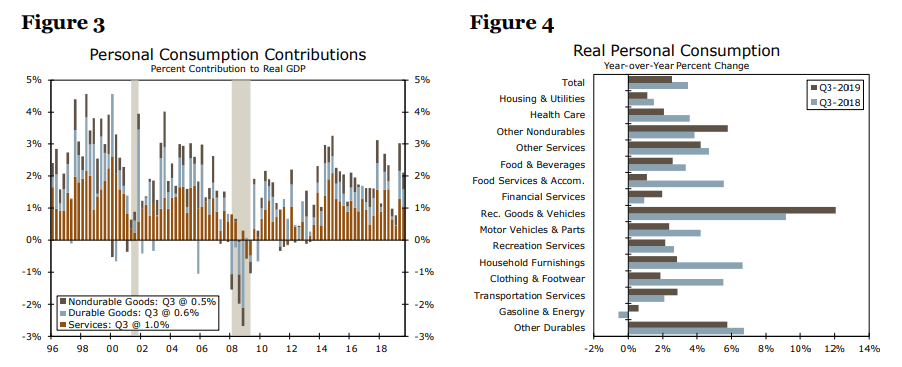
Services spending may not be completely impervious to uncertainty but it is certainly resilient. No matter how worried people get, they seldom take a cold shower in the dark as a way to cope. People might put off a vacation which is why recreational services tend to get cut during a downturn. This is not unlike how RV-purchases tend to crater during a recession; both categories as we shall see in a moment are holding up rather well at present. However outlays on things like housing and utilities, basic financial services and healthcare tend to underpin services outlays, which helps explain why even during recessions, services PCE seldom posts a decline and even when it does, the declines are typically small (Figure 3).
Author
Wells Fargo Research Team
Wells Fargo

















