Chinese Gold imports up to start the year

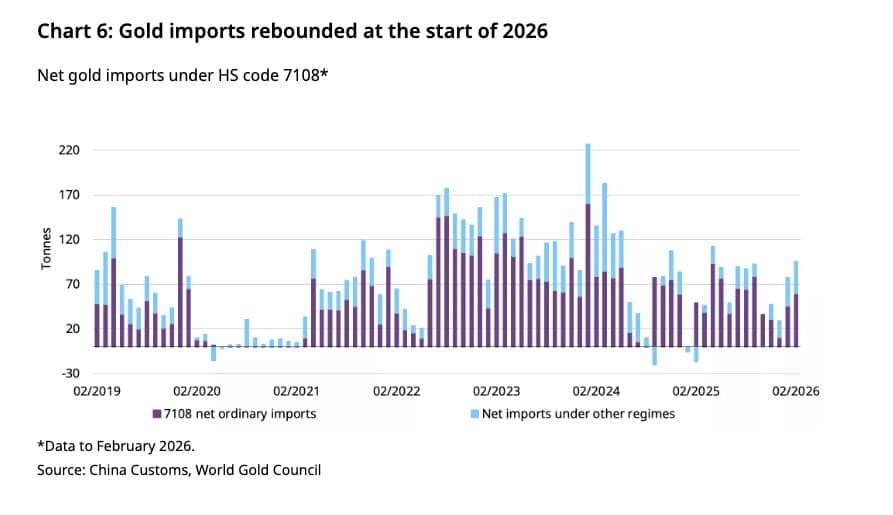
Chinese gold imports surged in the first two months of the year, underpinned by strong demand.
China ranks as the largest gold market in the world.
According to the latest data released by China Customs, the country imported a net 77 tonnes of gold in January. That compares to just 6 tonnes in January 2025.
The import pace picked up speed in February, with China bringing in 96 tonnes of gold, a 63-tonne year-on-year increase.
Continued strong demand was also evident in March as banks, jewelers, and refiners withdrew 134 tonnes of gold from the Shanghai Gold Exchange (SGE). SGE activity reflects wholesale demand.
SGE gold withdrawals were up 57 percent month-on-month and 12 percent higher than the same period last year.
According to the World Gold Council, the month-on-month gain was primarily seasonal as wholesalers restocked inventory in the wake of the Chinese New Year holiday.
A strong March drove Q1 wholesale demand to 345 tonnes. That was a 3 percent increase over Q1 2025, but still 23 percent below the 10-year average.
Overall, gold demand in China continues to be a tale of two sectors, with strong investment demand offsetting persistent weakness in jewelry sales.
Coin and bar sales have continued the strong upward trend we saw throughout most of last year. Global coin and bar demand hit a 12-year high in 2025, and more than half of it came from two countries – China and India.
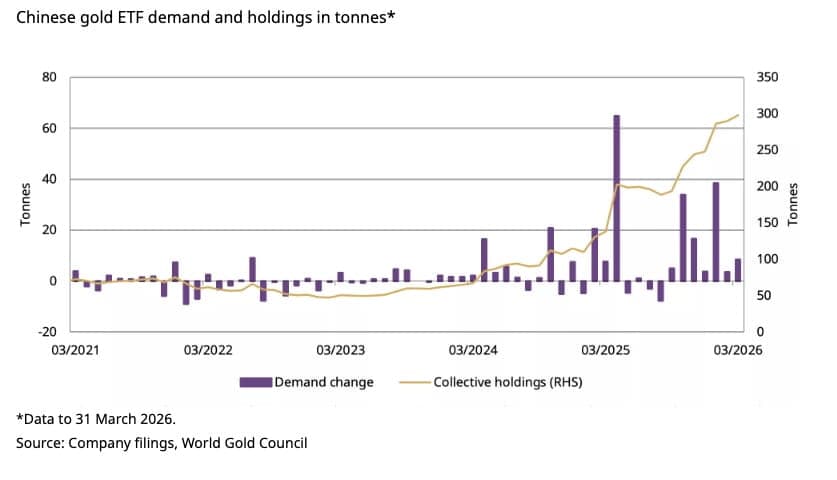
Inflows of gold into Chinese ETFs also reflect strong investor interest. While North American funds were shedding gold as the price dipped in the initial phase of the Iran conflict, Chinese funds were still adding metal.
In fact, China-based ETFs have reported an increase in gold holdings for seven straight months. In March, Chinese fund gold inflows totaled 8.4 tonnes.
As the World Gold Council explained, the falling gold price did not deter Chinese investors.
“In March, the CSI300 stock index fell 6 percent and the local currency depreciated by 0.8 percent against the dollar; these factors, combined with safe-haven demand prompted by the U.S.-Israel-Iran war, and continued regional geopolitical tensions, supported local gold ETF buying. We also witnessed some dip buying during the first half of the month.”
Thanks to a combination of rising prices and gold inflows, assets under management (AUM) by Chinese ETFs rose 26 percent to ¥304 billion ($44 billion) and total gold holdings climbed to 298 tonnes in Q1.
A gold ETF is backed by a trust company that holds metal owned and stored by the trust. In most cases, investing in an ETF does not entitle you to any amount of physical gold. You own a share of the ETF, not gold itself. ETFs are a convenient way for investors to play the gold market, but owning ETF shares is not the same as holding physical gold.
To receive free commentary and analysis on the gold and silver markets, click here to be added to the Money Metals news service.
Author

Mike Maharrey
Money Metals Exchange
Mike Maharrey is a journalist and market analyst for MoneyMetals.com with over a decade of experience in precious metals. He holds a BS in accounting from the University of Kentucky and a BA in journalism from the University of South Florida.