China’s growth imbalance worsened with domestic activity slowing in July
We had another month of disappointing data in July as domestic activity fell short of forecasts across the board. The NBS attributed weather effects for the miss, but data has generally been soft since the second quarter. China's K-shaped divergence continues to widen, and risks to the growth outlook remain balanced to the downside.
Fixed asset investment growth continues to underwhelm
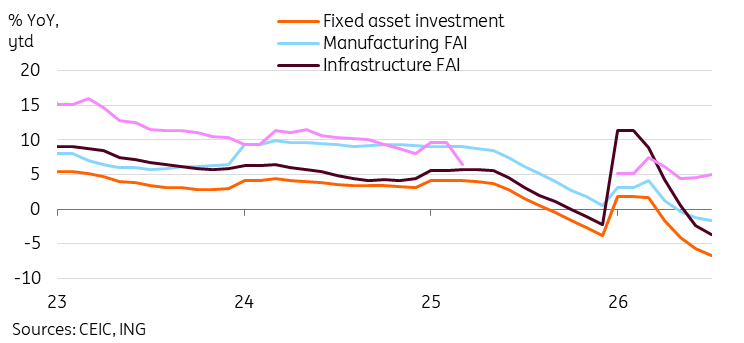
Fixed asset investment (FAI) dropped to -6.7% year-on-year, year-to-date over the first seven months of the year, down from -5.7% YoY in the first half of 2026. The reading once again undershot market expectations (market: -6.2%, ING: -6.3%) and marked the lowest level since April 2020.
There’s very little in terms of silver linings in the investment data. Hi-tech investment is the only category looking decent, accelerating a second consecutive month to 5.0% YoY ytd, up from 4.6% YoY ytd. Rail, ships, and aerospace (18.7%) continues to outperform on an industry level, followed by textiles (7.9%) and computers and communications (7.8%).
Everything else looks pretty soft. Manufacturing (-1.7%), infrastructure (-3.6%), and real estate (-19.2%) year-to-date FAI all fell further into contraction territory in July. Auto sector investment fell -5.3% YoY ytd even amid strong exports, as competition strengthens and domestic auto demand slows.
Private sector investment remains a major drag, down -9.4% YoY ytd, while public sector investment also slowed further to -3.3% YoY ytd.
The July Politburo meeting noted a goal to accelerate the pace of fiscal expenditures and the use of bond proceeds. This could signal faster project approvals in the second half of the year, after we saw a sharp slowdown of investment so far this year. If this objective is achieved, it’ll be first seen in public-sector-led investment. Whether that is enough to help FAI growth overall bottom out in the coming months remains to be seen.
Hi-tech FAI the lone bright spot amid broad-based deceleration of investment
July retail sales disappoint as consumption stagnates
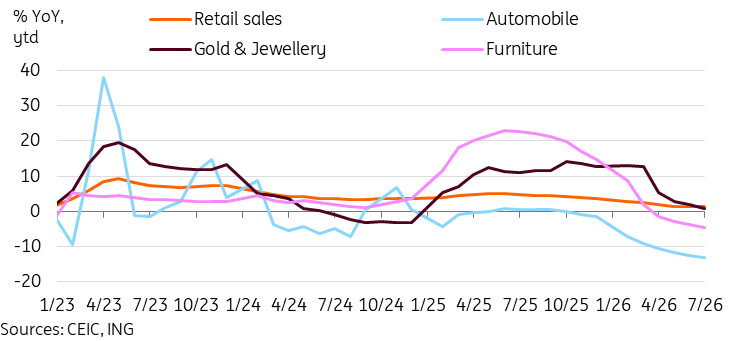
Retail sales failed to build on the small recovery of last month, falling to 0.6% YoY in July, down from 1.0% YoY in June. This fell well short of market expectations (market: 1.5%, ING: 1.7%). Year-to-date, retail sales have grown by just 1.2% YoY.
We discussed in last month’s report several subcategories are creating a substantive drag on retail sales growth, and they further worsened in July.
Amid China’s EV transition, we saw both a sharp drop in auto sales (-17.0%) and petroleum (-7.6%).
Furniture (-8.8%) and building and decoration materials (-14.2%) also saw steeper declines in July, though household appliances (-1.9%) saw a smaller contraction amid the continued weakness of the property market.
Finally, gold and jewellery sales fell sharply by -10.1% YoY as retail buying interest waned amid the gold price slump. Next month’s data will be interesting to see if the recovery of gold prices in August will translate to stronger gold and jewellery sales.
Weak consumer confidence and the impact of previously front-loaded consumption via the trade-in policy continue to drag growth.
Markets may have been disappointed at a lack of tangible policy support for consumption after July’s Politburo meeting. While boosting consumption remains an important medium-term goal, we haven’t seen too much in terms of stimulus to shore up near-term spending. Resources continue to be concentrated in the tech race rather than boosting domestic consumption.
Three forces are dragging China's consumptions beyond simply soft confidence
Industrial production slows by more than expected
Industrial production rose 4.5% YoY in July, slowing from 5.3% in June and falling short of forecasts for a smaller moderation (market: 5.0%, ING: 5.0%). This brought year-to-date industrial production growth to 5.3% YoY, slightly lower than the 5.4% recorded in the first half, but still relatively resilient compared with other domestic activity indicators.
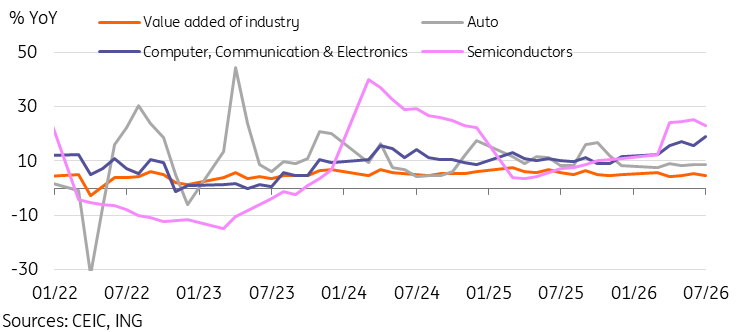
Manufacturing continued to outperform the headline, growing 5.5% YoY in July, while high-tech manufacturing accelerated to 16.9% YoY, up from 14.1% in June. This reinforces the structural theme that China’s industrial growth is increasingly being driven by industrial upgrading and high-tech manufacturing, the strategic priorities for the country.
Looking at the outperforming sectors, strength remained concentrated in high-tech manufacturing sectors. On the VAI side, computer, communication and other electronic equipment rose 19.1% YoY, making it the strongest major sector, followed by rail, ships and aerospace (13.6%), and special equipment (12.6%).
The product-level industrial production data also point to continued strength in new economy sectors. Industrial robots rose 30.2% YoY, new energy vehicles rose 29.9% YoY, and semiconductor integrated circuits rose 20.7% YoY, This supports the view that the industrial cycle is being increasingly supported by robotics, semiconductors, NEVs and higher-end manufacturing.
In contrast, traditional property and infrastructure-linked sectors remained weak. Cement output fell -11.6% YoY, steel products fell -4.1% YoY, and flat glass declined -3.6% YoY, underscoring the continued drag from the old property and construction-related industrial cycle.
Industrial activity continues to outperform amid solid external demand and industrial upgrading themes
Property prices yet to bottom but another month of stabilisation in tier 1 cities
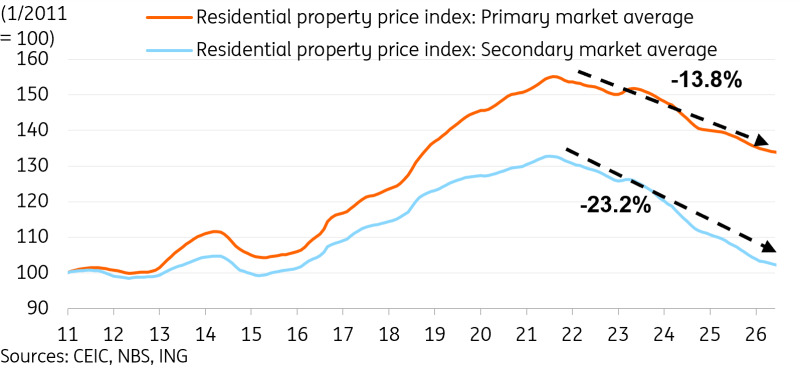
China's National Bureau of Statistics released its 70-city sample of property prices for July. New home prices fell by -0.18% month-on-month, while used home prices dipped by -0.29%. In the past few months, the monthly decline in prices has been relatively small, but we have yet to confirm a bottom for the overall market.
The city-level breakdown showed that 23 of 70 cities saw new home prices stabilise or pick up in July, which was a 15-month high. However, only 8 of 70 cities saw secondary market prices pick up in July, marking a five-month low. We have argued that secondary market prices are more important, given the impact on household balance sheets. In the secondary market, prices were generally stable or rising in China's tier 1 cities. Any stabilisation of property prices would likely start from the core.
As expected, property investment continued to slump, dropping to -19.2% YoY ytd. Investment looks likely to remain an overhang, as inventories remain elevated and prices have yet to confirm the bottom. As long as investment continues to drop, local governments may also find it hard to raise revenue via land sales.
70-city property prices continued to slide in July
Author

ING Global Economics Team
ING Economic and Financial Analysis
From Trump to trade, FX to Brexit, ING’s global economists have it covered. Go to ING.com/THINK to stay a step ahead.