China: Growth on track for 6% in 2020

IMF to revise up Chinese growth from 5.8% to around 6% after phase-one deal.
Data on industrial production and retail sales underpin growth of at least 6% in Q4 and early 2020. We see more upside in Chinese equities.
Signing of a phase-one deal is still on track for early January. Xi Jinping will not join Davos meeting, which could have been a Xi-Trump signing opportunity.
USD/CNY treads water around 7-level. We look for more downside in 2020.
Growth estimates revised higher following phase-one deal
Following the US-China phase-one deal, the IMF is set to revise its China GDP forecast higher for 2020 to around 6% from 5.8%. This was the message from the new IMF Director Kristalina Georgieva in an interview with Caixin. We have also seen other houses revise their forecasts higher on the back of the deal. Consensus seems to be forming around 6% growth in 2020. The signal coming out of the recent China Economic Work Conference was also that the new growth target for 2020 will be around 6%. It will not be revealed officially, though, until the National People's Congress starting on 5 March.
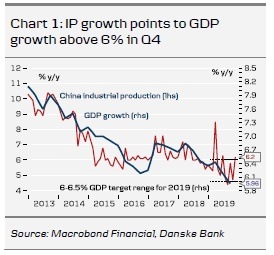
Data on industrial production surprised to the upside rising to 6.2% y/y in November from 4.7% y/y in October. As chart 1 shows, it points to GDP growth towards the top of the 6-61/2% target range and lowers the risk of GDP growth falling below 6%. Chinese retail sales for November were also released this week and they showed an increase to 8.0% y/y from 7.2% y/y in October. The data is volatile, though, and more generally shows a picture of stabilisation in the 7-8% range over the past six months.
China refrained from lowering the policy rate (Loan Prime Rate) this week in a sign that it is reluctant to ease policy further. However, efforts are being made to get more credit through to the private sector, which continues to be starved of credit access. The State Council, China's cabinet, called on banks to cut financing costs by 0.5 percentage points next year for small and micro businesses. It also instructed five of the country's largest state-owned commercial banks to increase the value of loans made to these companies by at least 20% next year.
Comment. We saw the first sign of a turn in the Chinese business cycle in October, 10 October 2019. However, a continued moderate recovery has hinged on a de-escalation of the US-China trade war and this is exactly what we got with the phase-one deal. Our GDP forecast for 2020 has been 6.0% for some time based on the assumption of easing trade tensions and increasing effects of the policy stimulus. We stick to this view and now see risks as more balanced after having been mainly to the downside.
Author
Danske Research Team
Danske Bank A/S
Research is part of Danske Bank Markets and operate as Danske Bank's research department. The department monitors financial markets and economic trends of relevance to Danske Bank Markets and its clients.