China Economy Gauge still flashing warning signs


Summary
We have updated our China Economy Gauge, which tracks local economic conditions on a high-frequency basis, to include October's data releases. While some measures surprised to the upside, overall data was mixed, indicating that China's economy is still broadly decelerating and should still face headwinds in the coming months from COVID-related restrictions, enhanced regulatory scrutiny, and a slowdown in the real estate sector.
October Data Mixed, But Further Slowdown Likely
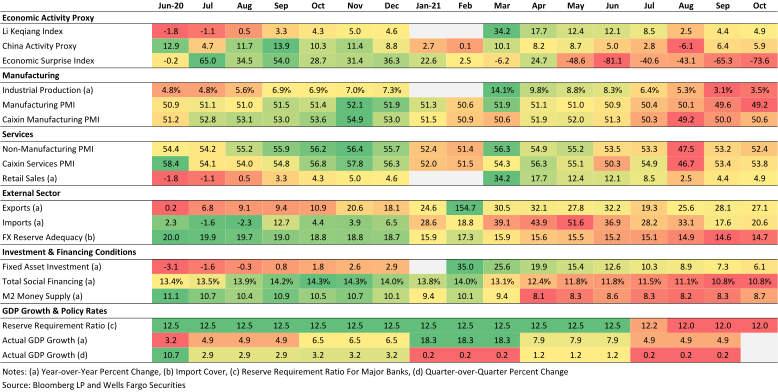
Last month, we created our China Economy Gauge in an effort to monitor the evolution of the Chinese economy at a higher frequency (Figure 1). In September, our model flashed warning signals and indicated that China’s economy was under pressure. COVID-related restrictions and a sharp slowdown in the local real estate industry ultimately weighed on Q3 GDP growth, while a nationwide crackdown on sectors deemed potentially damaging to China’s longer-term output continues to inject volatility into local financial markets. The consequence of these factors was yet another downward revision to our annual GDP forecast. As of now, we forecast China’s economy to grow 8% this year, down from 8.2% a month earlier, and down from closer to 9% at the start of this year. As far as the balance of risks to our GDP forecast, we continue to believe another downward revision is likely. The same virus, real estate, and policy dynamics that resulted in an underwhelming Q3 GDP print still exist today, and in our view, are unlikely to recede before the end of 2021. With that said, we updated our economy gauge to include the latest economic and sentiment data releases. In our view, these data are mixed and still indicate that China’s economy faces multiple headwinds and is still decelerating; however, we would be remiss not to mention some recent activity data were stronger than consensus forecasts expected.
As far as China’s October data, a few measures of economic activity were broadly better than consensus expectations. Retail sales beat expectations and rose 4.9% year-over-year against a consensus forecast of 3.8%. In addition, retail sales firmed from September, a surprise given COVID-related restrictions were tightened in October and were expected to disrupt consumer spending patterns. On the manufacturing side, industrial production grew 3.5% year-over-year versus a consensus forecast of 3.1%, a welcome surprise as Chinese manufacturing plants experienced energy rationing amid coal shortages. In fact, the rise in industrial production picked up pace for the first time in eight months in October. On a less positive note, fixed investment missed expectations and grew only 6.1%, which implies capital spending in China continues to soften. In addition, the China activity proxy slowed in October, while the economic surprise index turned more negative. And while PMI data were released a few weeks ago, the October manufacturing PMI fell further into contraction territory and the services PMI also trended lower.
As mentioned, the October data releases, in our view, were mixed. This so-so data resulted in our economy gauge showing some lighter shades of red for indicators such as retail sales and industrial production; however, our interpretation of the monitor is that warning signs are still flashing and China’s economy continues to broadly decelerate. We believe November and December data releases could further reveal the slowdown as COVID restrictions were tightened already in early November. In addition, China’s real estate sector is still under significant pressure. Recent data indicate home sales continue to slow and weigh on economic output, while we expect some of the more systemically important Chinese property developers to continue to struggle making bond repayments, which should exacerbate the overall slowdown in China’s economy.
In an effort to offset an economic slowdown, we maintain our view that policy in China will turn more accommodative in the near future. Our economy gauge continues to suggest the People’s Bank of China (PBoC) will lower the Reserve Requirement Ratio (RRR) another 50 bps before the end of this year. We also believe the central bank will continue to support the economy through liquidity injections and also continue to believe the PBoC could accommodate a weaker renminbi in the near future to support the economy.
Author
Wells Fargo Research Team
Wells Fargo