Central Banks to raise the volatility this week

FOMC meeting
In their relentless pursuit of combating inflation, the Federal Reserve has adopted the resolute mantra, "It's not over until it's over." Following the first-time 15-month decision to keep interest rates unchanged in June, Federal Open Market Committee (FOMC) members show no signs of prolonging their wait. The upcoming July 26 meeting is poised to witness another quarter-point increase, marking the eleventh hike since March 2022.
Although June brought a moment of inflationary triumph, with prices rising at the slowest pace since August 2021, stubborn inflation keeps the Fed vigilant, as they foresee their preferred core prices reaching 3.9 percent by year-end, up from 3.6 percent.
The Federal Reserve seems to strategically plan rate hikes for this year, as economists assume they are setting the stage for increases at alternate meetings. If this pattern continues, rates would likely remain steady in September, followed by another increase in November. Bankrate's quarterly survey reflects an average forecast of 5.5-5.75 percent as the peak for the federal funds rate, with 37 percent expecting one more rate hike and 33 percent anticipating two.
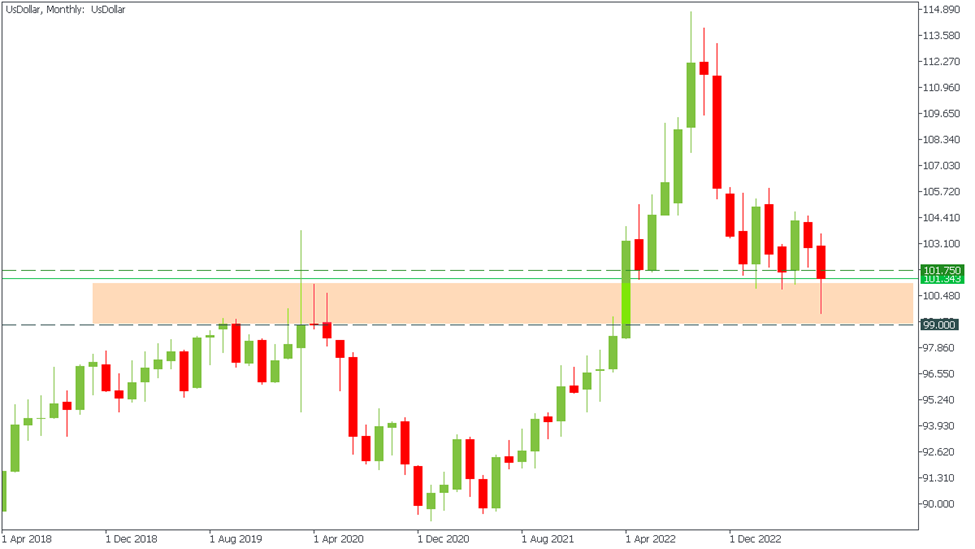
On the Monthly timeframe, the US dollar index has reached a massive support zone creating 2019-2020 highs. The uptrend is preferred as long as the index closes its monthly candles above 99.00.
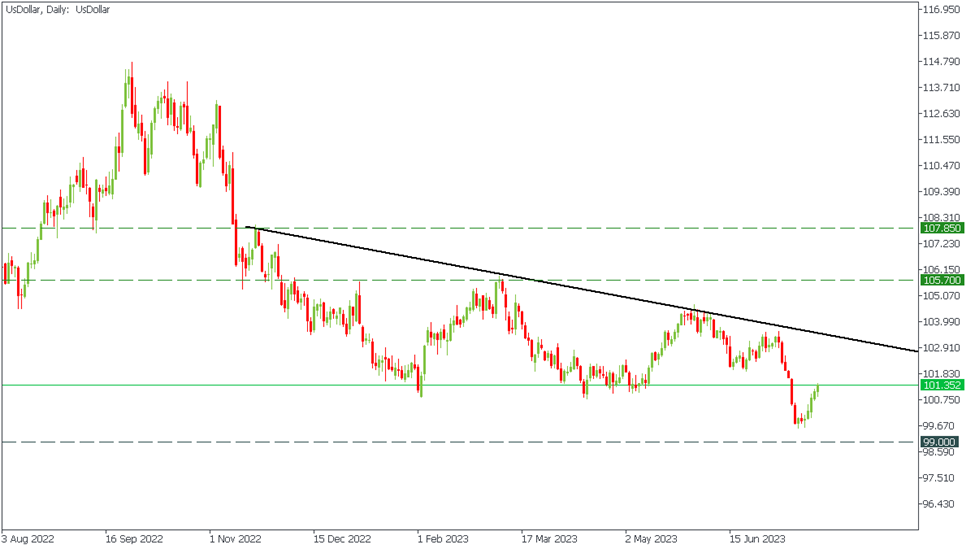
Traders should closely monitor the reaction to the descending resistance trendline, as a breakout above will signal the end of this correction. After the breakout, the index will likely move toward 105.70 and 107.85.
However, buying now is not recommended as before a reversal, the index may decline to 99.00 again.
ECB meeting
The European Central Bank (ECB) is expected to raise interest rates by 25 basis points on July 27, with most economists also expecting another hike in September. Despite inflation in the eurozone nearly halving from its peak last year, the ECB remains committed to curbing inflation, stating that it will remain too high for too long. The central bank has implemented eight consecutive rate hikes since July 2022, totaling 400 basis points, and there is debate among investors and analysts about the number of additional hikes needed to achieve the 2% inflation target.
The ECB's hawkish stance suggests that rate cuts are not likely in the near future. Therefore, the euro has strengthened against the dollar, driven by expectations of narrowing interest rate differentials.
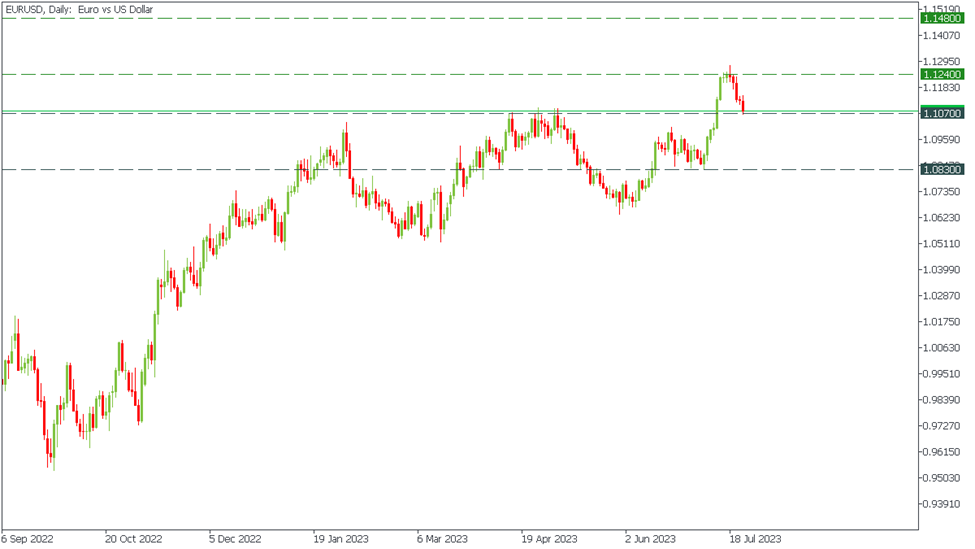
EUR/USD is currently testing the recent highs from May 2023.
-
If the price declines below 1.1070, it will move to 1.0830.
-
However, if it rejects, the pair may head toward 1.1240 and 1.1480.
BOJ meeting
The Bank of Japan (BOJ) is likely to maintain its current yield control policy at the upcoming meeting on July 28. Policymakers prefer to assess more data before making any changes, and there is no consensus within the central bank regarding the timing of phasing out stimulus. Although there has been speculation that the BOJ may tweak yield curve control (YCC) at the meeting to address market distortions caused by bond buying, stable 10-year yields below the 0.5% cap have reduced the urgency for immediate action.
BOJ policymakers believe they can afford to wait for more clarity on the global economy's trajectory and its impact on Japanese firms' profitability and wage hikes next year. While inflation has exceeded the BOJ's target for over a year, sustainability remains a key concern. The central bank is expected to make only minor adjustments to YCC, aiming to make it more sustainable without major policy changes.
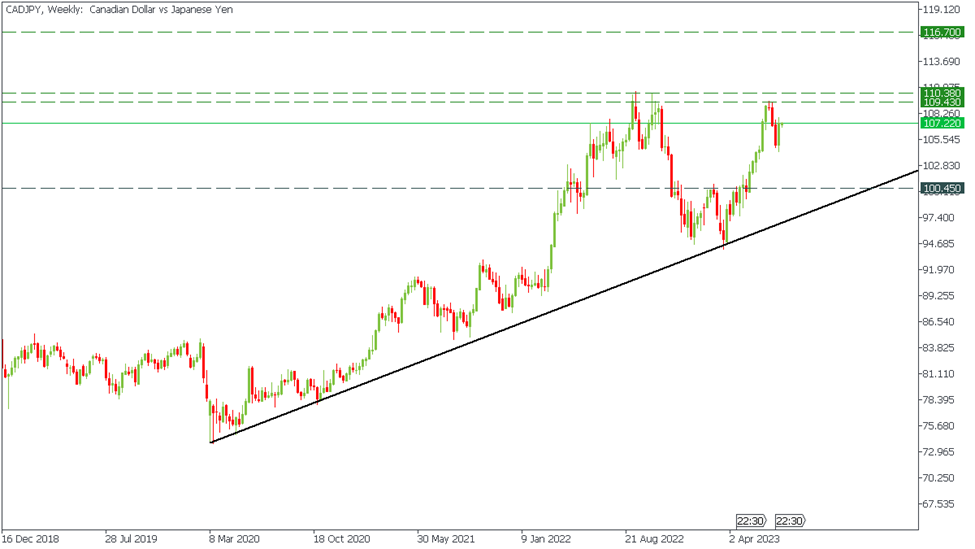
Buyers are attempting to push CADJPY above the resistance range of 109.42 - 110.38.
-
If they succeed, the price will skyrocket to 116.70.
-
However, in case of rejection, the pair may decline to the trendline around 100.45.
This article is sponsored content
Author

FBS Team
FBS
FBS team is a group of professional analysts focused on Forex, stock, and commodity markets. Each expert possesses a years-long experience in fundamental and technical analysis.















