Canadian Dollar stares at 114.7K lost jobs and a Fed rate hike

The Canadian Dollar (CAD) faces pressure from two directions. Canada's labour market continued to deteriorate, while job creation in the United States (US) significantly exceeded expectations, strengthening market bets on another interest rate hike by the Federal Reserve (Fed).
This divergence puts the Loonie in a particularly difficult position. While the Bank of Canada (BoC) has just raised interest rates for the first time in more than three years, the latest employment figures raise questions about its ability to continue tightening monetary policy without worsening the economic slowdown.
Canada lost 114.7K jobs in three months, a warning sign difficult to ignore
Canada's labour market is experiencing a prolonged period of weakness. According to Statistics Canada, the economy unexpectedly shed 4.7K jobs in October, compared with expectations of 13.6K new positions. Meanwhile, the Unemployment Rate rose to 6.7% from 6.5% in September, reaching its highest level in six months.
Although October's job losses appear relatively modest, they extend a much more concerning trend. Following the loss of 41.7K jobs in August and 68.3K in September, the Canadian economy has now shed a total of 114.7K positions over three months.
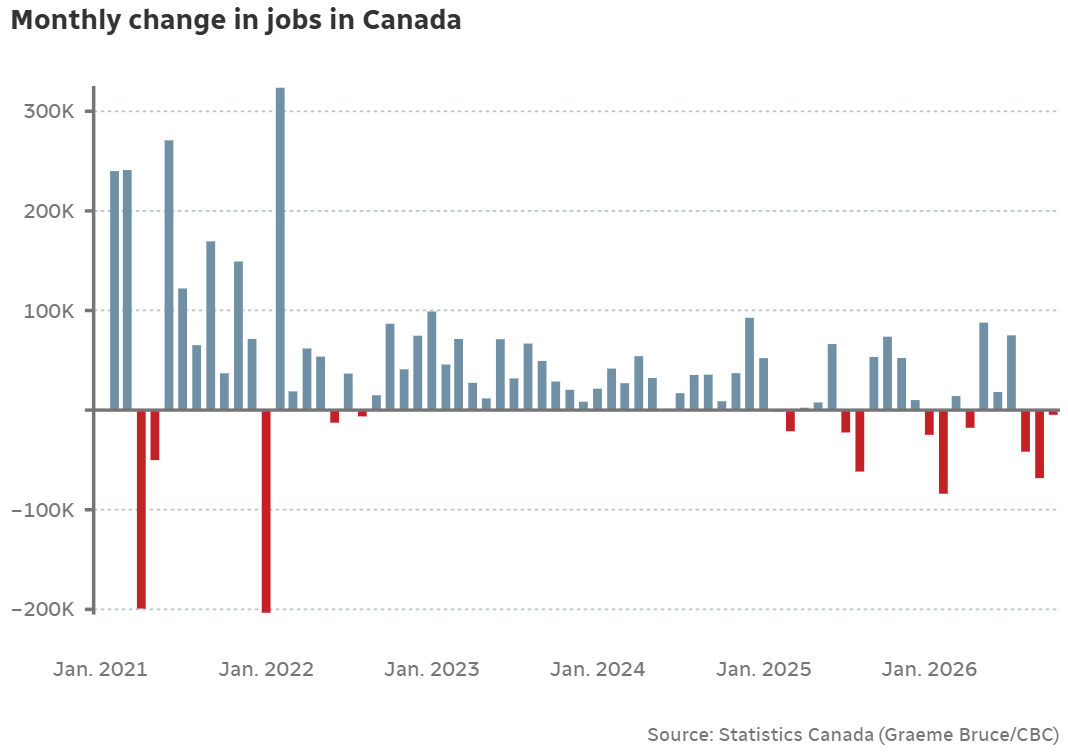
Canadian Imperial Bank of Commerce (CIBC) Senior Economist Andrew Grantham highlights the persistence of this deterioration in a note cited by CBC: "While the Canadian Labour Force Survey is notoriously volatile, three monthly declines in a row is a trend that is hard to ignore."
The composition of the employment figures raises further concerns. Full-time employment fell by 18.1K positions, while the private sector sheds 53K jobs, marking its first contraction since February. This weakness is partially offset by an increase of 50K public-sector jobs. Wholesale and retail trade also lost 29K positions, illustrating the difficulties businesses face amid ongoing trade tensions with the United States. Young workers are particularly affected, with their Unemployment Rate climbing to 13.7% from 13%. Meanwhile, annual Average Hourly Wages growth slowed to 2% from 2.3% in September.
These developments suggest that Canada's labour market difficulties extend beyond a temporary employment correction.
Bank of Canada faces a dilemma between inflation and unemployment
The deterioration in employment comes at a particularly sensitive moment for the Bank of Canada. On October 28, the central bank raised its benchmark interest rate by 25 basis points (bps) to 2.5%, delivering its first hike in more than three years. The decision was partly driven by concerns over elevated energy prices and their potential transmission to broader inflation.
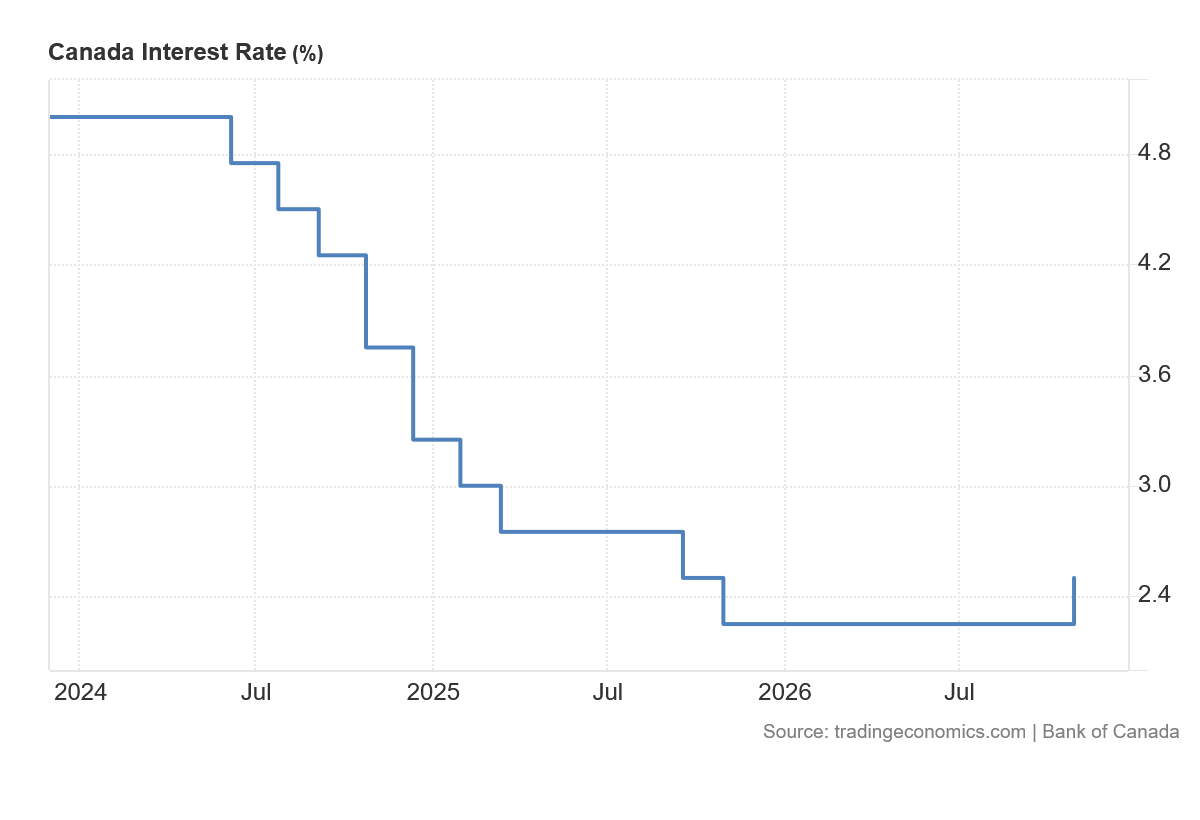
However, the latest employment figures significantly complicate this strategy. On the one hand, persistent inflationary pressures justify maintaining restrictive monetary policy. On the other hand, declining private-sector employment, rising unemployment and slowing wage growth suggest that the Canadian economy already has considerable spare capacity.
Capital Economics Senior North America Economist Thomas Ryan argues that October's employment figures should temper expectations of further monetary tightening. In a note cited by The Canadian Press, he states: “Ultimately, this adds to our conviction that the bank will hike rates no more than twice more as a precaution against upside inflation risks, before calling it a day.”
Financial markets are also beginning to reflect this shift in expectations. According to Reuters, investors now anticipate another 25-basis-point rate hike in March, compared with January before the employment report. This reassessment reduces potential monetary policy support for the Canadian Dollar, particularly against a US currency benefiting from expectations of a more restrictive policy stance.
United States adds 165,000 jobs as Fed tightening expectations intensify
Across the border, the contrast is striking. The US Bureau of Labor Statistics (BLS) reported that Nonfarm Payrolls (NFP) increased by 165K in October, significantly exceeding expectations of 65K. The Unemployment Rate fell to 4.1% from 4.2% in September. Upward revisions to previous months reinforce the picture of resilience. Employment figures for August and September were revised higher by a combined 84K jobs, suggesting that the US labour market is stronger than initially estimated. Annual wage growth, however, eased slightly to 3.1% from 3.2%, potentially limiting some inflation concerns.
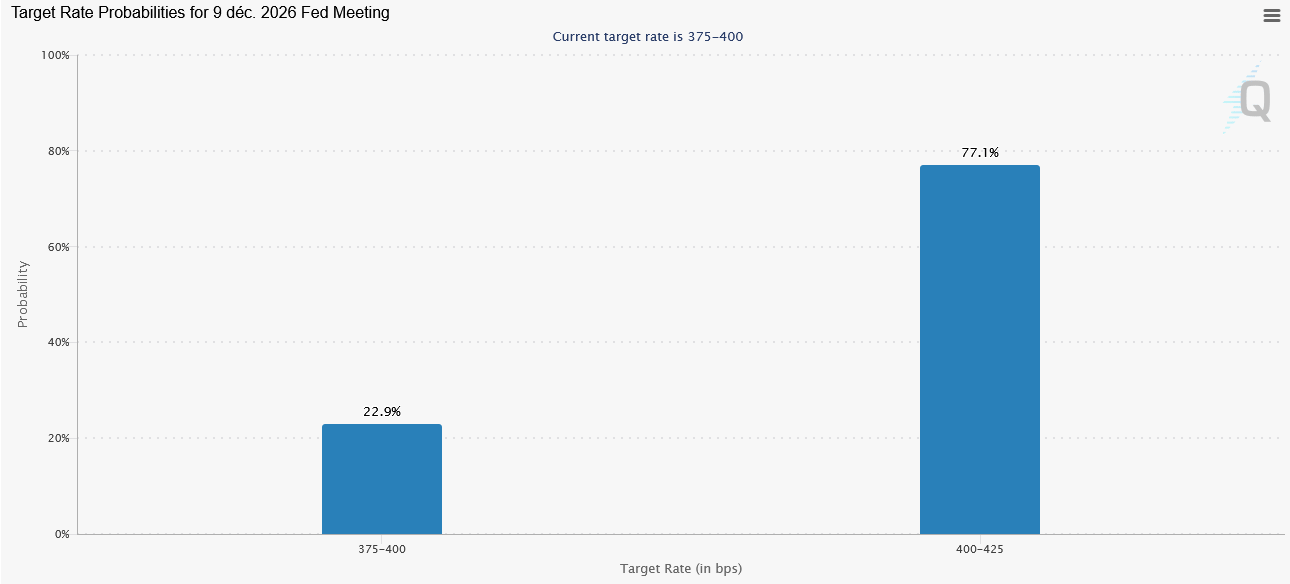
Nevertheless, robust employment gives the Fed greater flexibility to maintain restrictive monetary policy or raise interest rates further if price pressures persist. According to the CME FedWatch tool, markets now assign nearly an 80% chance to a 25-basis-point interest rate hike in December, up from around 70% the previous day.
Why the Canadian Dollar could remain under pressure
The main risk for the Canadian Dollar now lies in the growing divergence between the monetary policy outlooks of the two countries. In the United States, strong employment reinforces the case for additional tightening. In Canada, job losses and slowing wage growth limit the central bank's room for manoeuvre. A widening interest rate differential in favour of the United States could encourage investors to favour US Dollar-denominated assets over the Loonie.
Trade tensions represent another significant risk. US tariffs continue to weigh on Canadian hiring and investment prospects, while elevated energy costs complicate efforts to contain inflation. However, a slowdown in US inflation or an unexpected improvement in Canadian employment could narrow this divergence and provide some support for the CAD.
In the near term, the outlook remains unfavourable for the Canadian Dollar. As long as US economic data continues to surprise to the upside while Canada's labour market deteriorates, USD/CAD could maintain its upward bias, supported by increasingly divergent monetary policy expectations.
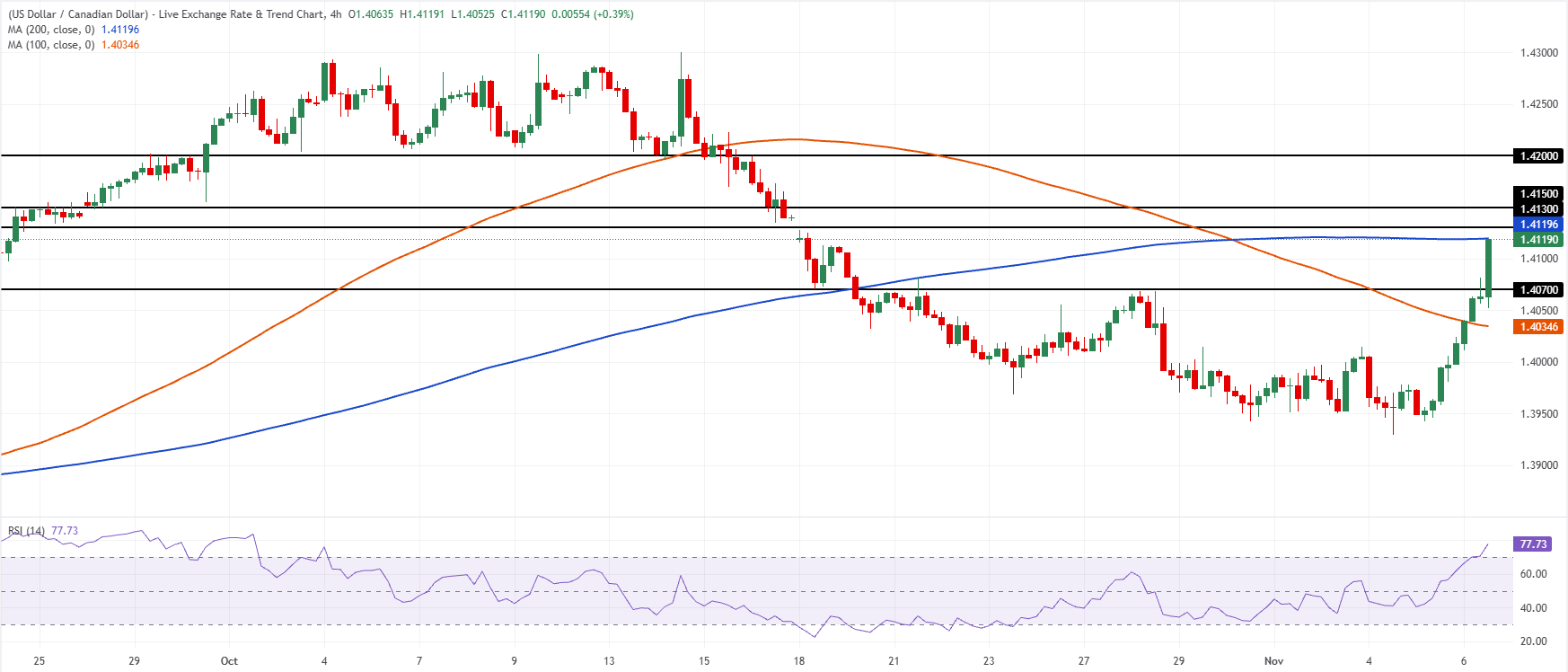
In the four-hour chart, USD/CAD is capped just beneath the 200-period simple moving average (SMA) at 1.4120, which acts as immediate overhead resistance. The pair remains under a dense topside barrier formed by horizontal levels at 1.4130 and 1.4150, keeping the near-term bias cautious despite a strong advance from the 100-period SMA (EMA) support at 1.4035. The Relative Strength Index (14) has surged into overbought territory near 77, hinting that upside momentum may be stretched and vulnerable to a corrective pullback while price holds below the 200-period SMA.
On the topside, initial resistance is located at the 200-period SMA at 1.4120, followed by the horizontal caps at 1.4130 and 1.4150, with a more distant barrier at 1.4200. On the downside, the first area to watch is the recent price zone around 1.4119, with stronger support seen at the horizontal floor near 1.4070 and then at the 100-period SMA at 1.4035, where buyers previously emerged; a slide back toward this cluster would signal that the current rally is losing traction.
(The technical analysis of this story was written with the help of an AI tool. Know more.)
Author

Ghiles Guezout
FXStreet
Ghiles Guezout is a Market Analyst with a strong background in stock market investments, trading, and cryptocurrencies. He combines fundamental and technical analysis skills to identify market opportunities.

















