Canadian Dollar on hold ahead of Canada, US CPIs


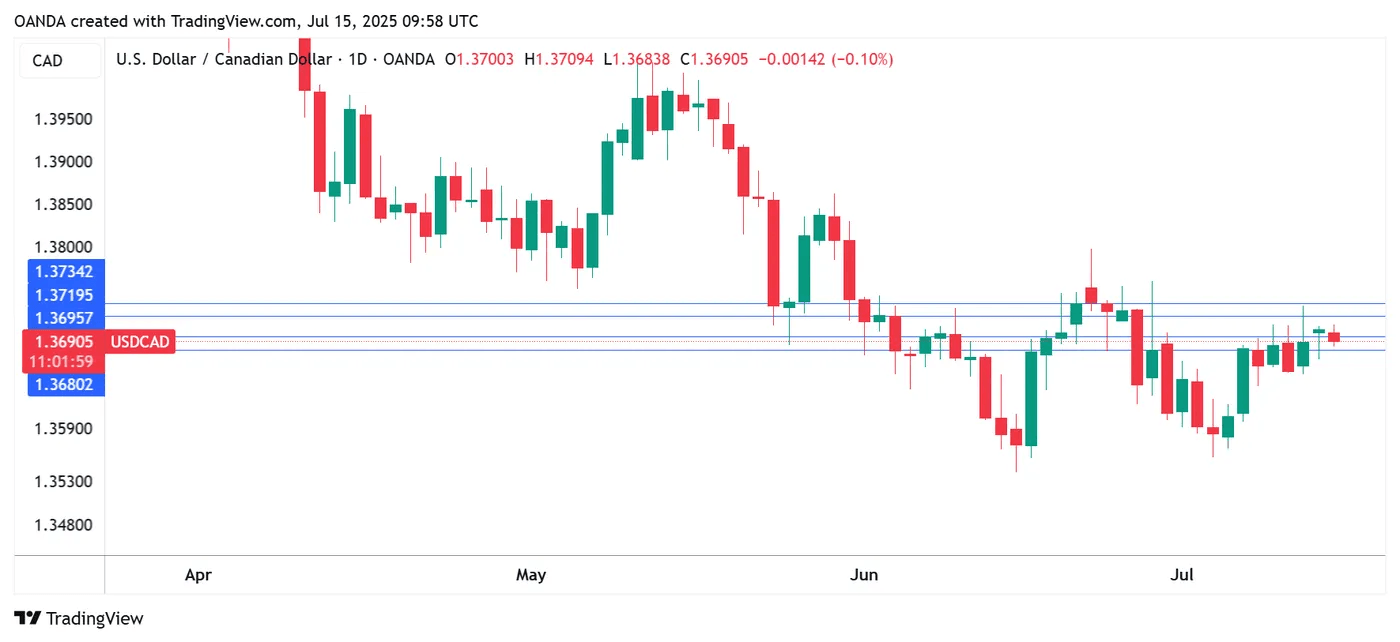
The Canadian dollar continues to drift but that could change with the release of Canadian and US inflation later today. In the North American session, USD/CAD is trading at 1.3687, down 0.13% on the day.
Canadian, US CPI expected to have accelerated in June
It promises to be an interesting day as both Canada and the US release the June inflation reports.
In Canada, headline CPI is expected to rise to 1.9% y/y from 1.7% in May, while the monthly rate is projected to ease to 0.1% from 0.6%. Two key core CPI indicators are expected to show an average of 3.0% y/y, unchanged from May.
In the US, the markets are also bracing for higher inflation. The consensus for headline CPI is 2.7% y/y, compared to 2.4% in May. Monthly, CPI is expected to rise to 0.3%, up from 0.1% in May. Core CPI is expected to rise to 3.0% y/y from 2.8% and monthly to 0.3% from 0.1%.
How will the Bank of Canada and the Federal Reserve view the inflation numbers? The BoC won't have any problem with a CPI of around 2%, which is the Bank's inflation target. Still, core CPI, which is a better gauge of long-term inflation than headline CPI, is uncomfortably high at 3%, and the BoC would like to see the core rate move lower before lowering interest rates.
Have the Trump tariffs boosted inflation?
In the US, if June inflation rises as is expected, fingers will quickly point at President Trump's tariffs as finally having an impact. Recent inflation reports have not shown a significant spike higher to the tariffs, which were first imposed in April. However, the tariffs may have needed time to filter throughout the economy and could be felt for the first time in the June inflation reading.
The Fed is widely expected to hold rates at the July 30 meeting, with the markets pricing in a 95% chance of a hold, according to CME's FedWatch. For September, the odds of a rate cut stand at 59%. Today's inflation report could cause a shift in these numbers.
USD/CAD technical
- USD/CAD is testing support at 1.3695. Next, 1.3680 is a weak support line, followed by 1.3656.
- There is resistance at 1.3719 and 1.3734.
Author
Kenny Fisher
MarketPulse
A highly experienced financial market analyst with a focus on fundamental analysis, Kenneth Fisher’s daily commentary covers a broad range of markets including forex, equities and commodities.