Brazil's bifurcated policy and FX outlook


Summary
Despite the Fed approaching interest rate cuts, we believe the Brazilian Central Bank (BCB) will pivot back to tighter monetary policy in the near future. Rising inflation expectations - fueled by loose fiscal policy and currency weakness - will be the driving forces for policymkaers to shift back to rate hikes, and can offer a pillar of support for the Brazilian real. We also believe Lula will demonstrate more explicit fiscal responsibility in 2025, which can also act to underpin Brazilian real strength over the medium-term. Longer term, we are less optimistic on Brazil's currency as monetary and fiscal policy dynamics should change course as local economic trends worsen and the 2026 presidential election comes into focus.
Brazilian Central Bank to move back to tightening
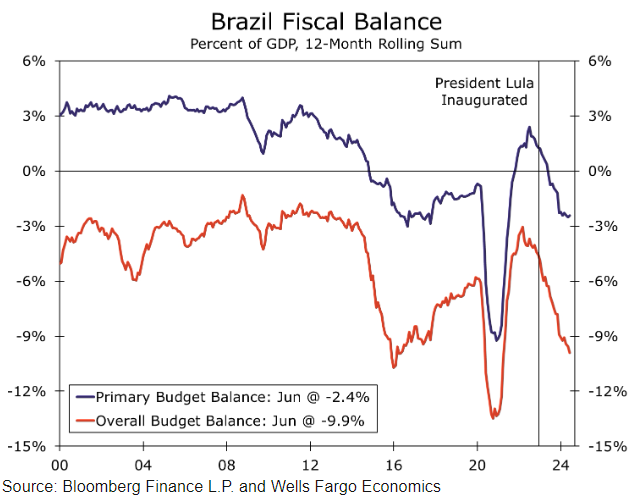
As we highlighted in our August International Economic Outlook, the Federal Reserve shifting to rate cuts in September will likely create policy space for select emerging market central banks to also lower interest rates. However, certain institutions may be more motivated to respond to domestic economic conditions rather than Federal Reserve monetary policy decisions. In our view, the Brazilian Central Bank (BCB) fits the mold of a developing economy central bank that is more focused on the evolution of local economic trends rather than the direction of policy rates in the United States. In fact, not only do we believe the Brazilian Central Bank will not pivot to easing in conjunction with the Fed, we believe BCB policymakers are likely to pursue rate hikes as early as next month. Our view for the Brazilian Central Bank to shift back to tighter monetary policy stems from renewed inflationary pressures, resilient economic activity as well as reduced political pressure to pursue accommodative monetary policy. As far as inflation, headline CPI has trended higher since April and now sits at the upper bound of the BCB's inflation target range. Food and beverage inflation has contributed meaningfully to the rise in headline inflation; in addition, services disinflation has stalled and is currently at uncomfortable levels for BCB policymakers. One of the key contributors to elevated services inflation is fiscal loosening under the Lula administration. Since Lula started his third term in office, Brazil's fiscal balance—both overall and primary—has worsened to deficits last experienced during the end of the commodity super-cycle and Brazil's political shock in 2015-2016 (Figure 1). Fiscal slippage is a concern often expressed by COPOM members in official statements and public pronouncements, and with Brazil's fiscal situation still a challenge to containing inflation expectations, we believe BCB policymakers will be most inclined to defend against a fiscal dominance scenario materializing. On activity, Brazil's June economic activity index—often viewed as a proxy for GDP—beat expectations by a wide margin coming in at 1.37% month-on-month relative to a consensus forecast of 0.50%. Stronger-than-forecast activity has been a trend for most of 2024, and with the latest data outperforming, upside risks to inflation exist and can provide additional rationale for policymakers to tighten monetary policy.
Author
Wells Fargo Research Team
Wells Fargo