Boomers Prefer to Die at Home: Enormous Glut of Senior Housing

Developers keep building housing for seniors. The problem is, seniors don't want it.
Senior housing faces a budding glut as Boomers Prefer to Stay Home.
The rise of technologies that help the elderly stay in their homes threatens to upend one of commercial real estate’s biggest bets: Aging baby boomers will leave their residences in droves for senior housing.
“People don’t want to go to a place where there’s only a bunch of other old people,” said James Crispino, head of the senior practice at design firm Gensler.
The aging-in-place technology trend marks a challenge to the numerous real-estate developers who have been rushing to build senior housing to accommodate the roughly 72 million Americans born between 1946 and 1964, representing about 20% of the U.S. population. In about one decade, boomers will start reaching their mid-80s, the typical move-in age for senior housing.
Senior-housing developers added 21,332 new units in 2018—more than double the number that was added in 2014, according to the National Investment Center for Senior Housing & Care, an industry organization. Senior housing is now one of the fastest-growing commercial real-estate sectors, ahead of office, retail, hotels and apartments, according to Green Street Advisors.
But developers might have jumped the gun a bit and now some worry there is an emerging glut of senior housing. Senior-housing occupancy fell in the third quarter of 2019 to 88% compared with 90.2% in the fourth quarter of 2014, according to the National Investment Center for Senior Housing & Care.
Some companies specializing in senior housing are suffering. Shares of Ventas Inc., a big health-care real-estate investment trust, fell close to 9% one day last month after it said the occupancy rate of its senior-housing communities declined to 84.1% on June 30, compared with 84.5% a year earlier and 88.5% in June 2014.
Moreover, the average age that people enter senior housing has been rising, partly because of improving health. It is about 84 to 85 years today, compared with 82 one decade ago, according to Green Street analyst Lukas Hartwich.
Complicating the Problem
Developers are scrambling to come up with facilities where seniors do want to live.
Assuming they succeed, what about all the already built developments that do not fit the bill?
And if they don't succeed, it's even worse.
Build for Millennials?
Perhaps builders would be better off building developments where millennials want to live. But student-debt ridden millennials cannot afford to buy much of anything.
Housing Bubble Reblown
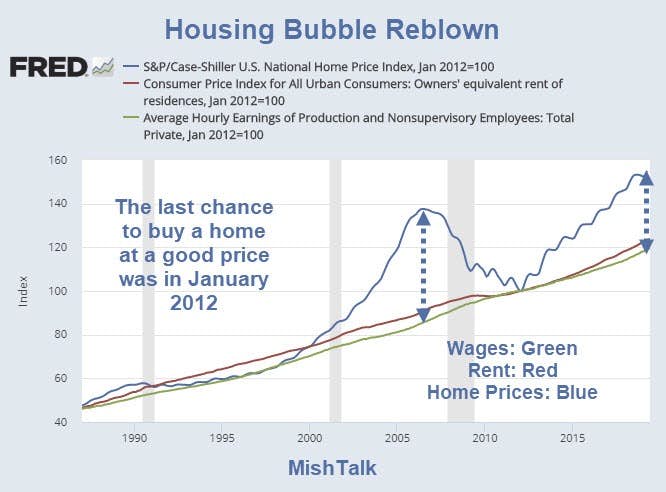
As noted in Housing Bubble Reblown: the Last Chance for a Good Price Was 7 Years Ago.
Moreover, millennials delay family formation because of debt, so fewer need a home.
Still others are squeezed by rent.
Squeezed Out of House and Home
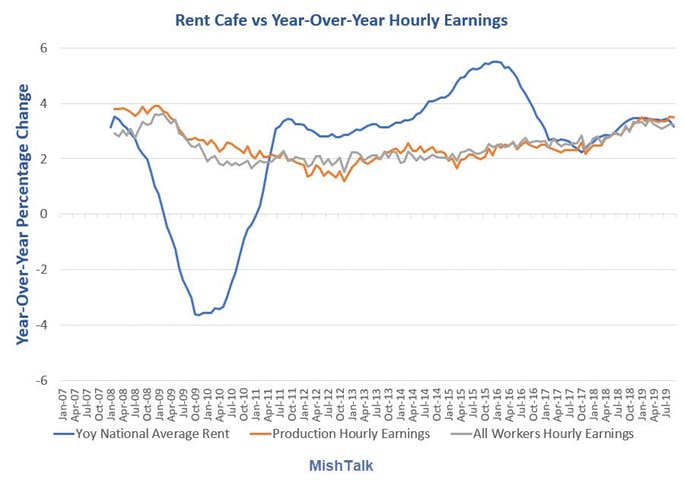
Millennials are Squeezed Out of House and Home.
They cannot afford to buy and they cannot afford to rent.
This will force more millennials to move back home.
Others will move back home (if they are not already there), to take care of aging parents.
Secular Deflationary Implications
To top it off, attitudes about housing and family formation have changed.
Millennials do not have the same values as their parents.
That is a secular change, not a cyclical one, with huge deflationary implications.
Author

Mike “Mish” Shedlock's
Sitka Pacific Capital Management,Llc
Mike “Mish” Shedlock is a registered investment advisor for SitkaPacific Capital Management.