Softer polish industry underscore risks to GDP growth outlook
Despite the conflict in the Middle East, Poland's second-quarter GDP growth was buoyant at 3.9% YoY – but softer-than-expected August industrial output data, alongside the prolonged energy crisis, calls for caution on the economic outlook for the coming quarters. We're sticking to our conservative forecast of GDP growth at 3.4% this year.
Industrial output short of expectations in August
Poland’s industrial output increased by 4.3% year-on-year in August (ING: 8.3%; consensus: 6.1%), following growth of 4.8% YoY in July (revised down from 5.1% YoY). Given a favourable calendar effect in the form of one additional working day compared with a year earlier and a low statistical base from last year, the result is disappointing.
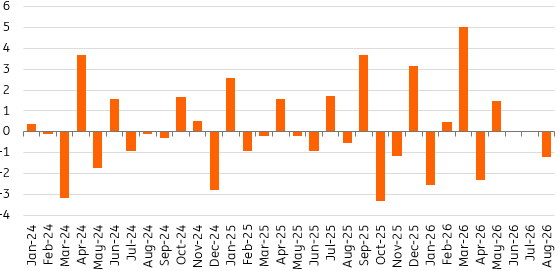
Growth in manufacturing output slowed to 3.4% YoY from 4.2% YoY a month earlier. Energy production continued to expand at a double-digit pace (10.5% YoY), as did mining output (18.7% YoY). Seasonally adjusted data points to a 1.2% month-on-month decline in industrial production, following two months of flat monthly readings.
Industrial production down in August
Industrial production MoM (SA).
Growth in August was driven mainly by the production of intermediate goods (8.5% YoY), non-durable consumer goods (4.8% YoY) and capital goods (4.7% YoY). In contrast, output of durable consumer goods and energy-related products declined (down by 7.0% YoY and 0.5% YoY, respectively).
Production increased in 25 out of 34 subsectors in August. The strongest gains were recorded in electrical equipment manufacturing (18.7% YoY) as well as machinery and equipment production (12.8% YoY), reflecting the advanced stage of the investment cycle co-financed by the National Recovery Plan (NRP). The largest declines were in the production of tobacco products (-11.7% YoY), textiles (-4.9% YoY), furniture (-2.3% YoY) and motor vehicles (-1.5% YoY), all of which are particularly exposed to competition from China. Recently, China has become Poland’s largest importer, ahead of Germany.
Producer price inflation increased
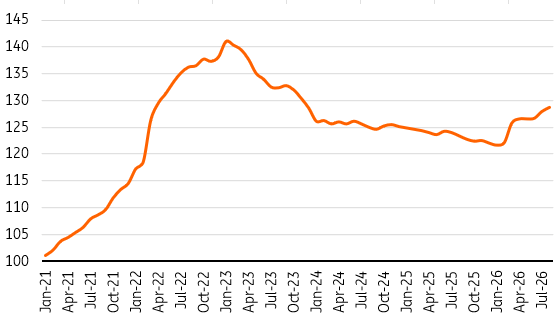
Producer prices (PPI) increased by 4.2% YoY in August (ING: 4.1%; consensus: 3.6%), following growth of 3.1% YoY in July (revised up from 2.8% YoY). The marked acceleration in producer price inflation was largely due to a base effect from August last year, when the PPI index fell by 0.5% MoM, compared with a 0.6% MoM increase this year. Prices in the petroleum refining sector rose strongly for another consecutive month, reflecting higher crude oil prices on global markets.
Energy crisis pushing PPI higher
PPI, December 2021=100.
Stronger investment and softer consumption seen in 2H26
August data suggests that, despite Poland's surprisingly strong economic performance in 2Q26 (with GDP growth of 3.9% YoY), the outlook for the second half of the year warrants caution. In particular, slowing wage growth and elevated fuel prices could weigh on household consumption growth, which already decelerated in 2Q. At the same time, the investment cycle supported by NRP funds is peaking and generating multiplier effects across the economy, and this could already be seen in 2Q26 corporate investment data.
While we see scope for GDP growth to exceed our current 3.4% forecast for 2026, geopolitical uncertainty and the protracted energy crisis prevent us from revising that forecast upwards.
Author

ING Global Economics Team
ING Economic and Financial Analysis
From Trump to trade, FX to Brexit, ING’s global economists have it covered. Go to ING.com/THINK to stay a step ahead.