BOJ Preview: Kuroda likely to squash expectations of near-term policy normalisation

The Bank of Japan is expected to maintain its massive stimulus program at a monetary meeting this Thursday despite growing signs of improvement in the economy, as domestic inflation remains stubbornly below the BoJ’s 2% target rate.
Markets expect near-term policy tightening
Nomura Global FX Strategy says, "there have been a few signs of rising market expectations for BOJ policy normalization". Thus, JPY has been facing upward pressure since November. The fact that USD/JPY is struggling to break above 113.00 despite the rise in the 10-year treasury yield to a 8-week high of 2.47 percent, suggests the investors fear Kuroda might make some tiny gesture towards tighter monetary policy.
After all, Kuroda did talk about “reversal rate” during a speech in November.
Further, Japanese growth has been extremely impressive and calls from newcomer Goushi Kataoka to increase stimulus to speed up meeting the BOJ's 2 percent inflation target has not gained support of other board members. Also, newcomer Hitoshi Suzuki recently said the BOJ may need to raise its yield targets or slow ETF buying in the future.
The advanced nation central banks are increasingly under pressure to put less weight on their inflation targets and withdraw policy support more quickly. A Bloomberg report dated Dec. 11 says, "Wall Street economists are telling investors to brace for the biggest tightening of monetary policy in more than a decade. With the world economy heading into its strongest period since 2011, Citigroup Inc. and JPMorgan Chase & Co. predict average interest rates across advanced economies will climb to at least 1 percent next year in what would be the largest increase since 2006.
So yields (rates) are likely to up across the globe and that would put upward pressure on the Japanese government bond yields, thereby making it difficult for the BOJ to keep 10-year yield at zero percent. Hence, it is not altogether wrong to say that BOJ might reduce stimulus/hike yield curve control target in 2018.
Still, governor Kuroda is unlikely to signal a major change in stance, says Nomura Global FX strategy Team. The Research Team at Barclays also expects the BOJ to retain the current policy by a majority vote.
This is because, core consumer inflation remains stuck at 0.8 percent and firms polled by the BOJ do not expect inflation to pick up pace in coming years. Most economists polled by Reuters expect the BOJ's next move to be a withdrawal of stimulus, though they do not expect such step to be taken until late 2018 or beyond.
Guidance in Q&A could influence Yen
Global FX Strategy Team at Nomura says, "Governor Kuroda’s press conference will provide a reality check. We do not expect Governor Kuroda to increase market expectations of near-term policy normalization. We think investors expecting a near-term tightening will be disappointed by Governor Kuroda’s unchanged accommodative stance, which is likely to weaken JPY."
Barclays Research Team says, "Governor Kuroda will have a chance to express his views on any proposals for further easing and, indeed, speculation around the prospect of normalization.”
Kuroda is likely to talk about the topic of reversal rates and natural yield curves.
The Japanese Yen could spike if-
- Kuroda says the future monetary policy is more dependent on growth, financial stability and less about inflation.
The Yen may depreciate if-
- Kuroda reiterates that reversal rate theory has not been empirically tested and
- Maintains that inflation would guide the future decisions.
USD/JPY - Bullish break likely
Monthly chart
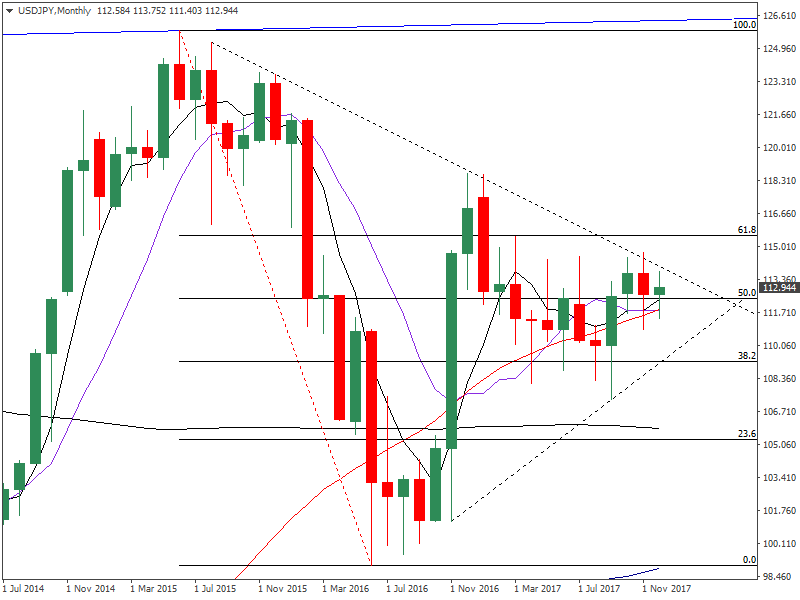
- The pair is likely to test the descending trend line resistance of 114.00 and could extend the gains towards 114.74 (last month's high), given the monetary policy divergence (US-Japan yield differential) is likely to increase further in 2018.
Yield spread chart
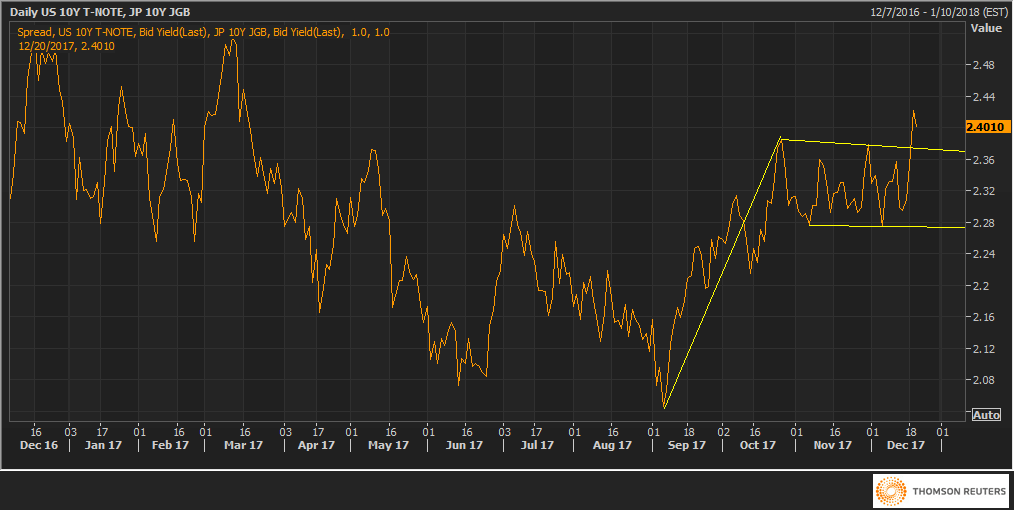
- The spread chart also shows a bull flag breakout (bullish continuation pattern), which indicates potential for further gains in the USD/JPY.
On the other hand, USD/JPY could drop to 112.16 (100-day MA) if Kuroda sounds hawkish during the Q&A session.
Author

Omkar Godbole
FXStreet Contributor
Omkar Godbole, editor and analyst, joined FXStreet after four years as a research analyst at several Indian brokerage companies.

















