|

BOC Drops its Hawkish Bias, USD/CAD Breaks Above 1.3500
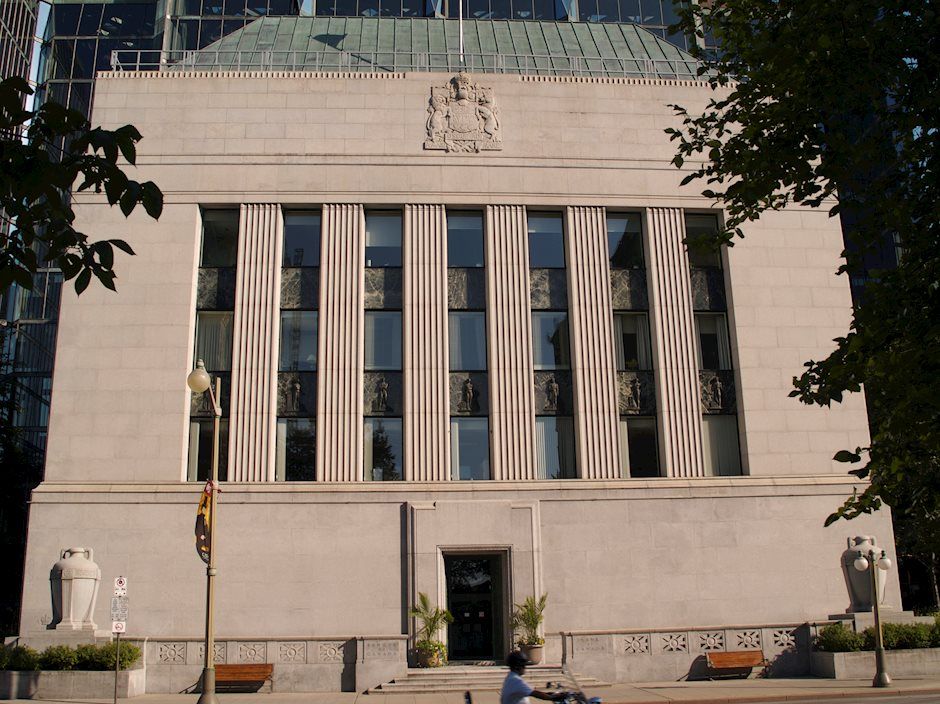
To the surprise of no informed market participant, the Bank of Canada left interest rates unchanged at 1.75% in today’s monetary policy meeting. A pre-meeting Bloomberg poll of 24 economists showed this result was unanimously expected, so the “decision” itself didn’t lead to any meaningful market moves.

That said, traders were keeping a close eye on the central bank’s guidance for future interest rate changes, and that’s where we saw the big market-moving news. In its March meeting, the BOC downgraded, but ultimately retained, its hawkish bias, noting that there was “increased uncertainty about the timing of future rate increases.” Today’s statement went one step further, dropping the hawkish bias in favor of a neutral outlook“We will continue to evaluate the appropriate degree of monetary policy accommodation as new data arrive.”

Traders have taken the hint, raising the market-implied odds of a rate cut by December from about 18% before the meeting to roughly 50% now. In addition to dropping its outlook toward raising rates, the Bank of Canada dramatically cut its 2019 GDP forecast from 1.7% to 1.2% on slower global growth and sluggish domestic housing data.

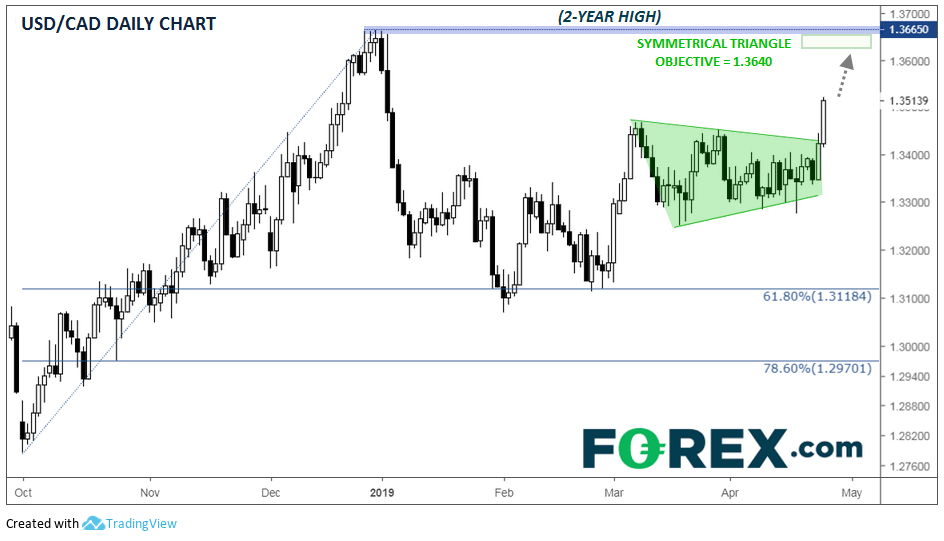
In today’s Asian session, my colleague Matt Simpson noted that we were “looking for USD/CAD to break above its March high,” given the general strength in the US dollar and the potential for a dovish surprise from the BOC. That’s exactly what we’ve seen so far, with the pair definitively breaking out of the topside of its “symmetrical triangle” pattern. The measured move target projection of this pattern comes in just below December’s nearly 2-year high:
USDCAD

Source: TradingView, FOREX.com

Author

Matt Weller, CFA, CMT

Matt Weller, CFA, CMT

Faraday Research

Matthew is a former Senior Market Analyst at Forex.com whose research is regularly quoted in The Wall Street Journal, Bloomberg and Reuters. Based in the US, Matthew provides live trading recommendations during US market hours, c


More from Matt Weller, CFA, CMT
Share:

Editor's Picks

EUR/USD trims gains, hovers around 1.1900 post-US data

EUR/USD trades slightly on the back foot around the 1.1900 region in a context dominated by the resurgence of some buying interest around the US Dollar on turnaround Tuesday. Looking at the US docket, Retail Sales disappointed expectations in December, while the ADP 4-Week Average came in at 6.5K.

GBP/USD comes under pressure near 1.3680

The better tone in the Greenback hurts the risk-linked complex on Tuesday, prompting GBP/USD to set aside two consecutive days of gains and trade slightly on the defensive below the 1.3700 mark. Investors, in the meantime, keep their attention on key UK data due later in the week.

Gold loses some traction, still above $5,000

Gold faces some selling pressure on Tuesday, surrendering part of its recent two-day advance although managing to keep the trade above the $5,000 mark per troy ounce. The daily pullback in the precious metal comes in response to the modest rebound in the US Dollar, while declining US Treasury yields across the curve seem to limit the downside.

XRP holds $1.40 amid ETF inflows and stable derivatives market

Ripple trades under pressure, with immediate support at $1.40 holding at the time of writing on Tuesday. A recovery attempt from last week’s sell-off to $1.12 stalled at $1.54 on Friday, leading to limited price action between the current support and the resistance.

Dollar drops and stocks rally:  The week of reckoning for US economic data

Following a sizeable move lower in US technology Stocks last week, we have witnessed a meaningful recovery unfold. The USD Index is in a concerning position; the monthly price continues to hold the south channel support.

XRP holds $1.40 amid ETF inflows and stable derivatives market

Ripple trades under pressure, with immediate support at $1.40 holding at the time of writing on Tuesday. A recovery attempt from last week’s sell-off to $1.12 stalled at $1.54 on Friday, leading to limited price action between the current support and the resistance.