BLS quietly erases thousands of jobs from past reports

If you believe the headlines, the employment situation in the U.S. is still solid.
Maybe you shouldn't believe the headlines.
They tend to bury the lead.
We got the June jobs report from the Bureau of Labor Statistics (BLS) on Friday. The economy added 206,000 jobs. That sounds pretty good, even though the unemployment rate ticked up to 4.1 percent.
The rise in unemployment seems to have tripped some warning buzzers in the mainstream. The New York Times tells us "job growth extends streak" but cautions that "signs of concern emerged."
"Halfway through the year, and four years removed from the downturn set off by the coronavirus pandemic, the U.S. job engine is still cruising — even if it shows increased signs of downshifting. Employers delivered another solid month of hiring in June..."
Even with the caveat, the report still sounds pretty good, doesn't it?
In the fourth paragraph, the reporter mentions in passing that the job numbers in the previous two months were revised downward. He never says how much they were revised downward. In fact, he never mentions it again. You might think that little bit of news wasn't significant.
It was.
The downward revisions were quite significant.
In May, the BLS reported 272,000 new jobs. That number was revised downward to 218,000.
In April, the BLS reported 165,000 new jobs. That number was revised downward to 108,000.
In other words, 111,000 jobs just vanished from the books.
Poof.
That dropped the six-month average from 253,000 jobs to 222,000 jobs.
Remember, this is just a function of math. Those 111,000 jobs were apparently just a figment of the collective imaginations over at the BLS.
This has been an ongoing pattern. The BLS releases a report. The media trumpets the greatness of the labor market. And then the BLS quietly revises the numbers down a month or two later and you hardly hear a peep.
Mishmash.com created a graph showing the revisions compared to the initial reports going back to January 2023. As you can see, nearly every revision was downward.
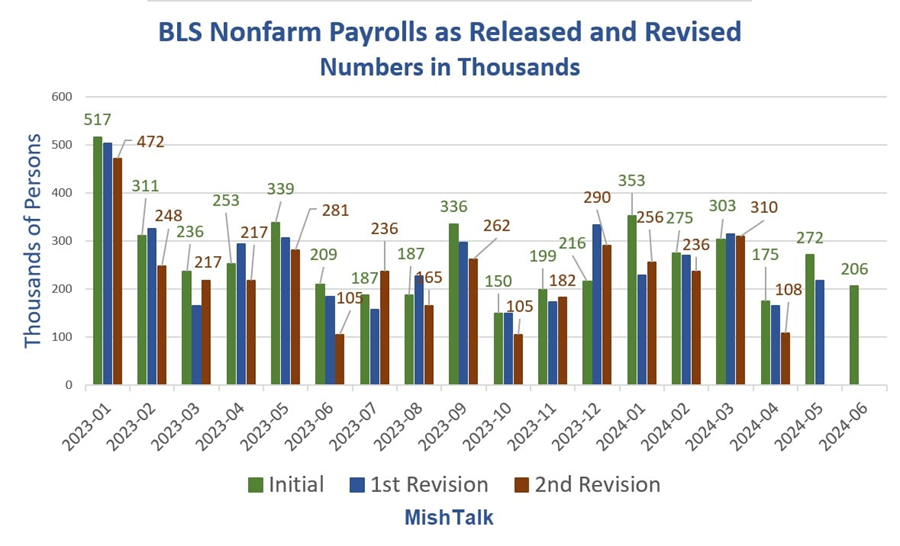
We can debate whether or not the revised numbers tell a different story than the initial data. But at the least, it should make you question the veracity of the data.
And it raises a big question: can we put any faith in this data at all?
Some people are paying attention. In May, Rep. Mary Miller (R-Ill.), questioned Acting Labor Secretary Julie Su about the constant revisions.
“Either you’re putting out fake numbers to give Joe Biden good headlines—and then quietly revising the job numbers down—or the BLS is failing to accurately report the numbers.”
While it is fair to say that the BLS has always revised data after the initial reports, one still has to wonder why the lion's share of revisions is down.
It's notable that markets only react to the initial numbers. You never see a gold rally because the BLS erased a bunch of jobs from the economy with a few clicks of its calculator. The revisions happen quietly in the back alleys. Nobody pays any attention to them. That creates the illusion that the labor market is much stronger than it is.
So, again, I have to ask the question: why should we trust any of these numbers, much less make decisions based on them?
To receive free commentary and analysis on the gold and silver markets, click here to be added to the Money Metals news service.
Author
Mike Maharrey
Money Metals Exchange
Mike Maharrey is a journalist and market analyst for MoneyMetals.com with over a decade of experience in precious metals. He holds a BS in accounting from the University of Kentucky and a BA in journalism from the University of South Florida.