|

Bitcoin Analysis: Trend reversal confirmed as 43% miners support Segwit2x

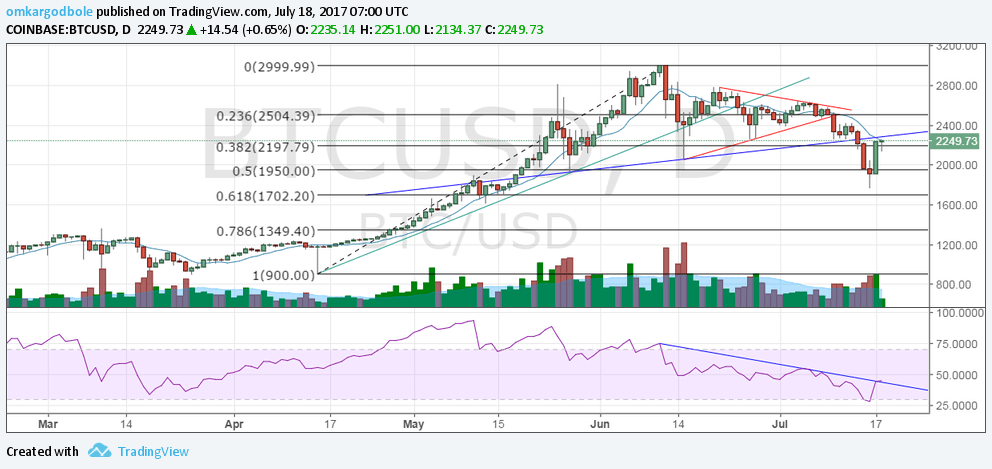
Bitcoin prices rallied on Monday as 43% of the miners signaled support for the scaling proposal Segwit2x. This came as positive surprise to traders since miners weren't expected to show support until July 21. BTC/USD on CoinBase broke above the 100-DMA level of $2065 yesterday and closed above $2197.79 (38.2% Fib R of $900-$2999.99).

A minor dip to $2134 seen earlier today has been quickly reversed and the virtual currency is now chipping away at the resistance offered by the 10-DMA level of $2243.

As per coinmarketcap.com, Bitcoin has gained 10% in the last 24 hours. Ethereum is up 12.53%. Ripple has gained 10.29%, while Litecoin has added 3%. The total market cap stands at $78.9 billion, while the Bitcoin Dominance rate is 46.8%.

Technicals

Resistance:

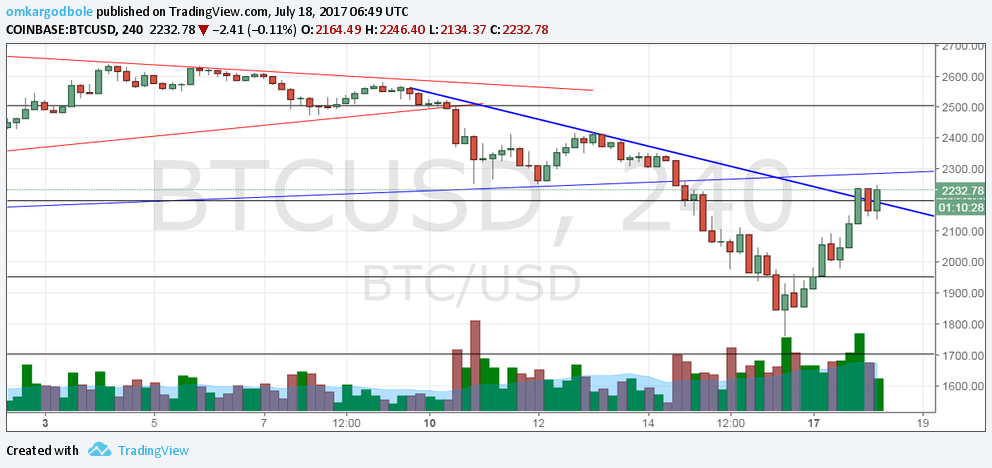
  • $2223 (4-hour 50-MA)
  • $2293 (head and shoulders neckline resistance)
  • $2383 (4-hour 100-MA)

Support:

  • $2197.79 (38.2% Fib R of $900-$2999.99)
  • $2050 (June 15 low)
  • $2000

4-Hour chart

Daily chart

Observations

  • Falling trend line breached on the 4-hour chart
  • Spinning bottom and a bullish follow through on the daily chart
  • Big jump in volumes on Monday
  • RSI challenging the downtrend line

Comments

The bullish reversal confirmation indicates the dips are likely to find new buyers unless the virtual currency breaks below $2000. However, the 10-DMA is still sloping downwards, thus break above $2300 is likely to be short lived. We are likely to witness sideways trading today with a positive bias.

Author

Omkar Godbole

Omkar Godbole

FXStreet Contributor

Omkar Godbole, editor and analyst, joined FXStreet after four years as a research analyst at several Indian brokerage companies.


More from Omkar Godbole
Share:

Editor's Picks

AUD/USD stays defensive below 0.7150 after Chinese data

AUD/USD remains on the back foot below 0.7150 in the Asian session on Tuesday, close to an over three-week low touched the previous day. US bond yields hold near multi-year highs ahead of the FOMC meeting and oil-driven inflation risks, supporting the US Dollar and weighing on the currency pair. Mixed Chinese activity data for August also fail to inspire the Aussie.

USD/JPY extends gains toward 155.00 amid USD resurgence

USD/JPY keeps pushing higher toward 155.00 early Tuesday, looking for more upside, as traders await the FOMC and BoJ meetings this week. Meanwhile, Fed rate-hike bets and oil-driven inflation risks keep US bond yields near multi-year highs, supporting the US Dollar and the pair. That said, a more hawkish repricing of the BoJ normalization path might continue to underpin the Japanese Yen and could limit USD/JPY's upside. .

$4,275: Gold skating on thin ice as eyes remain on Mideast conflict, Fed

Gold is briefly regaining $4,300 early Tuesday, looking to build on a tepid recovery from six-week troughs near $4,250. Traders are monitoring the widening conflict in the Middle East ahead of the two-day US Federal Reserve monetary policy meeting later in the day.

Bitcoin remains volatile amid CLARITY Act vote – Zcash, Stellar rally

Bitcoin holds steady around $78,000 on Tuesday, sustaining its roughly 2% recovery from the previous day. Broader cryptocurrency market volatility remains elevated ahead of the scheduled CLARITY Act cloture vote on Tuesday. Zcash and Stellar retain bullish momentum, emerging as the top performers over the last 24 hours.

Hard assets are entering their next explosive phase – Are you positioned?
It’s official: Commodities and Hard Assets have become the best-performing asset class of 2026. In a year defined by persistent inflation, geopolitical conflict, rising sovereign debt and intensifying supply disruption, capital is rotating aggressively into the one area governments cannot print and central banks cannot manufacture: scarce physical assets.
Venezuela’s 65-billion-barrel Oil deal could reshape America’s inflation fight
The United States (US) has secured unprecedented access to part of Venezuela’s vast Oil reserves. The timing is particularly significant as the war with Iran is disrupting Middle Eastern supplies, keeping energy prices elevated and reviving concerns about inflation.