Australian Inflation Preview: Monthly Consumer Price Index could bring hope or despair
- The Australian Monthly Consumer Price Index is foreseen at 5.2% YoY in October.
- RBA Governor Michele Bullock suggests a tighter employment sector is still needed.
- AUD/USD bullish strength persists, with the pair aiming to test the 0.6700 mark.

The Australian Bureau of Statistics (ABS) will release the Monthly Consumer Price Index (CPI) Indicator on Wednesday. Inflation is expected to have eased to 5.2% YoY from the 5.6% posted in September – still too high for the Reserve Bank of Australia (RBA) to declare victory in the fight against price pressures.
The September monthly CPI report indicated that housing, transport, food, and non-alcoholic beverages showed the most significant price rises.
Reserve Bank of Australia between a rock and a hard place
The RBA decided to hike rates to 4.35% in its November meeting, and Governor Michelle Bullock explained that the decision was made to avoid the risk of a potential uptick in price pressures. Additionally, policymakers expressed concerns about businesses passing on inflation costs to consumers, somehow justified by the September monthly CPI report.
At the time, Bullock also added that “the remaining inflation challenge we are dealing with is increasingly homegrown and demand-driven.” With that in mind, it is clear that Australian policymakers will keep a close eye on inflation gauges.
But there is still another twist on how macroeconomic data could affect RBA’s future monetary policy decisions. Speaking in a panel discussion titled "Inflation, Financial Stability and Employment" at the Hong Kong Monetary Authority and Bank for International Settlements High-Level Conference, Bullock said the central bank has to be a "little bit careful" with using rates to bring down inflation without lifting unemployment, adding monetary policy is already restrictive.
The employment sector has given modest signs of loosening. However, the unemployment rate stands near record lows, contracting to 3.6% in September, far away from what the central bank needs to complete its battle towards price stability.
Financial markets are betting central banks are at the end of their tightening cycle, but such an end is far from confirmed. Speculative interest is already pricing in rate cuts from major central banks throughout 2024, but policymakers insist rates should remain higher for longer to tame inflation.
That said, inflation-related figures tend to be quite sensitive and could trigger comprehensive market reactions.
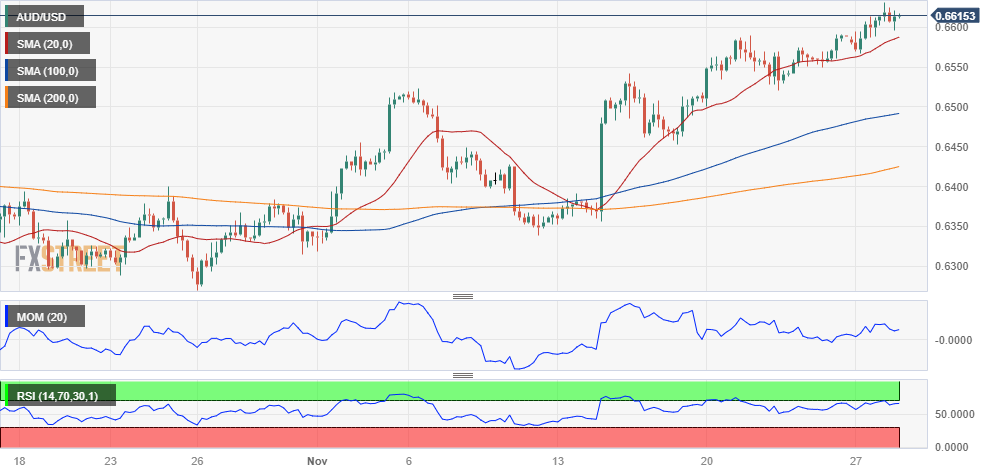
AUD/USD Technical Outlook
The Australian Dollar trades above 0.6600 against the US Dollar, with AUD/USD trading near 0.6631, a multi-month high posted early on Tuesday. The pair retreated afterwards as Australian Retail Sales unexpectedly contracted by 0.2% MoM in October, missing expectations of a 0.1% advance.
Nevertheless, AUD/USD is up for a fourth consecutive day, posting higher highs and higher lows, in line with additional gains in the near future. The pair faces resistance at 0.6630, with gains above the area favoring an extension towards 0.6670, en route to 0.6710.
A strong support region stands around 0.6560, where the first line of buyers should appear. If the level gives up, AUD/USD could extend its near-term slide towards the 0.6520 region.
Author

Valeria Bednarik
FXStreet
Valeria Bednarik was born and lives in Buenos Aires, Argentina. Her passion for math and numbers pushed her into studying economics in her younger years.