Australian Dollar Price Forecast: Next stop at the 200-day SMA?
- AUD/USD extends its multi-day bearish streak to the vicinity of 0.6800.
- The US Dollar maintains its solid pace on the back of steady geopolitical jitters.
- The RBA will publish its Minutes of the March meeting on Tuesday

The Australian Dollar (AUD) remains under sustained downside pressure, dragging AUD/USD to multi-week lows. While persistently elevated domestic inflation and the Reserve Bank of Australia’s (RBA) cautious stance should help limit the downside to some extent, escalating geopolitical tensions continue to weigh on sentiment across the broader risk complex.
The selling bias surrounding the Australian Dollar (AUD) doesn't seem to be slowing down, which has pushed AUD/USD to break below the 0.6900 support level and hit new two-month lows at the beginning of the week.
The bearish sentiment around spot remains well and sound on the back of a stronger Greenback. Indeed, safe-haven demand picks up pace in the current context of continued geopolitical worries in the Middle East conflict, favouring extra inflows into the safe haven universe.
Australia: resilient, but starting to cool
Australia’s story still looks solid on the surface, and that continues to give the Australian Dollar a decent floor. But dig a little deeper, and there are early signs that momentum is starting to ease.
The broader mix hasn’t really changed. Growth is holding up, inflation remains elevated, and the RBA is still leaning hawkish. That combination continues to support the currency.
That said, activity indicators are beginning to soften at the margin. March’s Purchasing Managers' Index (PMI) is expected at 50.1 in manufacturing and 46.6 in services, hinting at a gradual loss of pace. Trade remains supportive, with a A$2.631 billion surplus at the start of the year.
Zooming out, the economy is still expanding at a healthy clip. The Gross Domestic Product (GDP) rose by 0.8% QoQ in Q4 and 2.6% YoY, while the labour market is only easing slowly after the Unemployment Rate rose to 4.3% and the Employment Change increased by 48.9K.
Inflation, however, remains the key issue. The latest readings show only modest improvement, as the Consumer Price Index (CPI) eased slightly to 3.7% YoY, while the Trimmed Mean slipped to 3.3% from a year earlier, and the Weighted Median eased to 3.5%. That said, disinflation is happening, but at a slow pace, and not enough to satisfy the central bank.
From a policy perspective, the job is far from finished. Inflation is not expected to return to target until mid-2028, keeping the pressure firmly in place.
China: stabilising, but not lifting
China’s role in the Aussie narrative has clearly shifted. It's not the dominant force it once was, now functioning more as a stabilising influence.
The surface figures seem fine: the economy saw a 4.5% expansion in the fourth quarter of 2025, retail sales climbed 2.8% year-over-year, and trade conditions are generally favourable.
However, a closer look reveals a more complicated scenario.
The National Bureau of Statistics' (NBS) official Purchasing Managers' Index (PMI) figures continue to indicate a shrinking economy. Conversely, private surveys, such as those conducted by RatingDog, paint a picture of persistent growth.
Inflation dynamics add another layer after the CPI rose 1.2% over the last twelve months in February, while the Producer Price Index (PPI) remained in deflation at an annualised -0.9%. This allows the People’s Bank of China (PBoC) to stay on hold, keeping the Loan Prime Rates (LPR) at 3.50% and 3.00% for the one-year and five-year tenors, respectively.
For the AUD, the takeaway is straightforward: China is no longer a drag, but it is not providing a meaningful boost either.
RBA: direction clear, timing debated
The RBA’s latest decision says a lot about where policy stands. A narrow 5–4 vote to lift the Official Cash Rate (OCR) to 4.10% highlights how finely balanced the Board is.
The core message remains unchanged: capacity constraints persist, and rising oil prices could add to near-term inflation pressures. Governor Michele Bullock reiterated that excess demand is still the key issue, with energy acting as an additional upside risk.
At this stage, the debate is less about direction and more about timing. Some policymakers are leaning towards a pause to assess how external shocks feed through.
Markets, however, are still pricing a relatively firm path, with expectations tilted towards further tightening by year-end (around 63 basis points).
AUD positioning: building, but not convincing
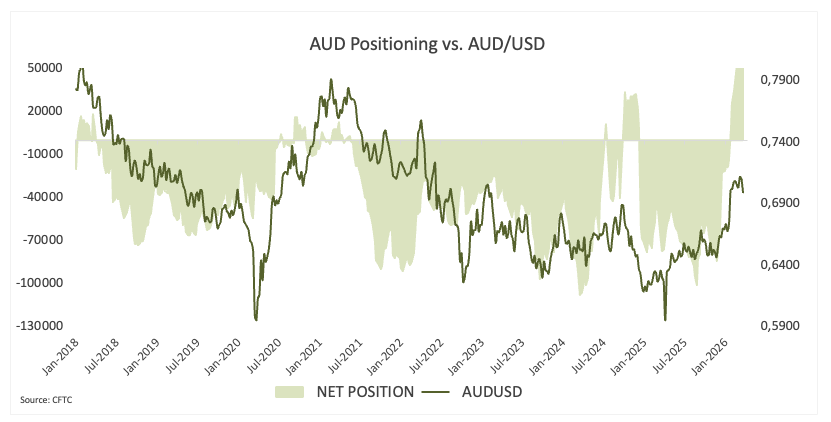
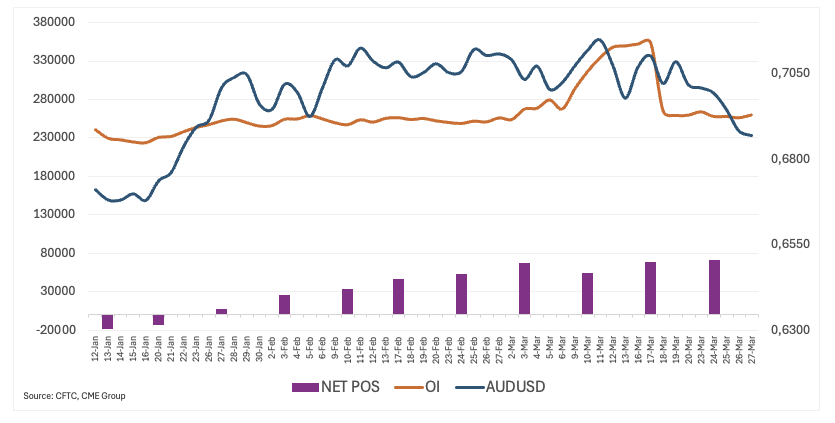
Positioning tells a slightly different story. The latest data from the Commodity Futures Trading Commission (CFTC) show net long positions continuing to build, rising to above 70K contracts in the week ending March 24.
What stands out, though, is the divergence with price. AUD/USD has drifted lower over the same period, slipping from above 0.7100 to just below the key 0.7000 threshold.
That disconnect matters. It suggests investors are leaning constructively on the Aussie from a medium-term perspective, likely anchored in the domestic backdrop and China stabilisation, even as near-term price action fails to confirm it.
At the same time, open interest has eased, hinting that the build-up in longs is not particularly aggressive and may lack strong conviction.
What it means
This setup is more fragile than it appears.
A long position held for too long, especially without any sign of price movement in your favour, can quickly turn sour. If the economy takes a turn for the worse, or if the US dollar keeps gaining strength, the chances of a squeeze increase.
FX summary
The Aussie retains some underlying support, yet the current positioning makes it more susceptible in the short run. Without more decisive price movement, long positions could become a source of pressure, rather than providing support, particularly in a more risk-averse market.
AUD/USD: What to Watch
Near term: price action in AUD will be swayed by the dynamics of the Greenback and overall market mood, particularly with the ongoing geopolitical issues.
Risks: a waning risk appetite, signs of economic weakness from China, or a change in the RBA’s position could swiftly turn the tide against the currency pair.
Technical corner
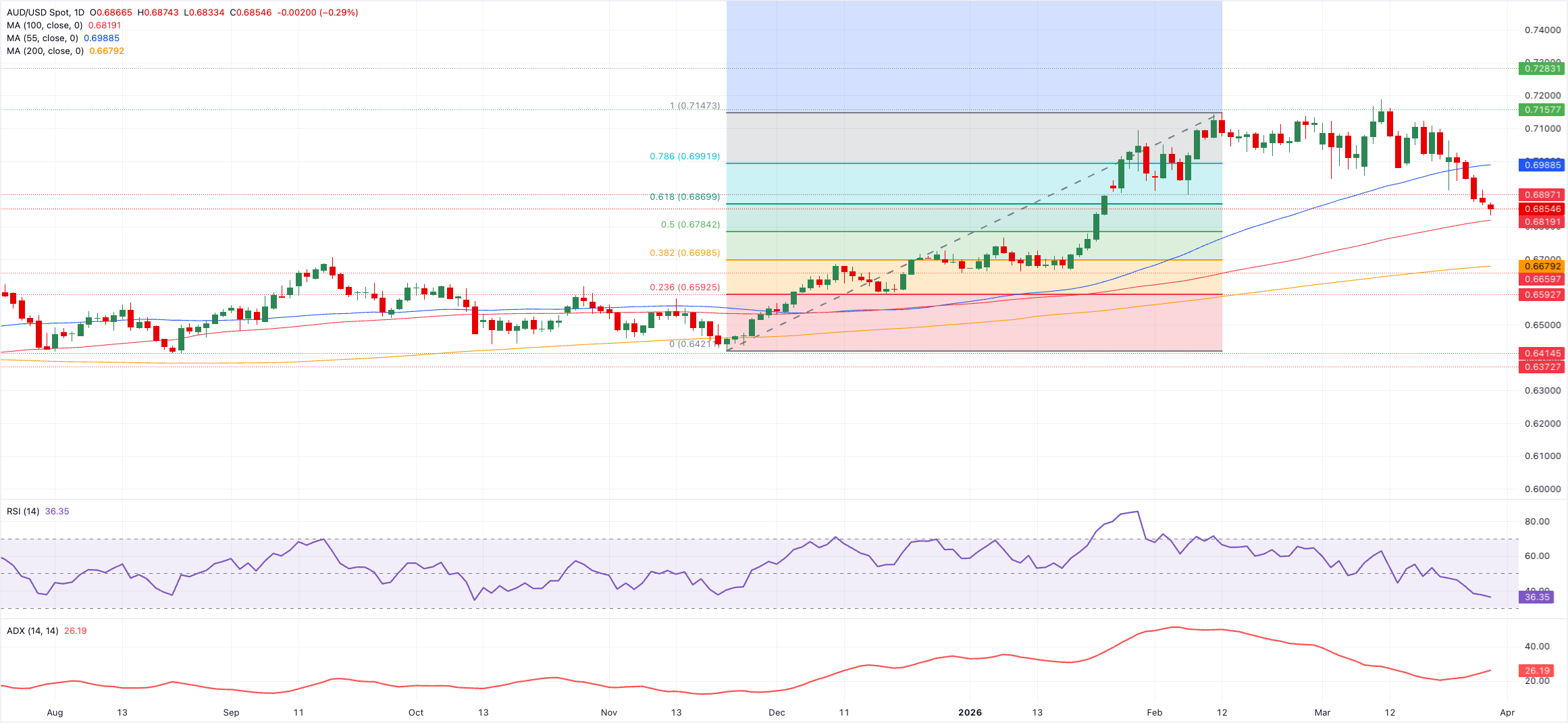
In the daily chart, AUD/USD trades at 0.6853. The near-term bias turns mildly bearish as spot extends its retreat from the 0.7150 area and slips below the 23.6% Fibonacci retracement at 0.6976 measured from the 0.6421 low to the 0.7147 high. Price now holds under the 55‑ and 100‑day Simple Moving Averages (SMAs), while remaining well above the rising 200‑day SMA around 0.6680, framing a corrective downswing within a broader uptrend. The Relative Strength Index (RSI) at 36 signals building bearish momentum, and the Average Directional Index (ADX) rising back toward the mid‑20s suggests this downside phase is gaining directional strength after the prior trend pause.
Immediate resistance stands at 0.6897, with stronger upside barriers at the 38.2% retracement at 0.6870 and the 0.6976 area, where the broken 23.6% retracement aligns with the clustered mid‑term SMAs. A daily close above 0.6976 would ease downside pressure and open the way back toward 0.7158, ahead of 0.7283. On the downside, initial support appears at the 0.6784 level, corresponding to the 50.0% retracement of the 0.6421–0.7147 advance, followed by horizontal support at 0.6660 near the rising 200‑day SMA. A break below 0.6660 would expose deeper support at 0.6593, with 0.6414 and 0.6373 coming into view if the corrective slide extends.
(The technical analysis of this story was written with the help of an AI tool.)
Bottom line: supported, but not straightforward
Australia’s fundamentals remain solid, and the RBA is not stepping back just yet.
But this is far from a one-way trade.
When risk sentiment holds, the AUD performs. When volatility picks up, the US Dollar tends to take control.
The bias remains supportive, but it comes with clear caveats.
US-China Trade War FAQs
Generally speaking, a trade war is an economic conflict between two or more countries due to extreme protectionism on one end. It implies the creation of trade barriers, such as tariffs, which result in counter-barriers, escalating import costs, and hence the cost of living.
An economic conflict between the United States (US) and China began early in 2018, when President Donald Trump set trade barriers on China, claiming unfair commercial practices and intellectual property theft from the Asian giant. China took retaliatory action, imposing tariffs on multiple US goods, such as automobiles and soybeans. Tensions escalated until the two countries signed the US-China Phase One trade deal in January 2020. The agreement required structural reforms and other changes to China’s economic and trade regime and pretended to restore stability and trust between the two nations. However, the Coronavirus pandemic took the focus out of the conflict. Yet, it is worth mentioning that President Joe Biden, who took office after Trump, kept tariffs in place and even added some additional levies.
The return of Donald Trump to the White House as the 47th US President has sparked a fresh wave of tensions between the two countries. During the 2024 election campaign, Trump pledged to impose 60% tariffs on China once he returned to office, which he did on January 20, 2025. With Trump back, the US-China trade war is meant to resume where it was left, with tit-for-tat policies affecting the global economic landscape amid disruptions in global supply chains, resulting in a reduction in spending, particularly investment, and directly feeding into the Consumer Price Index inflation.
Author

Pablo Piovano
FXStreet
Born and bred in Argentina, Pablo has been carrying on with his passion for FX markets and trading since his first college years.