Australian Dollar Price Forecast: Extra gains still on the cards
- AUD/USD builds on Friday’s advance and revisits 0.7260.
- The US Dollar trades with marginal gains amid geopolitical jitters.
- Westpac publishes the Consumer Confidence gauge on Tuesday.

The Aussie Dollar continues its march north almost unabated, lifting AUD/USD to the area of multi-year tops. For now, the pair’s positive outlook remains unchanged, propped up by elevated inflation in Oz and the RBA’s hawkish stance.
The Australian Dollar (AUD) extends Friday’s rebound, prompting AUD/USD to revisit the 0.7250-0.7260 band while opening the door to a probable test of yearly peaks sooner rather than later.
The pair’s positive performance comes pari passu with an improvement in the sentiment surrounding the risk complex, as investors remain hopeful of a US-Iran deal that ends the current crisis in the Middle East.
In the meantime, the extra uptick in spot comes on the back of the lack of clear direction in the US Dollar (USD), as scepticism over the White House's intentions regarding the Strait of Hormuz and the conflict in general seems to weigh on market participants.
Australia remains resilient, but signs of strain are emerging
The Australian economy does look healthy and stable altogether and, honestly, is in much better shape than many of its G10 peers.
This performance appears underpinned by a solid domestic demand and pretty decent figures when it comes to economic growth. The spectre of sticky inflation seems to justify the cautious and data-dependent stance from the Reserve Bank of Australia (RBA), particularly following the latest meeting, where it raised rates to 4.35%, broadly in line with market expectations.
Supporting the above, the preliminary data from the Purchasing Managers’ Index (PMI) showed Manufacturing at 51.0 and Services at 50.3, both recovering and back to expansion territory in April. However, this bounce feels more like a slow grind higher than a meaningful pickup in activity… for now.
In the opposite direction, the latest trade balance figures showed an unexpected deficit of A$1.841 billion in March, markedly lower than the A$5.026 billion recorded in February. The Gross Domestic Product (GDP), meanwhile, showed the economy expanded by 0.8% QoQ and 2.6% YoY in late 2025.
On the not-so-bright side, the labour market seems to be somewhat cooling: the Unemployment Rate remained at 4.3% in March, and the Employment Change slowed sharply to 17.9K from close to 50K recorded in the previous month.
Back to the thorny inflation issue: the latest Consumer Price Index (CPI) came in at 4.1% YoY, with both the Trimmed Mean and Weighted Median running at 3.5% YoY. Following these prints, any real sense of disinflation now appears dim to keep the optimism in place.
For the RBA, that means the job is far from done, as policymakers continue to signal that inflation may only return to target around mid-2028, keeping the focus firmly on patience rather than any imminent pivot.
China holds steady, but momentum is fading
China now looks more like a stabilising force than the tailwind it usually was for the Australian economy.
Let’s see some numbers: the economy expanded by 5.0% YoY in Q1, Retail Sales gained 2.43% since the beginning of the year and 1.7% over the last twelve months.
Of note is the sharp reduction of the trade surplus, which narrowed to just over $51 billion in March from nearly $214 billion previously, all in response to weaker demand dynamics.
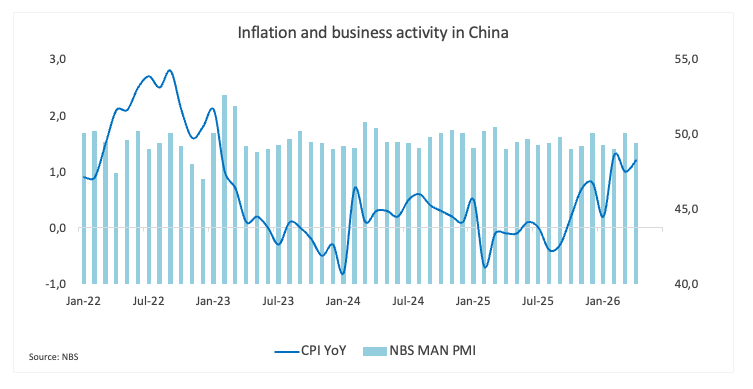
However, business activity seems to be regaining traction after the National Bureau of Statistics (NBS) reported Manufacturing PMI at 50.3 in April, while Services slipped into contraction territory at 49.4. At the same time, private gauges such as RatingDog still point to expansion, with Manufacturing climbing to 52.2 and Services up to 52.6.
The disinflationary pressure in China has been losing steam, as the CPI rose 1.2% YoY in April, while Producer Prices jumped by 2.8% YoY, moving further away from deflation.
And what about the People’s Bank of China (PBoC)? As expected, it kept the Loan Prime Rates (LPR) unchanged at 3.00% for the one-year tenor and 3.50% for the five-year tenor last month.
To sum up, China is no longer pushing growth higher, but it is not dragging it down aggressively either. It is simply keeping things steady.
The RBA is still fighting inflation, even as growth slows
The RBA matched consensus earlier in the month, lifting its Official Cash Rate (OCR) by 25 basis points to 4.35%. The statement read like a central bank dealing with a more complicated world: the outlook has clearly worsened, with growth marked down and inflation pushed higher, leaving policymakers facing a more uncomfortable trade-off.
Inflation is now expected to stay higher for longer, with the CPI only returning to target around 2027–2028. At the same time, the GDP is set to run below trend, and the jobless rate is seen gradually drifting higher.
A big part of that shift comes from the oil shock linked to the Middle East conflict. The bank sees it as a hit to growth but also a fresh source of inflation pressure, exactly the kind of mix central banks dislike. There are even references to possible energy shortages if the situation drags on.
For now, though, there is little sign that demand has rolled over in a meaningful way, and underlying inflation pressures remain firm, with businesses increasingly expected to pass on higher costs.
In her press conference, Governor Michele Bullock sounded a bit more measured. The key message is that rates are now in restrictive territory, which gives the RBA some breathing space.
In her words, the bank can now afford to “sit and see”, taking time to assess how the shock plays out rather than rushing into further moves. That in itself feels like a shift in tone.
Still, the door to more tightening is not closed. Bullock made it clear that if higher costs start feeding into inflation expectations, the RBA would have to respond, potentially with higher rates.
Bullock also framed the situation quite bluntly, describing the oil shock as something that reduces real incomes and “makes us poorer”, while warning that even a quick resolution would not prevent higher costs from lingering.
All in all
The central bank is still focused on inflation, but it sounds less eager to keep tightening aggressively. Rates are now seen as restrictive enough to pause if needed, although risks around energy and inflation expectations mean the job is not fully done yet.
So far, markets now see the RBA keeping its interest rate unchanged at its June 16 gathering, while around 37 basis points of extra tightening is pencilled in by year-end.
AUD/USD rallies, but the market still wants confirmation
Base case
The pair has managed to break above the key 0.7200 level, but it still feels heavily dependent on the broader backdrop. Without a sustained improvement in risk sentiment or continued US Dollar weakness, the move could start to lose traction.
Bull case
Further conviction is needed. If risk appetite picks up serious pace, spot could extend the uptrend and thus retarget the minor 0.7300 barrier, all prior to the 2022 ceiling at 0.7593. Speculative positioning is expected to have its say in this scenario.
Bear case
Some loss of momentum should not be ruled out in the current volatile context. If sentiment deteriorates, the Greenback picks up pace, or Chinese data disappoint, spot could slip back below the initial contention zone at 0.7100, opening the door to a deeper move at the same time.
The rally is there, although markets are still not fully convinced.
Speculator continue to support the AUD
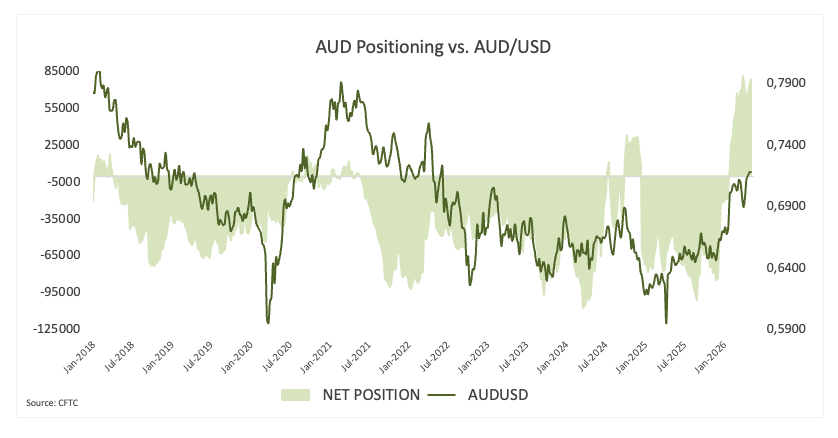
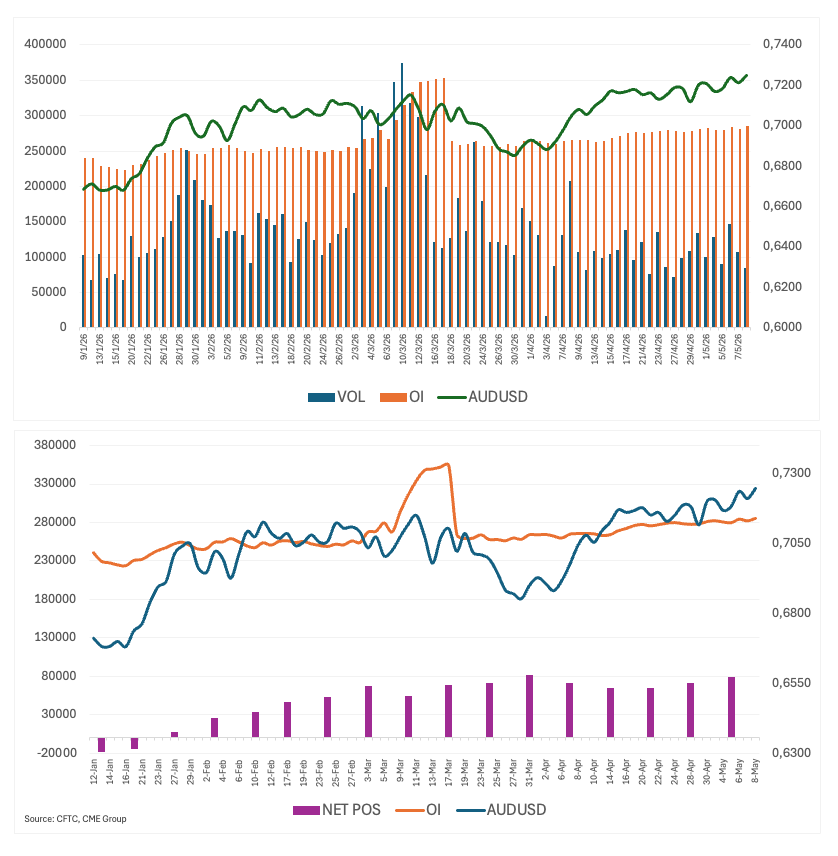
According to the latest Commodity Futures Trading Commission (CFTC) data, speculative net longs in the Australian Dollar increased to five-week highs of nearly 78.7K contracts for the week ending May 5.
The move also came in tandem with the third consecutive uptick in open interest, this time hitting around 279.5K contracts.
It is worth recalling that speculators’ sentiment toward the Aussie shifted in late January following several years of being net short.
This shift in mood echoes in the pair’s price action, which was trading in the 0.6900 region in late January and has approached the 0.7300 region at some point last week.
What actually matters for the Aussie right now
In the near term, it is still all about the US Dollar, global risk sentiment, and geopolitics. Those remain the key drivers of price action. Next on tap in Oz will be the Consumer Confidence gauge tracked by Westpac, while the release of US inflation figures measured by the CPI should also gather attention.
Key risks include a sharper slowdown in China, a more aggressive Federal Reserve (Fed), a change of heart from investors when it comes to risk sentiment, or any shift in the RBA’s stance. Any of these could quickly destabilise the Australian currency in the short-term horizon.
Technical Analysis
In the daily chart, AUD/USD trades at 0.7250. The pair retains a bullish near-term bias as spot holds comfortably above the 55-day and 100-day simple moving averages (SMAs) at roughly 0.7078 and 0.6983, with the 200-day SMA down at 0.6766 reinforcing a broader constructive structure. A firmer Relative Strength Index (RSI) around 63 points to sustained upward momentum, although the subdued Average Directional Index (ADX) near 15 hints that the current advance lacks strong trend conviction.
On the topside, immediate resistance is aligned with the horizontal barrier at 0.7283, a clear hurdle that, if broken, could open the way toward the next key cap near 0.7661. On the downside, initial support is seen at 0.7188, ahead of the clustered dynamic floors offered by the 55-day SMA at 0.7078 and the 100-day SMA at 0.6983; further weakness would bring focus to 0.6833 and the longer-term 200-day SMA at 0.6766, with deeper levels at 0.6660 and 0.6593 guarding the broader bullish structure.
(The technical analysis of this story was written with the help of an AI tool.)
Bottom line: the tone is improving, but doubts remain
The broader backdrop for the Australian Dollar remains supportive, and the RBA’s stance should continue to provide a degree of support on dips.
But this is still a currency that trades heavily on sentiment. When confidence is strong, the Aussie performs well. When uncertainty creeps in, the US Dollar tends to take over.
So while the medium-term story still leans constructive, the near-term outlook feels less certain. The move higher is there, but conviction is not quite there yet.
US-China Trade War FAQs
Generally speaking, a trade war is an economic conflict between two or more countries due to extreme protectionism on one end. It implies the creation of trade barriers, such as tariffs, which result in counter-barriers, escalating import costs, and hence the cost of living.
An economic conflict between the United States (US) and China began early in 2018, when President Donald Trump set trade barriers on China, claiming unfair commercial practices and intellectual property theft from the Asian giant. China took retaliatory action, imposing tariffs on multiple US goods, such as automobiles and soybeans. Tensions escalated until the two countries signed the US-China Phase One trade deal in January 2020. The agreement required structural reforms and other changes to China’s economic and trade regime and pretended to restore stability and trust between the two nations. However, the Coronavirus pandemic took the focus out of the conflict. Yet, it is worth mentioning that President Joe Biden, who took office after Trump, kept tariffs in place and even added some additional levies.
The return of Donald Trump to the White House as the 47th US President has sparked a fresh wave of tensions between the two countries. During the 2024 election campaign, Trump pledged to impose 60% tariffs on China once he returned to office, which he did on January 20, 2025. With Trump back, the US-China trade war is meant to resume where it was left, with tit-for-tat policies affecting the global economic landscape amid disruptions in global supply chains, resulting in a reduction in spending, particularly investment, and directly feeding into the Consumer Price Index inflation.
Author

Pablo Piovano
FXStreet
Born and bred in Argentina, Pablo has been carrying on with his passion for FX markets and trading since his first college years.
















