Why EUR/USD could be a buy near the bottom of its 52-week range

EUR/USD is starting to offer the kind of setup traders often look for: a beaten-down price, a nearby support zone, and enough upside room to make the risk/reward worth a closer look.
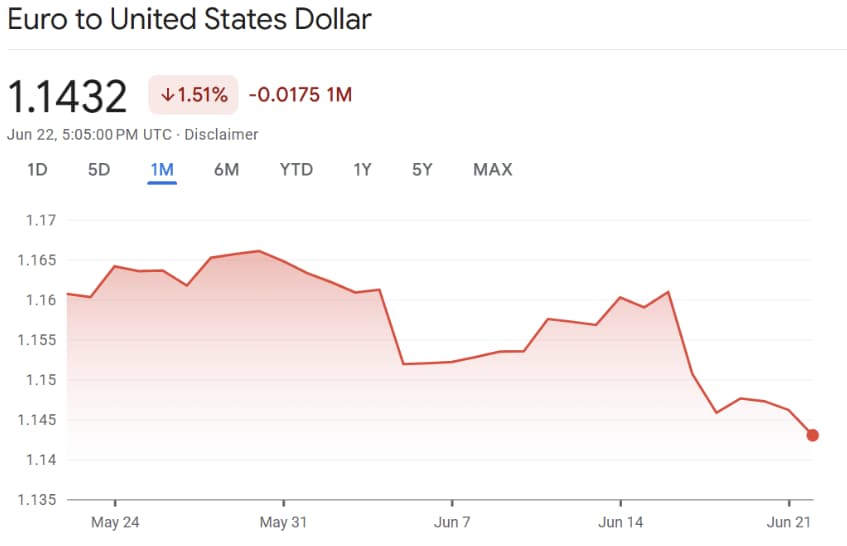
After slipping below 1.1500 on June 17, the pair is trading around 1.1430—just above its 52-week low near 1.1395. That is what makes the setup interesting. EUR/USD has already absorbed a stronger dollar narrative, and the pair is now close enough to support that the downside is easier to define.
That does not make the trade risk-free. The 1.1400 area is the line that needs to hold. A decisive break below that zone would not simply test support; it would risk pushing EUR/USD to a fresh 52-week low. But at present, the pullback still looks more like a potential reset than a confirmed breakdown.
EUR/USD is starting to offer the kind of setup traders often look for: a beaten-down price, a nearby support zone, and enough upside room to make the risk/reward worth a closer look.
After slipping below 1.1500 on June 17, the pair is trading around 1.1430—just above its 52-week low near 1.1395. That is what makes the setup interesting. EUR/USD has already absorbed a stronger dollar narrative, and the pair is now close enough to support that the downside is easier to define.
That does not make the trade risk-free. The 1.1400 area is the line that needs to hold. A decisive break below that zone would not simply test support; it would risk pushing EUR/USD to a fresh 52-week low. But at present, the pullback still looks more like a potential reset than a confirmed breakdown.
Sigmanomics forecast data adds support to that view. All 21 component models currently point higher, giving the pair a bullish tilt. That does not guarantee a rebound, but it does suggest the recent pullback may be losing momentum near an important support area.
Why the Euro’s policy backdrop looks firmer than the chart
EUR/USD has lost momentum, but the pullback may also be giving buyers a more attractive entry point.
The pair slipped back below 1.1500 on June 17, shifting the trade from a breakout chase into a support test. That weakness reflects a stronger dollar in the short run, but it does not necessarily break the bullish setup. If buyers can defend the lower end of the range, the recent drop may start to look less like a deeper breakdown and more like a reset after a failed breakout.
The chart still looks fragile, but the policy backdrop gives euro bulls more to work with than the latest price action suggests.
The dollar still offers the higher absolute yield, which keeps the carry advantage on the U.S. side. But EUR/USD had already been gaining ground despite that disadvantage, a sign that traders were looking beyond simple yield pickup. Instead, the market appeared more focused on marginal policy shifts, improving euro momentum, and whether the dollar’s strongest arguments had already been reflected in the price.
That is what makes the current support test important. The European Central Bank has already raised rates, giving the euro some support at the front end of the curve. The Federal Reserve, meanwhile, has sounded more inflation-sensitive, but it still held rates steady. If markets have already adjusted to a restrictive Fed, another sustained move lower in EUR/USD may require more than a higher-for-longer message. It may require a fresh dollar catalyst.
That catalyst could come from hotter inflation, higher oil prices, or renewed geopolitical stress. Without it, the dollar’s edge may remain intact, but less forceful. In currency markets, that can be enough to change the tone. EUR/USD does not need a perfect euro story to rebound if the selling pressure starts to fade.
Energy prices remain part of the equation. Higher oil is usually a tougher backdrop for Europe because the eurozone is more exposed to imported energy costs. But if the Iran-related risk premium fades, or if oil stays contained, one of the recent headwinds for the euro becomes less threatening. That would make it harder for sellers to keep pressing EUR/USD lower unless U.S. yields continue climbing.
Technically, EUR/USD is now testing an important area. The pair is trading around 1.1430, just above the more important 1.1400-1.1395 support zone near its 52-week low. If buyers can defend this area, the latest pullback still has a chance to look like a reset rather than a breakdown.
That also makes the risk line clearer. A decisive break below 1.1395 would mark a fresh 52-week low and weaken the bullish case. But as long as EUR/USD holds above that zone, bulls still have a defined setup to work with.
The upside path starts with a move back above 1.15. That would suggest buyers are returning after the support test. From there, 1.16 becomes the bigger level because it marks the failed breakout area. A recovery toward that zone would not require a major euro repricing. It would simply suggest the dollar’s latest push has gone far enough for now.
Sigmanomics strengthens the EUR/USD rebound case
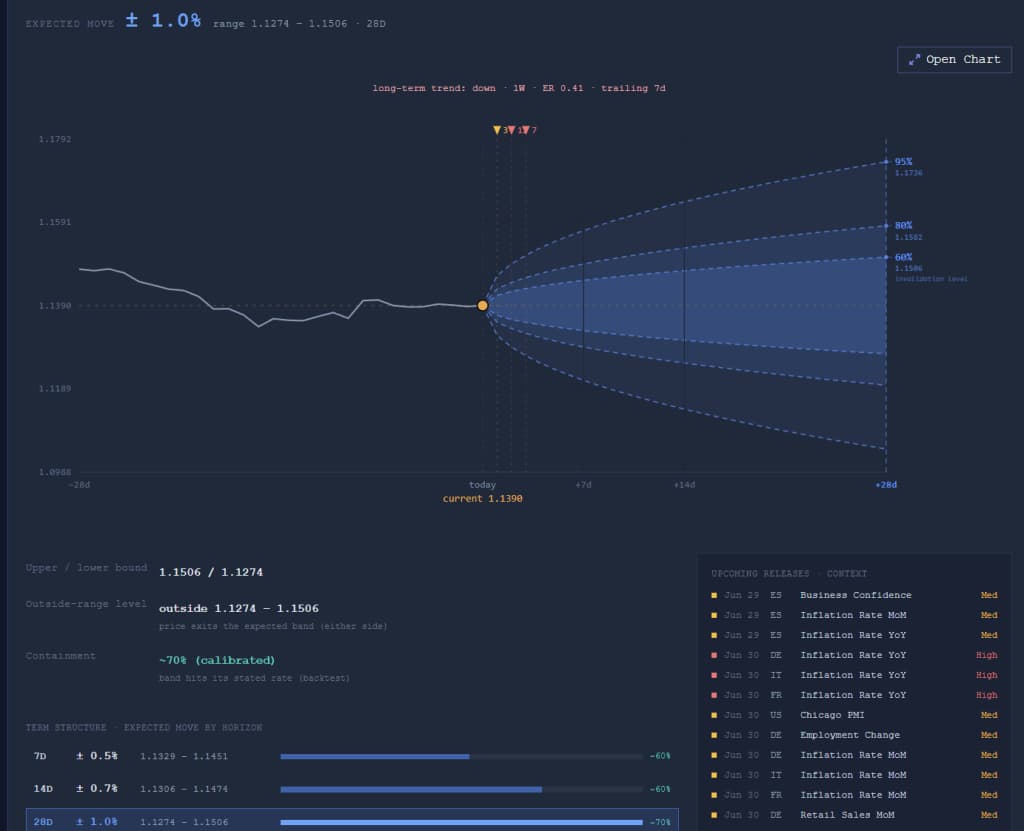
Sigmanomics forecast data also supports the bullish case. The 28-day signal shows a modest upside tilt, and all 21 component models currently lean bullish. That does not make a rebound automatic, but it does give the euro’s support zone more credibility and suggests the recent slide may be losing momentum.
That range lines up well with the chart. The upper boundary sits just below the failed-breakout zone, giving bulls a clear recovery target. The lower boundary sits below the 1.1400-1.1395 support area, which means a break under that zone would be a serious warning sign rather than just normal noise.
For traders, the model is best viewed as a map, not a prediction. It leans bullish, but it still defines the trade inside a tight range. The upside path points toward 1.1540 to 1.1600, while a decisive break below 1.1400 would weaken the bullish case and suggest euro sellers are still in control.
What long and short mean in EUR/USD
A bullish EUR/USD setup is ultimately a relative trade. It does not require the euro to have a flawless macro backdrop. It only requires the euro to hold up better than the dollar, or for the dollar’s recent strength to start fading.
That is why the quote structure matters. In EUR/USD, the euro is the base currency and the U.S. dollar is the quote currency. The exchange rate shows how many dollars are needed to buy one euro. If EUR/USD is trading at 1.1430, that means €1 costs $1.1430.
Going long EUR/USD means buying euros and selling dollars. The trade benefits if the euro strengthens against the dollar, or if the dollar weakens against the euro. In practical terms, a higher EUR/USD price reflects euro strength, dollar weakness, or some combination of both.
Going short EUR/USD means the opposite: selling euros and buying dollars. That trade benefits if EUR/USD falls, which means the dollar is gaining relative to the euro.
For this setup, the bullish view is not that everything looks perfect for Europe. It is that EUR/USD may be stretched near support, with downside easier to define and enough room for a rebound if the dollar story starts to cool.
The bottom line for EUR/USD
The dollar has had plenty working in its favor: a more inflation-sensitive Fed, lingering safe-haven demand, uncertainty around the Iran ceasefire and doubts about whether inflation is fully under control. Even so, EUR/USD doesn’t appear to have broken decisively into an extended bearish phase.
That is what gives bulls something to work with. The pair has already absorbed a stronger dollar narrative and moved back toward support, where the risk-reward profile becomes more attractive. From here, the trade is less about chasing euro strength and more about whether sellers can find enough new fuel to force another leg lower.
The bullish case does not require a perfect euro story. It only requires the dollar story to stop improving. If inflation pressure cools, oil prices stay contained or geopolitical risk fades, traders may have less reason to keep pressing the pair lower.
For now, the burden is shifting back to sellers. They have had the Fed, the safe-haven bid and the stronger dollar narrative on their side. If that still is not enough to produce a decisive breakdown, EUR/USD may be closer to a buyable reset than the chart first suggests.
Author

Sigmanomics
Sigmanomics
Sigmanomics is a financial intelligence platform that delivers expert insights, data-driven analysis, and real-time trading signals across global markets.