August’s US employment report allows USD to maintain the initiative

USD remains strong after a hotter-than-expected employment report for August
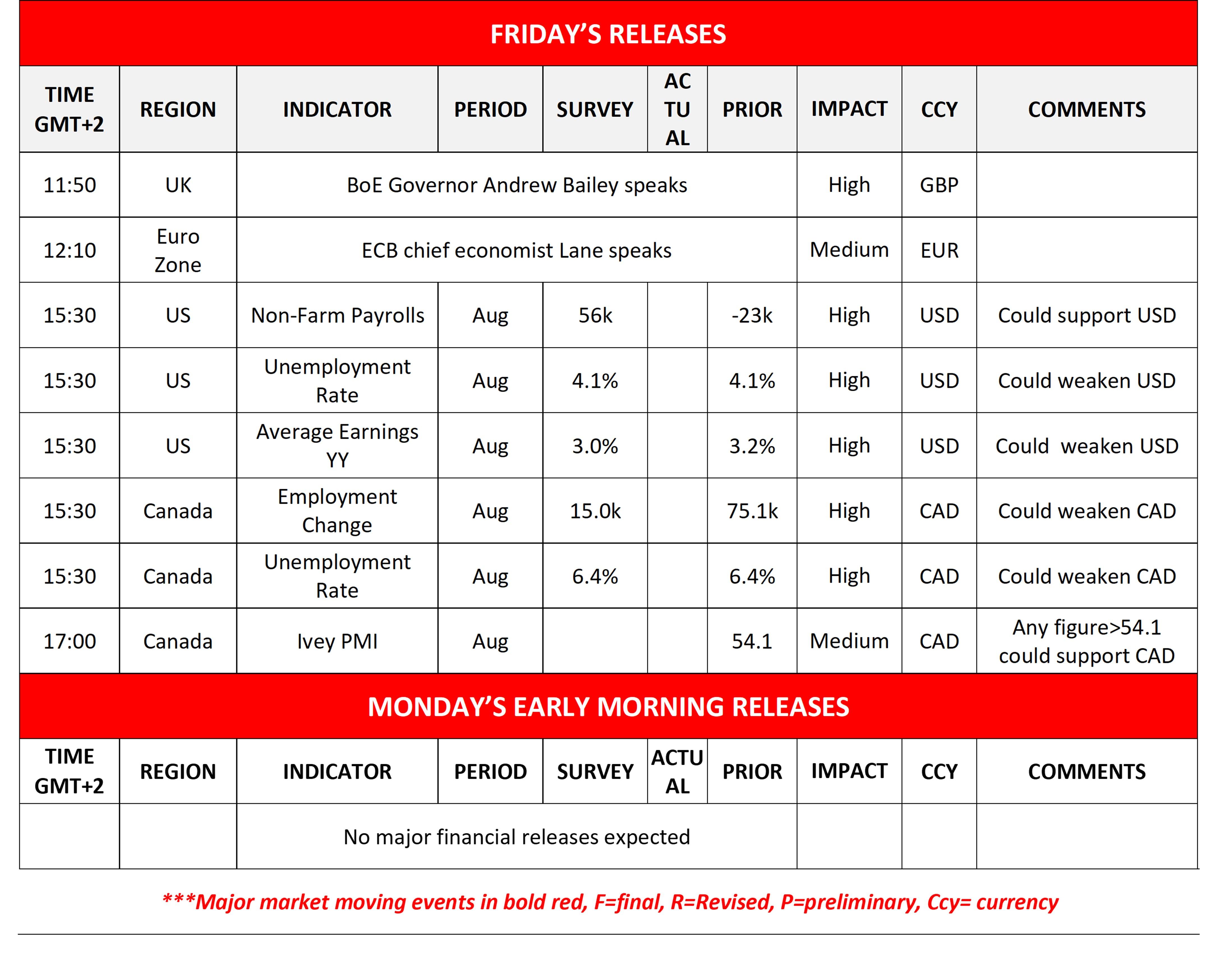
The USD got a boost on Friday as the US employment data for August were better than expected. The NFP figure rose beyond even most optimistic expectations reaching 162k, while the unemployment rate remained unchanged at 4.1%. The release tends to ease any market worries for the US employment market and practically paves the way for the Fed to proceed with a rate hike in it’s next meeting. Please note that the market currently prices in by 57% the possibility of a rate hike in the September meeting, according to FFF. We highlight the release of the US CPI rates for August on Friday as the next big test for the USD.
Busy EUR traders
EUR traders are expected to be quite busy this week, as we make a start today with the release of Euro Zone’s revised GDP rates for Q2. Yet the main focal point, is expected to be ECB’s interest rate decision on Thursday, and a rate hike is widely expected at the current stage. Should the bank hike rates as expected, market focus is to be placed on ECB’s forward guidance. Should the bank signal that the rate increase is the end of the hiking cycle, we may see the EUR slipping. We also note the wide election win of the AfD at regional German elections as a source of possible instability that may weigh on the EUR on a fundamental level.
Other highlights for today
Today we get Germany’s industrial output for July, Sweden’s preliminary CPI rates for August and Euro Zone’s Sentix index for September. In tomorrow’s Asian session, we get Japan’s overtime pay for July, Current account for July and revised GDP rates for Q2, China’s trade data for August, as well as Australia’s Business conditions and confidence for August and consumer confidence for September, while RBA Ass. Governor Hunter speaks.
As for the rest of the week
On Wednesday we get China’s inflation metrics for August and on Thursday we get Germanys’ final HICP rate for August, Sweden’s GDP rates for July, Norway’s CPI rates for August, the US weekly initial jobless claims figure, the US PP rates for August, while we highlight also ECB’s interest rate decision, and from Türkiye CBT’s interest rate decision. On Friday we get Japan’s PPI rates for August, UK’s GDP and manufacturing output rates for July, we highlight the US CPI rates for August, and also note the release of the US UoM consumer sentiment for September.
Charts to keep an eye out
EUR/USD remained relatively stable between the 1.1685 (R1) resistance line and the 1.1575 (S1) support level. We maintain a sideways motion bias for the pair as long as it remains within the corridor set by the R1 and the S1. The RSI indicator remains just above 50, yet nothing convincing about the pair’s bullish tendencies at the current stage. Should the bulls take over, we may see EUR/USD breaking the 1.1685 (R1) resistance line and start aiming for the 1.1825 (R2) level. Should the bears take control over EUR/USD, we may see the pair breaking the 1.1575 (S1) support line and start aiming for the 1.1470 (S2) support level.
XAU/USD slipped on Friday and during today’s Asian session, yet remained well between the 4550 (R1) resistance lien and the 4275 (S1) support level. The RSI indicator remains near 50, implying a rather indecisive market while the Bollinger bands narrowed, implying less volatility for gold’s price. The movement of both indicators tends to support our sideways motion bias at the current stage. For a bullish outlook to emerge, we require a clear break above the 4550 (R1) resistance line and gold’s price to start aiming for the 4890 (R2) resistance level. For a bearish outlook to emerge, gold’s price would have to break clearly the 4275 (S1) support line and start aiming for the 3960 (S2) support level.
EUR/USD daily chart
- Support: 1.1575 (S1), 1.1470 (S2), 1.1350 (S3).
- Resistance: 1.1685 (R1), 1.1825 (R2), 1.1925 (R3).
XAU/USD daily chart
- Support: 4275 (S1), 3960 (S2), 3600 (S3).
- Resistance: 4550 (R1), 4890 (R2), 5245 (R3).
Author

Peter Iosif, ACA, MBA
IronFX
Mr. Iosif joined IronFX in 2017 as part of the sales force. His high level of competence and expertise enabled him to climb up the company ladder quickly and move to the IronFX Strategy team as a Research Analyst. Mr.