AUD/USD Price Forecast: Traders await breakout through multi-week-old range
- AUD/USD rebounds from a weekly low amid the emergence of some intraday USD selling.
- The tariffs-block news boosts investors’ confidence and benefits the risk-sensitive Aussie.
- US-China trade tensions and the RBA’s dovish outlook caps the pair ahead of the US data.


The AUD/USD pair builds on its steady intraday ascent from the 0.6400 neighborhood, or a fresh weekly low touched earlier this Thursday, and for now, seems to have snapped a two-day winning streak. The intraday move higher is sponsored by the emergence of fresh selling around the US Dollar (USD), which failed to capitalize on early gains backed by hawkish FOMC Minutes released on Wednesday and the tariffs-block news.
In fact, Minutes of the Federal Reserve's (Fed) May 6-7 meeting revealed a consensus to maintain the wait-and-see stance amid the uncertainty over economic outlook and trade policies. Moreover, Fed officials highlighted the need to keep interest rates on hold for some time, until the net economic effects of the array of changes to government policies become clearer. This, along with Tuesday's mostly upbeat US macro data, which calmed recession fears, lifts the USD to a one-and-half-week top.
Meanwhile, a US federal court on Wednesday blocked US President Donald Trump's "Liberation Day" tariffs from going into effect. The Court of International Trade ruled that the president overstepped his authority by imposing across-the-board duties on imports from every country in the world. Investors cheered the court's order, triggering a sharp rise in the equity markets. This fails to assist the safe-haven buck to preserve intraday gains and benefits the perceived riskier Australian Dollar (AUD).
Apart from this, expectations that Trump’s dubbed “Big, Beautiful Bill” would worsen the US budget deficit at a faster pace than previously expected act as a headwind for the Greenback. It, however, remains to be seen if the AUD/USD pair is able to extend the positive momentum amid deep-rooted US-China trade tensions. In fact, the Trump administration is reportedly moving to restrict the sale of critical US technologies, including those used in the manufacturing of semiconductors, to China.
Further, persistent geopolitical risks stemming from the protracted Russia-Ukraine war and conflicts in the Middle East might keep a lid on the market optimism. This, along with the Reserve Bank of Australia's (RBA) dovish outlook, might contribute to capping the AUD/USD bulls. Traders now look forward to the US economic docket – featuring the release of the Prelim Q1 GDP print, the usual Weekly Initial Jobless Claims, and Pending Home Sales data – to grab short-term opportunities.
The market attention will then shift to Australia's monthly Retail Sales figures, due during the Asian session on Friday, and the US Personal Consumption Expenditure (PCE) Price Index. The latter is seen as the Fed's preferred inflation gauge and should provide some cues about the future rate-cut path. This, in turn, will play a key role in influencing the near-term USD price dynamics and providing some meaningful impetus to the AUD/USD pair ahead of the official Chinese PMIs on Saturday.
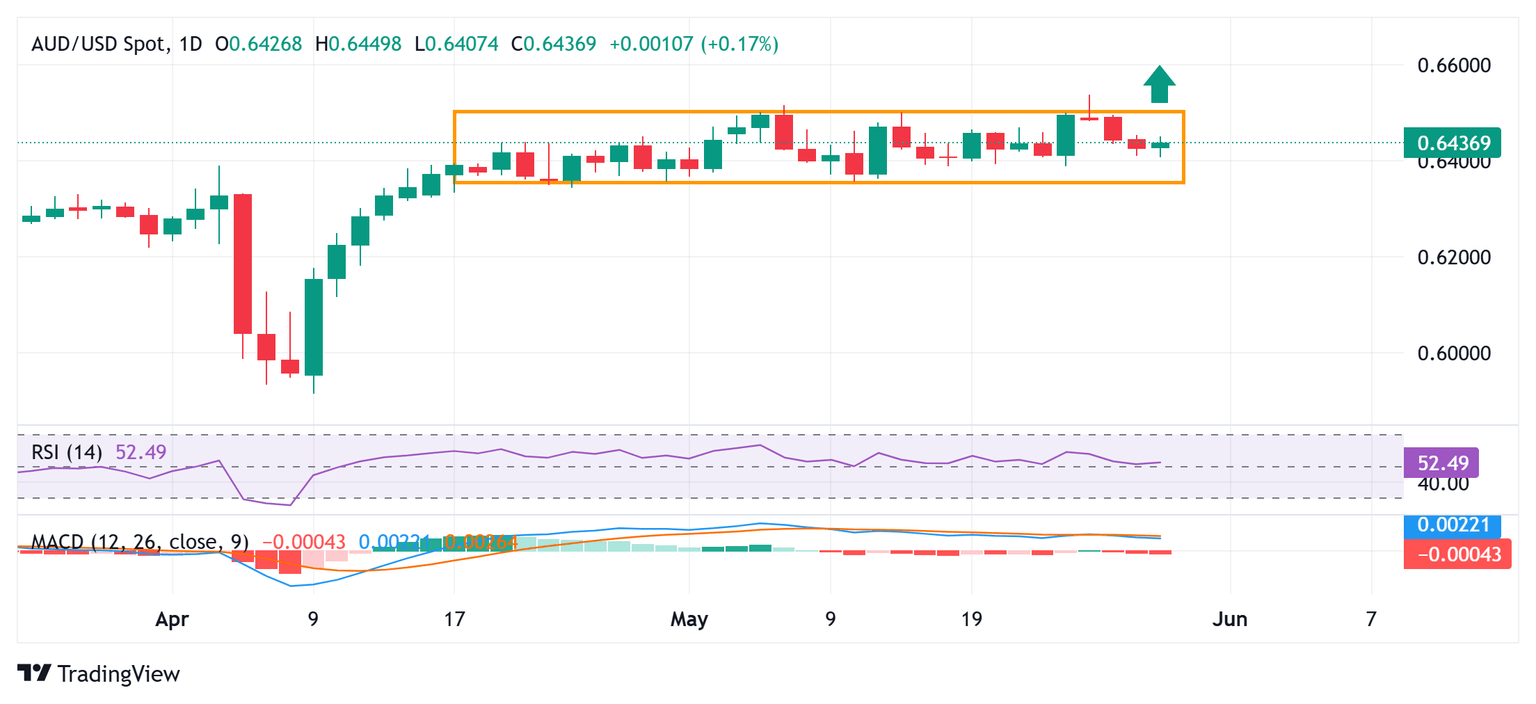
AUD/USD daily chart
Technical Outlook
The AUD/USD pair has been oscillating in a multi-week-old trading range, which points to indecision among traders over the next leg of a directional move. Meanwhile, slightly positive oscillators on the daily chart support prospects for an eventual breakout to the upside. However, it will still be prudent to wait for sustained strength and acceptance above the 0.6500 mark before positioning for any further gains. Spot prices might then surpass the year-to-date high, around the 0.6535-0.6540 zone touched earlier this month, and aim to reclaim the 0.6600 mark before climbing to testing the 0.6640 hurdle.
On the flip side, the 0.6400-0.6390 region might continue to protect the immediate downside ahead of the 0.6365-0.6360 area, or the lower boundary of the short-term trading range. A convincing break below the latter might shift the near-term bias in favor of bearish traders and pave the way for deeper losses. The AUD/USD pair might then accelerate the slide towards the 100-day Simple Moving Average (SMA), around the 0.6320 area, en route to the 0.6300 round figure, the 0.6245 intermediate support, and eventually drop to sub-0.6200 levels.
Premium
You have reached your limit of 3 free articles for this month.
Start your subscription and get access to all our original articles.
Author
Haresh Menghani
FXStreet
Haresh Menghani is a detail-oriented professional with 10+ years of extensive experience in analysing the global financial markets.