AUD/USD Price Forecast: Trade jitters favor bears; Trump’s reciprocal tariffs awaited
- AUD/USD struggles to capitalize on its modest intraday uptick amid rising trade tensions.
- The RBA’s inaction and the upbeat Chinese PMI provide a minor intraday lift to the Aussie.
- A modest USD uptick caps the upside ahead of Trump’s reciprocal tariffs announcement.


The AUD/USD pair seesaws between tepid gains/minor losses through the first half of the European session on Tuesday and remains within striking distance of a four-week low touched the previous day. The Australian Dollar (USD) attracted some intraday buyers after the Reserve Bank of Australia (RBA) announced its policy decision and left the Official Cash Rate (OCR) unchanged at 4.1% at the conclusion of the April monetary policy meeting. In the accompanying policy statement, the RBA sounded cautious about the outlook and reiterated that returning inflation sustainably to target remains the highest priority. Adding to this, RBA Governor Michele Bullock said that the board did not discuss a rate cut and has not made up its mind on a May move, underpinning the domestic currency.
Meanwhile, China’s Caixin Manufacturing PMI improved from 50.8 in the previous month to 51.2 in March compared to the 51.1 expected. This comes on top of better-than-expected China's official PMIs on Monday, which, along with a slight improvement in the global risk sentiment, provides a modest lift to the Aussie. However, persistent global trade uncertainties cap the AUD/USD pair. US President Donald Trump last week unveiled a 25% tariff on imported cars and will announce reciprocal tariffs later today, at 19:00 GMT. Moreover, Trump said on Sunday that reciprocal tariffs would essentially include all nations, dashing hopes that the levies would be limited to a smaller group of countries with the biggest trade imbalances. This, in turn, stokes worries about a widening global trade war and acts as a headwind for the resources-linked Australian Dollar (AUD).
The US Dollar (USD), on the other hand, struggles to gain any meaningful traction amid the growing acceptance that the Federal Reserve (Fed) will resume its rate-cutting cycle amid worries about a tariff-driven US economic slowdown. This, along with the global flight to safety, keeps the US Treasury bond yields depressed and the USD bulls on the defensive. Apart from this, hopes for more stimulus measures from China should help limit the downside for the AUD/USD pair. Traders now look forward to the US economic docket – featuring the release of JOLTS Job Openings data and ISM Manufacturing PMI. The focus, however, will remain glued to Trump's trade policies, which will continue to influence the broader risk sentiment and drive the USD demand. Nevertheless, the aforementioned mixed fundamental backdrop warrants caution before placing fresh directional bets.
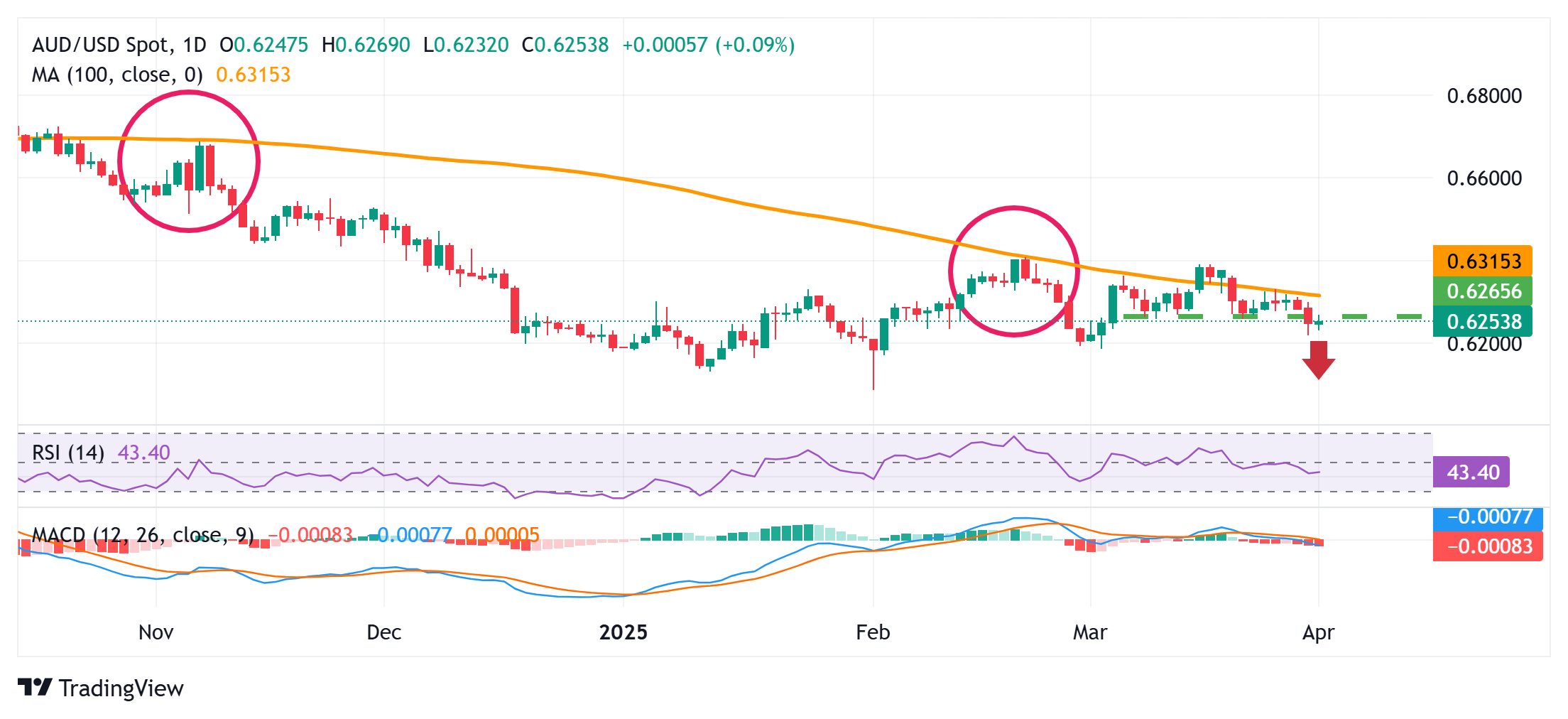
AUD/USD daily chart
Technical Outlook
From a technical perspective, the recent failure to find acceptance above the 100-day Simple Moving Average (SMA) and the overnight breakdown below the 0.6260-0.6255 horizontal support was seen as a key trigger for bearish traders. Moreover, oscillators on the daily chart have again started gaining negative traction and suggest that the path of least resistance for the AUD/USD pair is to the downside. Hence, any subsequent move up beyond the aforementioned support breakpoint now turned resistance, could be seen as a selling opportunity and remain capped near the 0.6300 mark. This is followed by the 0.6325-0.6330 supply zone, which if cleared should lift spot prices to the year-to-date peak – levels just above the 0.6400 mark touched in February.
On the flip side, the overnight swing low, around the 0.6220-0.6215 region, could offer some support to the AUD/USD pair ahead of the 0.6200 mark. A convincing break below the latter would reaffirm the negative bias and drag spot prices to the 0.6135 intermediate support en route to the 0.6090-0.6085 region, or a multi-year low touched in February. The downward trajectory could extend further and eventually drag the currency pair to the 0.6000 psychological mark.
Premium
You have reached your limit of 3 free articles for this month.
Start your subscription and get access to all our original articles.
Author
Haresh Menghani
FXStreet
Haresh Menghani is a detail-oriented professional with 10+ years of extensive experience in analysing the global financial markets.