AUD/USD Price Forecast: Next key resistance emerges near 0.6700
- AUD/USD added to Friday’s uptick, clinched new yearly peaks near 0.6540.
- The US Dollar traded with modest losses following Trump’s U-turn on EU tariffs.
- Next on tap in Oz will be the RBA’s Monthly CPI Indicator.


The bid stance continued around the Australian Dollar (AUD) on Monday, encouraging AUD/USD to break above the key 0.6500 hurdle and hit new YTD peaks. Despite the pair's departure from its key 200-day SMA near 0.6450, the validity of this breakout remains uncertain.
Spot accelerated its upside momentum following the selling interest in the US Dollar (USD) after President Trump pushed back the deadline for tariffs on EU exports.
Different central banks' trajectories and AUD/USD dynamics
The defining narrative for the AUD/USD is also developing because of a growing policy difference between the Federal Reserve (Fed) and the Reserve Bank of Australia (RBA).
The Fed kept rates the same at its May meeting; Chair Jerome Powell sounded wary and adopted a data-dependent stance. Rising risk attitude and worse US inflation numbers in April have driven markets to price in a probable rate cut as early as September.
By comparison, the RBA dropped its official cash rate by 25 basis points to 3.85% on May 20. Predicting the OCR to be at 3.2% by 2027, the accompanying Monetary Policy Report (MPR) alluded to further easing. Policymakers stressed the ongoing uncertainty around local demand and global supply chains, even though they acknowledged that monetary policies are now "somewhat less restricted."
With a drop mean expected to conclude at 2.6%, the RBA also lowered its inflation projection and trimmed its GDP growth prognosis for 2025 to 2.1%.
Support from China is declining due to structural issues
Mixed results from China last week have given the Australian currency some encouragement. Although industrial output exceeded expectations, lower numbers in retail sales and fixed asset investment indicated a possible Q1 slowing down. Still, the larger path is on target for about a 5% increase in Q2.
Underlying structural problems continue to occur, though. Major drawbacks, however, include persistent volatility in China's housing market and concerns about US tariffs. In keeping with the dovish tone, on May 20 the People's Bank of China (PBoC) lowered both its 1-year and 5-year Loan Prime Rates by 10 basis points to 3.00% and 3.50%, respectively.
AUD's bearish attitude gathers pace
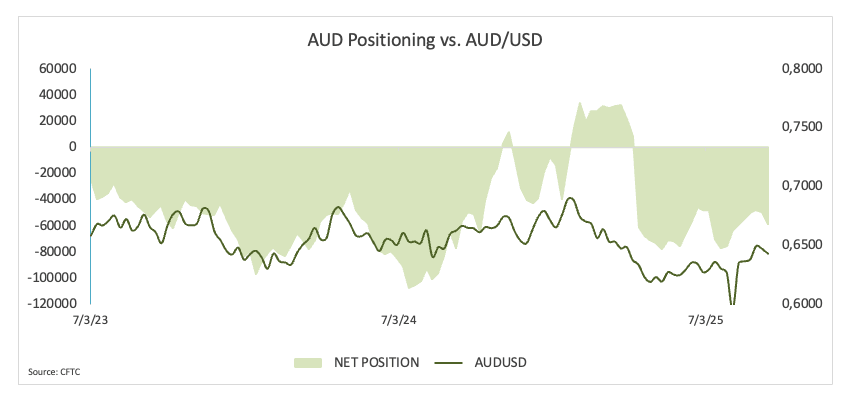
On May 20, CFTC data pointed to a bearish AUD posture regaining pace. While a decline in open interest suggests a maybe less negative view among speculators, net short holdings increased to four-week highs of just over 59K contracts.
Technical view: Bulls eye a breakthrough; direction still unclear
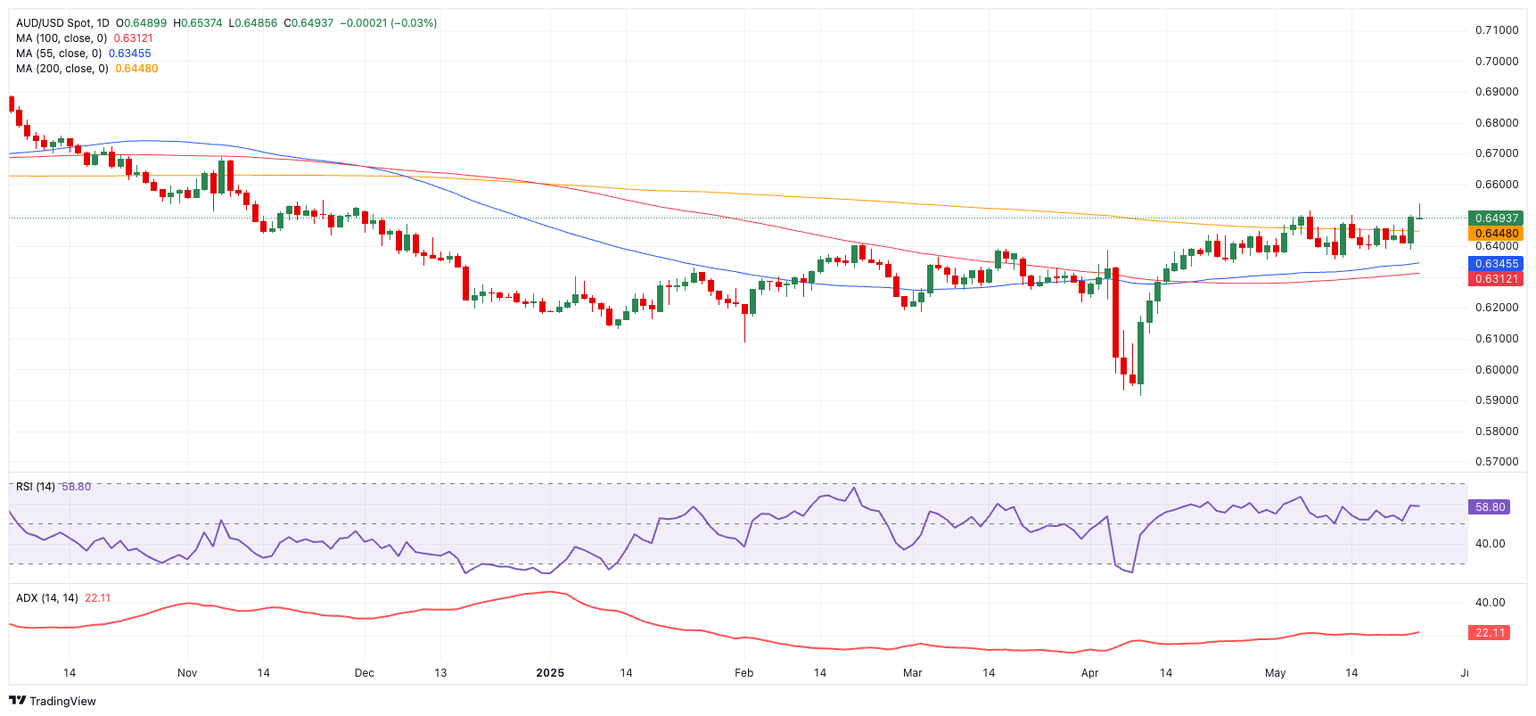
To rebuild a more sustainable positive momentum, AUD/USD needs a clean break above the 200-day SMA at 0.6451.
Next on the upside sits the 2025 peak at 0.6537 (May 26), ahead of the November 2024 high at 0.6687 (November 7), and the 2024 top at 0.6942 (September 30).
On the downside, quick support falls at the May low of 0.6356 (May 12), seconded by the transitory 55-day and 100-day SMAs at 0.6343 and 0.6310, respectively. Deeper losses might open the path towards the 2025 bottom at 0.5913 (April 9) and potentially the pandemic trough from March 2020 at 0.5506 (March 19).
With the Relative Strength Index (RSI) almost at 59 and the Average Directional Index (ADX) over 23—pointing to a relatively strong uptrend—momentum indicators tilt slightly positive.
AUD/USD daily chart
Premium
You have reached your limit of 3 free articles for this month.
Start your subscription and get access to all our original articles.
Author
Pablo Piovano
FXStreet
Born and bred in Argentina, Pablo has been carrying on with his passion for FX markets and trading since his first college years.