AUD/USD Price Forecast: Defends 200-day SMA amid fresh USD selling, RBA’s hawkish tilt
- AUD/USD stages an intraday recovery from a nearly two-week low touched on Tuesday.
- Economic concerns weigh on the USD and support the pair amid the RBA’s hawkish tilt.
- The risk-off mood might cap the Aussie ahead of the delayed US NFP report on Thursday.

The AUD/USD pair finds some support ahead of the 200-day Simple Moving Average (SMA) during the European session and recovers modest intraday losses to a nearly two-week low, touched earlier this Tuesday. Investors remain concerned about the weakening economic momentum on the back of the longest-ever US government shutdown, which fails to assist the US Dollar (USD) to capitalize on the previous day's positive move. This, along with the Reserve Bank of Australia's (RBA) hawkish tilt, turns out to be a key factor acting as a tailwind for the currency pair.
In fact, Minutes from the November RBA meeting showed that policymakers were growing increasingly cautious over future interest rate cuts amid sticky inflation and signs of resilience in the labor market. The central bank further signalled that it would only entertain cutting interest rates if there was a material deterioration in the labour market. This reflects a cautious approach given the lack of clarity around the effect of monetary policy settings on the economy, dampening chances of further rate cuts. This helps offset the risk-off mood and benefits the risk-sensitive Aussie.
Meanwhile, the return of key US macro data would provide clues on the health of the world's largest economy amid signs of a softening labor market. This holds back the USD bulls from placing fresh bets and helps limit the downside for the AUD/USD pair. Traders also seem reluctant and opt to wait for more cues about the Fed's rate-cut path. Hence, the focus will remain glued to the release of the FOMC meeting Minutes on Wednesday. This will be followed by the delayed US Nonfarm Payrolls (NFP) report for October, which will play a key role in driving the USD demand.
In the meantime, diminishing odds for another interest rate cut by the Fed in December could offer support to the USD and cap the AUD/USD pair. Against the backdrop of officials' caution signal on further policy easing recently, Fed Vice Chair Philip Jefferson said on Monday that the central bank needs to proceed slowly as monetary policy approaches the neutral rate. Traders might continue to scrutinize comments from Fed speeches for some impetus. Nevertheless, the fundamental backdrop warrants some caution before placing aggressive bullish bets around the currency pair.
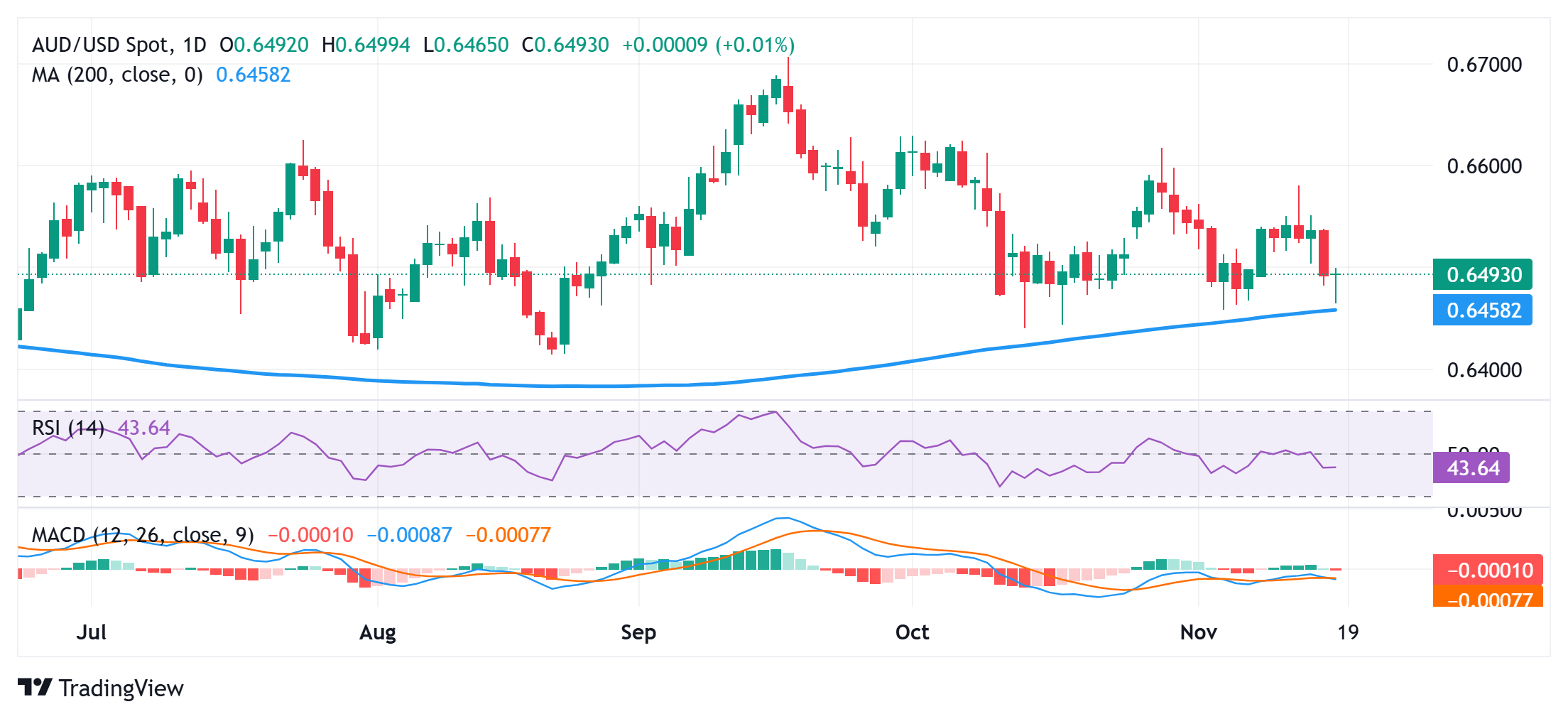
AUD/USD daily chart
Technical Outlook
Oscillators on the daily chart have just started gaining negative traction and back the case for the emergence of some selling around the AUD/USD pair at higher levels. That said, the recent repeated rebounds from a technically significant 200-day SMA warrant some caution for bearish traders. The said support is currently pegged near the 0.6460-0.6455 region, below which spot prices could accelerate the fall towards the 0.6415 horizontal support en route to the late June swing low, around the 0.6375-0.6370 region.
On the flip side, any further move up is likely to confront some resistance near the 0.6515-0.6520 area ahead of the 0.6550 supply zone and last week's swing high, around the 0.6580 region. Some follow-through buying, leading to a subsequent rise beyond the 0.6600 mark, would negate any near-term negative outlook and allow the AUD/USD pair to climb further to the 0.6660-0.6665 zone. The momentum could extend further towards the year-to-date peak, levels beyond the 0.6700 mark, touched in September.
Author

Haresh Menghani
FXStreet
Haresh Menghani is a detail-oriented professional with 10+ years of extensive experience in analysing the global financial markets.