AUD/USD Price Forecast: Bulls seem reluctant amid China’s economic woes, reduced Fed rate cut bets
- AUD/USD struggles to build on a modest intraday uptick amid China’s economic woes.
- A softer risk tone further seems to weigh on the Aussie amid a modest USD uptick.
- Economic concerns keep the USD bulls on the defensive and lend support to the pair.

The AUD/USD pair attracts some sellers following an intraday uptick to mid-0.6500s on Friday, though it lacks follow-through and remains close to a two-week high, touched the previous day. A generally weaker tone around the equity markets, along with concerns over China's economy, turns out to be a key factor undermining the Australian Dollar (AUD). Moreover, the emergence of some US Dollar (USD) buying is seen exerting downward pressure on the currency pair, though the downside potential seems limited.
The National Bureau of Statistics reported that China’s industrial output grew 4.9% year-on-year in October, compared to a 6.5% rise in the previous month and marking the weakest annual pace since August 2024. Adding to this, Retail Sales cooled from a 3.0% rise in September and expanded 2.9% last month, also representing the worst pace since August last year. Moreover, Fixed Asset Investment shrank 1.7% in the first 10 months of the year, steepening from a 0.5% decline in the January-to-September period.
This adds to worries about weak domestic demand and risks to growth in the world's second largest economy, and, in turn, is seen weighing on the China-proxy Aussie. The USD, on the other hand, draws support from reviving safe-haven demand and reduced bets for a rate cut by the US Federal Reserve (Fed) in December. A senior White House official said that key economic reports for October – employment and inflation data – may not be released at all, prompting several Fed officials to signal caution on further easing.
Minneapolis Fed President Neel Kashkari said the economic outlook is mixed as inflation continues to run higher. Separately, Boston Fed President Susan Collins said that given the limited information on inflation due to the government shutdown, she would be hesitant to ease policy further. Investors, however, remain concerned about weakening economic momentum on the back of the longest-ever US government shutdown and are still pricing in around a 50% chance that the US central bank will lower borrowing costs next month.
Adding to this, hopes for further stimulus from China and the Reserve Bank of Australia's (RBA) hawkish tilt might hold back traders from placing aggressive bearish bets around the AUD/USD pair. Moving ahead, traders might continue to scrutinize comments from influential FOMC members for more cues about the Fed's rate-cut path. This, in turn, will drive the USD and provide some impetus to spot prices. Nevertheless, the pair seems poised to register modest weekly gains, though it remains confined in a familiar range.
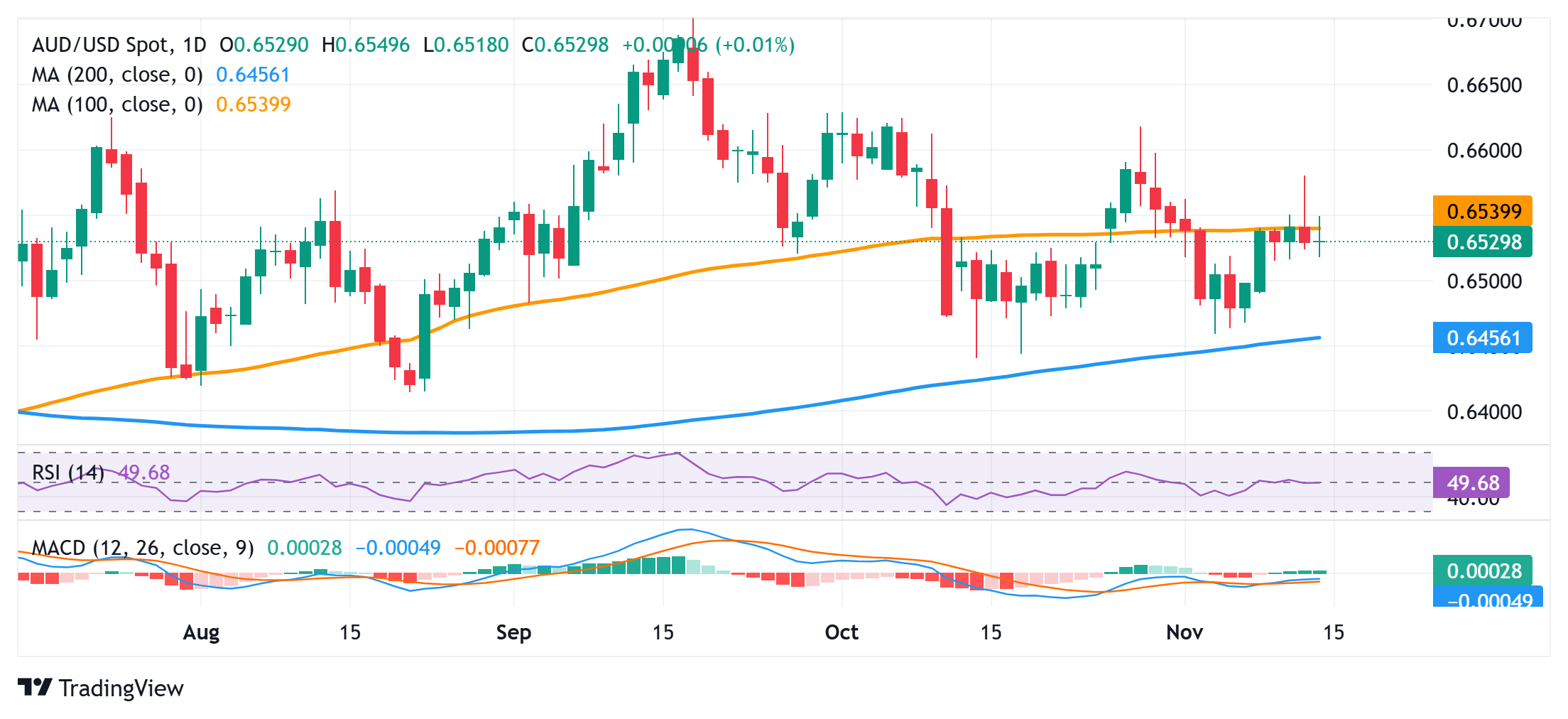
AUD/USD daily chart
Technical Outlook
Neutral oscillators on the daily chart warrant some caution before placing aggressive directional bets around the AUD/USD pair. Hence, any subsequent slide might continue to find some support near the 0.6515 horizontal zone. This is closely followed by the 0.6500 psychological mark, which, if broken, might prompt some technical selling and drag spot prices further below the 0.6480-0.6475 horizontal support, towards testing the 200-day Simple Moving Average (SMA), around the 0.6445 region. The latter nears October swing lows and should act as a key pivotal point for short-term traders.
On the flip side, the daily swing high, around the 0.6550 region, now seems to act as an immediate hurdle ahead of the overnight swing high, around the 0.6580 zone. Some follow-through buying, leading to a subsequent strength beyond the 0.6600 mark, would negate any near-term negative outlook and allow the AUD/USD pair to climb further to the 0.6660-0.6665 zone. The momentum could extend further towards the year-to-date peak, levels beyond the 0.6700 mark, touched in September.
Author

Haresh Menghani
FXStreet
Haresh Menghani is a detail-oriented professional with 10+ years of extensive experience in analysing the global financial markets.