AUD/USD Price Forecast: Bulls retain control as weaker USD offsets US-China trade war concerns
- AUD/USD attracts strong buying for the fourth straight day amid sustained USD selling bias.
- US recession fears, Fed rate cut bets and a positive risk tone weigh heavily on the Greenback.
- The AUD bulls seem unaffected by the escalation of trade tensions between the US and China.

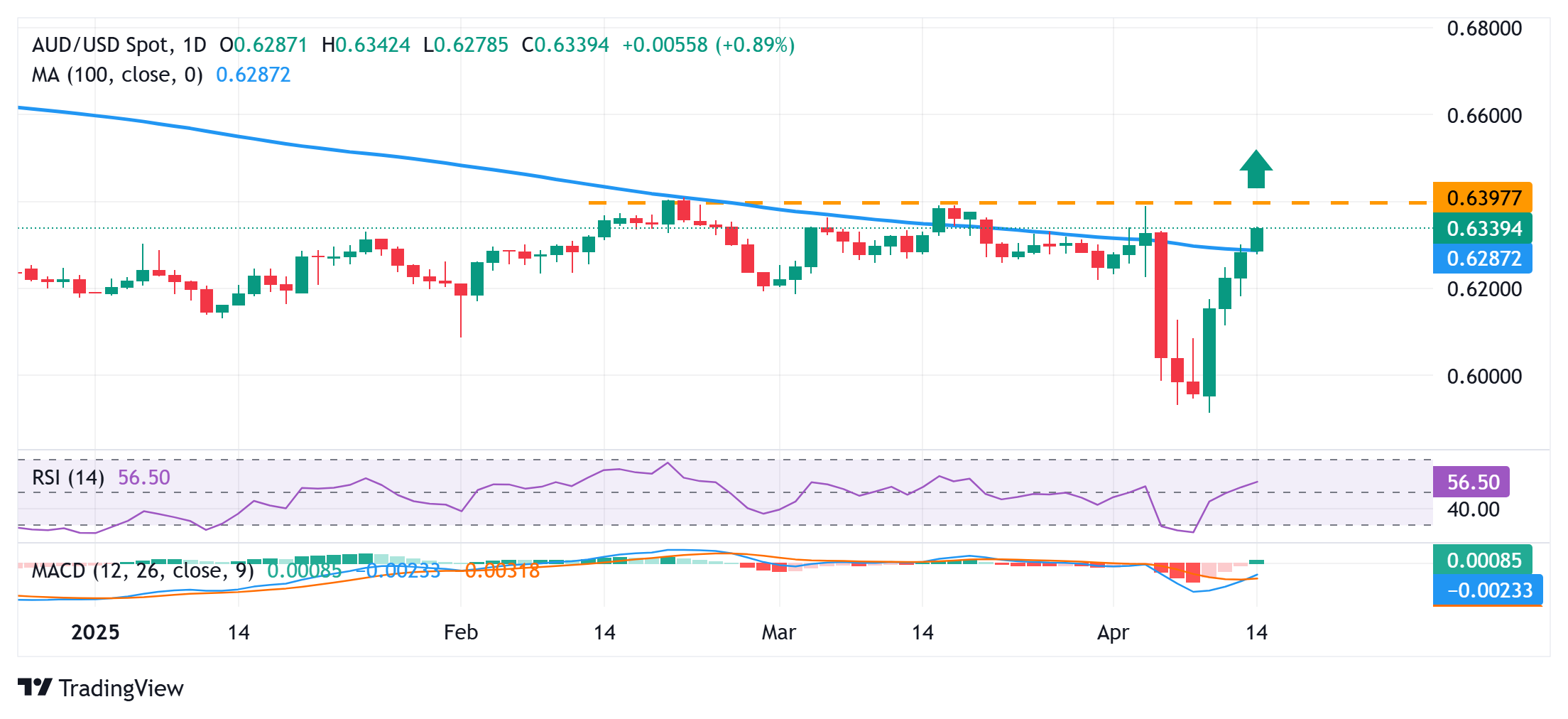
The AUD/USD pair builds on last week's strong recovery move from the 0.5915-0.5910 area, or its lowest level since March 2020 and gains follow-through positive traction for the fourth successive day on Monday. The momentum lifts spot prices to a one-and-half-week high, around the 0.6340 area during the early European session, and is sponsored by the underlying bearish tone surrounding the US Dollar (USD).
The initial market reaction to US President Donald Trump's decision last week to pause sweeping reciprocal tariffs for 90 days turned out to be short-lived amid heightened concerns over a US recession. The recent unusual spike in US Treasury yields suggests that investors are dumping US government bonds amid the weakening confidence in the US economy. Adding to this, softer US consumer inflation figures released last week reaffirmed market bets for more aggressive policy easing by the Federal Reserve (Fed), which keeps the USD depressed near its lowest level since April 2022.
The US Bureau of Labor Statistics reported last Thursday that the headline Consumer Price Index (CPI) fell 0.1% in March and the yearly rate decelerated sharply to 2.4% from 2.8% in February. Moreover, the core CPI, which strips out food and energy, rose just 0.1% from the month before and came in at 2.8% for the 12 months ended in March, marking its lowest rate in nearly four years. Traders were quick to react and are now pricing in 90 basis points of Fed rate cuts by year-end 2025, which, along with a further recovery in the global risk sentiment, undermines the safe-haven buck.
Meanwhile, expectations that China will roll out further fiscal and monetary stimulus measures in the coming months to underpin growth turn out to be another factor that benefits the Australian Dollar (AUD). This, to a larger extent, overshadows growing market worries about the escalating US-China trade war. China’s Ministry of Finance announced a steep increase in tariffs on US goods on Friday, raising duties from 84% to 125%. This move comes after US President Trump upped the ante in a trade war and decided to hike levies on goods imported from China to an unprecedented 145%.
Market participants this week will closely scrutinize comments from influential FOMC members, including Fed Chair Jerome Powell on Wednesday, for cues about the future rate-cut path. Apart from this, the US monthly Retail Sales figures, also due on Wednesday, will drive the USD demand and provide some meaningful impetus to the AUD/USD pair. In the meantime, the Greenback remains at the mercy of trade-related developments in the absence of any relevant US economic data on Monday. This, along with the broader risk sentiment, could produce short-term opportunities.
AUD/USD daily chart
Technical Outlook
From a technical perspective, the AUD/USD pair is looking to build on the momentum beyond the 100-day Simple Moving Average (SMA). Given that oscillators on the daily chart have been gaining positive traction, the move higher could lift spot prices back closer to the monthly peak, around the 0.6385-0.6390 region. Some follow-through buying beyond the 0.6400 mark will be seen as a fresh trigger for bulls and pave the way for further near-term appreciation.
On the flip side, any corrective pullback might now be seen as a buying opportunity near the 0.6300 round figure. This should help limit the downside near the 0.6245 horizontal support. A convincing break below the latter, however, would negate the positive outlook and make the AUD/USD pair vulnerable to slide back towards the 0.6200 mark. The downward trajectory could extend further towards the 0.6135 support en route to the 0.6100 mark, the 0.6040 horizontal zone, and eventually to the 0.6000 psycho-logical mark. Some follow-through selling might expose the multi-year low, around the 0.5915 region touched last week, with some intermediate support near the 0.5955 region.
Author

Haresh Menghani
FXStreet
Haresh Menghani is a detail-oriented professional with 10+ years of extensive experience in analysing the global financial markets.