AUD/USD Price Forecast: Bulls lighten bets amid a broadly firmer USD, ahead of US-China trade talks
- AUD/USD attracts heavy selling following an Asian session uptick amid a broadly stronger USD.
- The market anxiety ahead of the US-China talks overshadows the optimism led by the US-EU deal.
- Traders now look to the quarterly Australian CPI report and the FOMC decision on Wednesday.


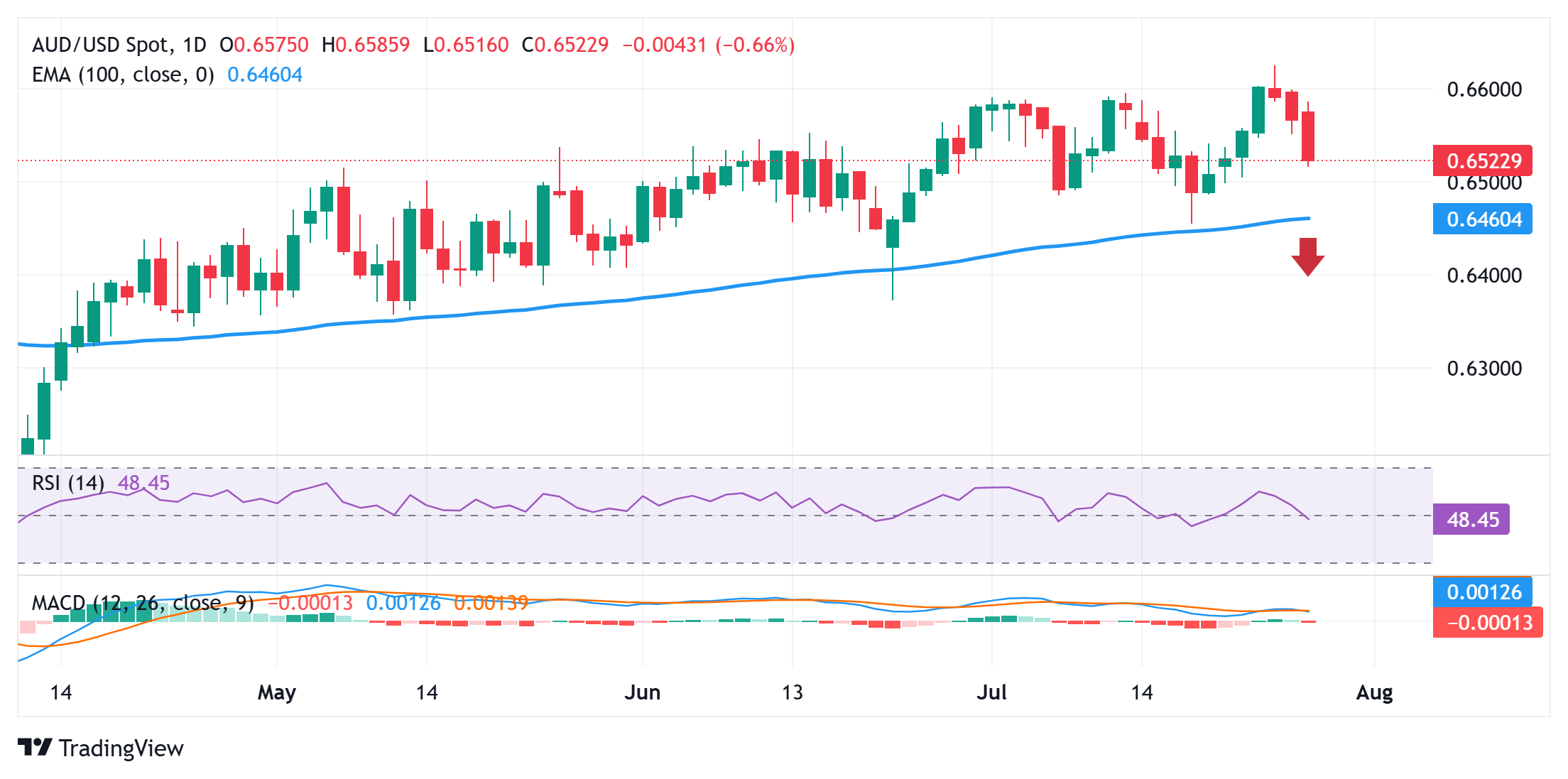
The AUD/USD pair extends last week's retracement slide from the 0.6585 region, or a fresh year-to-date peak, and attracts heavy follow-through selling for the third straight day on Monday. The downward trajectory remains uninterrupted through the early European session amid a broad-based US Dollar (USD) strength and drags spot prices to a multi-day low, around the 0.6515 region in the last hour.
US President Donald Trump and European Commission President Ursula von der Leyen announced a sweeping trade deal, with a baseline tariff of 15% on most European goods exported to the US. The initial optimism, however, fades rather quickly amid concerns that the framework is unbalanced and the lack of details regarding the steel and pharmaceutical sector levies. This, along with market anxiety ahead of the resumption of US-China trade talks, weighs on investors' sentiment and benefits the safe-haven Greenback.
Meanwhile, data released last week indicated a still resilient US labor market. Furthermore, expectations that higher US tariffs would reignite inflationary pressures in the second half of the year and force the Federal Reserve (Fed) to keep interest rates elevated for longer, further boost the USD. Apart from this, the growing acceptance that the Reserve Bank of Australia (RBA) would lower borrowing costs undermines the Australian Dollar (AUD) and contributes to the AUD/USD pair decline at the start of a new week.
Meanwhile, Trump has repeatedly attacked Fed Chair Jerome Powell personally over his stance on holding rates. This adds to worries that the Fed's independence could be under threat on the back of mounting political interference, which might hold back the USD bulls from placing aggressive bets and limit losses for the AUD/USD pair. Investors might also opt to wait for more cues about the Fed's rate-cut path before positioning for a firm direction. Hence, the focus will remain glued to the FOMC policy update on Wednesday.
Apart from this, market participants this week will confront the release of the quarterly Australian consumer inflation figures on Wednesday. Apart from this, important US macro data – JOLTS Job Openings, the Advanced Q2 GDP print, the Personal Consumption Expenditure (PCE) Price Index, and the Nonfarm Payrolls (NFP) report – should provide a fresh impetus to the AUD/USD pair.
AUD/USD daily chart
Technical Outlook
Some follow-through selling below the 0.6500 psychological mark would expose the monthly swing low, around the 0.6455 area. The latter nears the 200-day Exponential Moving Average (SMA), which, if broken decisively, would set the stage for deeper losses. The AUD/USD pair might then accelerate the fall towards the 0.6420 horizontal support en route to the 0.6400 mark and the June monthly swing low, around the 0.6375-0.6370 region. A convincing break below the latter will be seen as a fresh trigger for bearish traders.
On the flip side, the 0.6550 area now seems to act as an immediate hurdle ahead of the 0.6585 region, or the YTD peak. Some follow-through buying beyond the 0.6600 mark could lift the AUD/USD pair to the next relevant hurdle near the 0.6640 region en route to the 0.6680 region, or November 2024 swing high, and the 0.6700 round figure.
Author
Haresh Menghani
FXStreet
Haresh Menghani is a detail-oriented professional with 10+ years of extensive experience in analysing the global financial markets.

















