AUD/USD Price Forecast: Bulls have the upper hand while above 0.6540-0.6530 resistance breakpoint
- AUD/USD retreats from YTD peak as the USD is seen recovering from a multi-year low.
- Fed rate cut bets and a positive risk tone might cap the USD and support the Aussie.
- Traders look to the US ADP report for some impetus ahead of the US NFP on Thursday.


The AUD/USD pair attracts some sellers on Wednesday and moves away from a fresh year-to-date high, around the 0.6590 area touched the previous day. The Australian Dollar (USD) is weighed down by rather unimpressive domestic data. Adding to this, a modest US Dollar (USD) uptick exerts some downward pressure on the currency pair. The Australian Bureau of Statistics (ABS) reported that Retail Sales grew 0.2% MoM in May compared to 0% in April, though it fell short of estimates for a 0.4% rise. This comes on top of the economic uncertainty stemming from US President Donald Trump's tariffs and reaffirms market bets that the Reserve Bank of Australia (RBA) will cut interest rates again in July, undermining the Aussie.
The USD, on the other hand, gains some positive traction and for now, seems to have snapped a seven-day losing streak to its lowest level since February 2022 touched on Tuesday. This is seen as another factor that contributes to the AUD/USD pair's intraday slide. However, the growing acceptance that the Federal Reserve (Fed) would resume its rate-cutting cycle in the near future should cap the USD. In fact, Fed Governor Michelle Bowman and fellow Governor Christopher Waller suggested last week that the US central bank could consider cutting interest rates in July. Moreover, Fed Chair Jerome Powell said on Tuesday that the US central bank would have eased monetary policy by now if not for Trump’s uncertain trade policies.
When asked if July would be too soon for markets to expect a rate cut, Powell answered that it’s going to depend on the data. Nevertheless, traders still see a small chance that the next rate reduction by the Fed will come in July and are pricing in over a 75% probability of a rate cut at the September policy meeting. This, along with the upbeat market mood, should keep a lid on the attempted USD recovery move and help limit deeper losses for the risk-sensitive Aussie. Traders now look forward to the release of the US ADP report on private-sector employment to grab short-term opportunities around the AUD/USD pair ahead of the official employment details – popularly known as the Nonfarm Payrolls (NFP) report on Thursday.
Technical Outlook
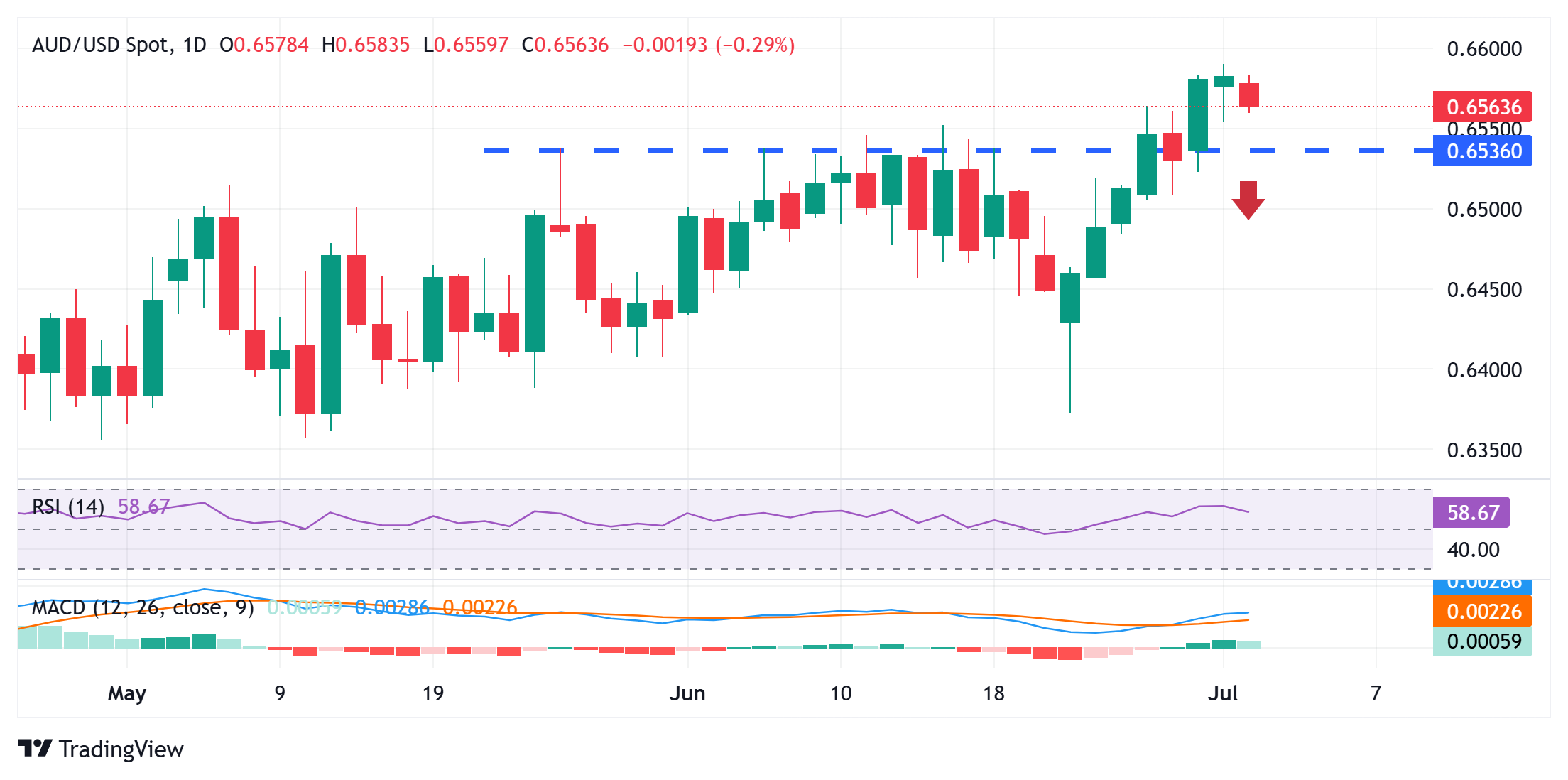
The recent breakout through a multi-week-old range and positive oscillators on the daily chart suggest that the path of least resistance for the AUD/USD pair is to the upside. Hence, any subsequent corrective slide to the 0.6540-0.6530 strong hurdle-turned-support could be seen as a buying opportunity and remain limited near the 0.6500 psychological mark. The latter should act as a pivotal point, below which spot prices could slide to the 0.6465-0.6460 horizontal support before extending the fall to the 0.6400 round figure en route to the 100-day Simple Moving Average (SMA), currently around the 0.6380 region.
On the flip side, bulls might now await a sustained move and acceptance above the 0.6600 round figure, above which the AUD/USD pair could climb to the 0.6640 hurdle. The upward trajectory could extend further and allow spot prices to test the 0.6680 intermediate hurdle, or November 2024 swing high, before aiming to reclaim the 0.6700 mark for the first time since October 2024.
Author
Haresh Menghani
FXStreet
Haresh Menghani is a detail-oriented professional with 10+ years of extensive experience in analysing the global financial markets.

















