AUD/USD Price Forecast: Bulls await move beyond 50% Fibo. amid US-China trade optimism
- AUD/USD regains positive traction amid US-China trade war de-escalation hopes.
- Easing geopolitical tensions also boost investors’ sentiment and benefit the Aussie.
- The weakening confidence in the US economy and Fed rate cut bets cap the USD.

The AUD/USD pair attracts fresh buyers near the 0.6350 region, or the weekly low touched earlier this Wednesday, and reverses a major part of the previous day's retracement slide from the year-to-date peak. Signs of easing US-China trade tensions lift the market sentiment and turn out to be a key factor that benefits the risk-sensitive Aussie. US Treasury Secretary Scott Bessent signaled on Tuesday that the current US-China standoff on tariffs is unsustainable and that the trade war would de-escalate soon. Later, White House spokeswoman Karoline Leavitt told reporters that the Trump administration is setting the stage for a deal.
Meanwhile, US President Donald Trump noted that the historically high tariffs of 145% he imposed on Chinese imports would eventually come down substantially. Moreover, Trump backtracked on his criticism of Federal Reserve (Fed) Chair Jerome Powell and said that he has no intention of firing him before the expiry of his term next year. Adding to this, Russian President Vladimir Putin said that he had a positive attitude towards any peace initiatives. Ukrainian President Volodymyr Zelenskyy responded by saying that we are ready to sit down in any format after the ceasefire, further boosting investors' confidence.
The Australian Dollar (AUD) draws additional support from data showing that private sector activity expanded for the seventh consecutive month in April. In fact, the S&P Global Flash Australia Manufacturing PMI fell from 52.1 in March to 51.7 – the lowest in two months. Meanwhile, the gauge for the services sector and the Composite PMI eased from 51.6 in the previous month to 51.4 in April, though they remained in the expansion territory. The US Dollar (USD), on the other hand, retreats after hitting a fresh weekly high and stalls the overnight recovery from a multi-year low, further lending support to the AUD/USD pair.
Trump's rapidly shifting stance on trade policies has eroded investors' trust and weakened confidence in the US economy. This, along with bets that the Federal Reserve will resume its rate-cutting cycle in June and lower borrowing costs at least three times by the end of this year, holds back the USD bulls from placing aggressive bets. Traders now look forward to the release of the US PMIs, which, along with speeches by influential FOMC members and trade-related developments, might influence the buck. Nevertheless, the fundamental backdrop suggests that the path of least resistance for the AUD/USD pair is to the upside.
AUD/USD daily chart
Technical Outlook
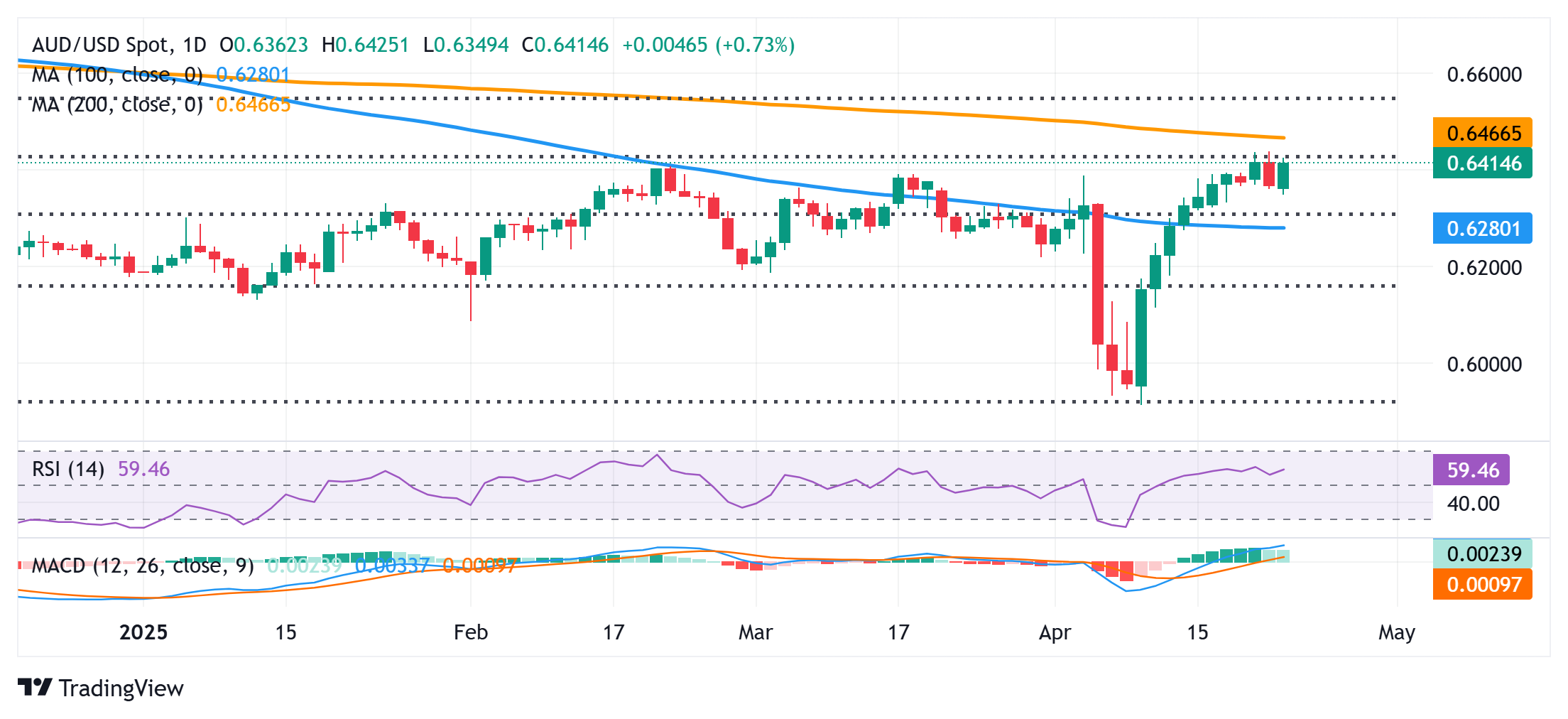
From a technical perspective, last week's sustained breakout through the 100-day Simple Moving Average (SMA) barrier and bullish oscillators on the daily chart validate the positive outlook for the AUD/USD pair. However, it will still be prudent to wait for some follow-through buying beyond the 0.6425-0.6430 region, or the 50% Fibonacci retracement level of the September 2024-April 2025 downfall, before positioning for further gains. Spot prices might then aim to surpass the very important 200-day SMA, currently pegged near the 0.6470-0.6475 area, and reclaim the 0.6500 psychological mark for the first time since early December 2024. The momentum could extend further towards the 61.8% Fibo. level, around the 0.6545 zone.
On the flip side, the 0.6400-0.6390 region now seems to offer some support ahead of the Asian session low, near the 0.6350-0.6345 area, and the 0.6300 round figure, or the 38.2% Fibo. level. Sustained weakness below the latter might prompt some technical selling and drag spot prices to the 0.6245 intermediate support en route to sub-0.6200 levels. This is followed by the next critical support near the 0.6130 region, or the 23.6% Fbo. level, which if broken decisively might shift the bias back in favor of bearish traders and pave the way for deeper losses.
Author

Haresh Menghani
FXStreet
Haresh Menghani is a detail-oriented professional with 10+ years of extensive experience in analysing the global financial markets.