AUD/USD Price Forecast: Bears look to seize control amid notable USD demand, ahead of US data
- AUD/USD corrects sharply from a three-week high amid an aggressive USD short-covering rally.
- The meltdown in the global bond markets weighs on the risk sentiment and benefits the buck.
- The RBA’s dovish tilt further undermines the Aussie ahead of this week’s key US macro releases.

The AUD/USD pair attracts heavy intraday selling on Tuesday and reverses a major part of its strong gains registered over the past four days, to a nearly three-week top touched the previous day. The downfall drags spot prices to the 0.6500 psychological mark during the first half of the European session and is sponsored by an aggressive US Dollar (USD) short-covering rally from the vicinity of the August monthly swing low.
Rising fiscal deficits, persistent inflation, and eroding central bank credibility continue to push global bond yields higher, raising concerns about the broader economy. The spillover effect tempers investors' appetite for riskier assets, which is evident from a turnaround in the risk sentiment and boosts the Greenback. Apart from this, the Reserve Bank of Australia's (RBA) dovish tilt is seen a another factor weighing on the Aussie.
In fact, the RBA slashed its outlook for economic growth in 2025 to 1.7% from 2.1%, and marginally lowered GDP forecasts for 2026 and 2027, to 2% and 2.1%, respectively. Furthermore, RBA Governor Michele Bullock said that the updated forecasts imply cash rates might need to be lower for price stability and did not rule out back to back rate cuts. Market participants now see a high probability of another rate cut in November.
Moreover, some forecasts extend bets to two or three RBA rate cuts by year-end. The Federal Reserve (Fed) is also anticipated to lower borrowing costs this month and deliver at least two 25 basis points (bps) rate cuts by the end of this year. That said, the incoming US macro data points to a strengthening economy. Moreover, expectations that inflation risk is much higher than recession risk might force the Fed to adopt a less dovish stance.
This, in turn, might now act as a tailwind for the USD and backs the case for a further depreciating move for the AUD/USD pair. Traders, however, might refrain from placing aggressive bets and opt to move to the sidelines ahead of key US macro releases scheduled at the start of a new month, starting with the ISM Manufacturing PMI later this Tuesday. Investors this week will also confront the release of JOLTS Job Openings on Wednesday, the ADP report on private-sector employment and ISM Services PMI on Thursday, and the Nonfarm Payrolls (NFP) report on Friday.
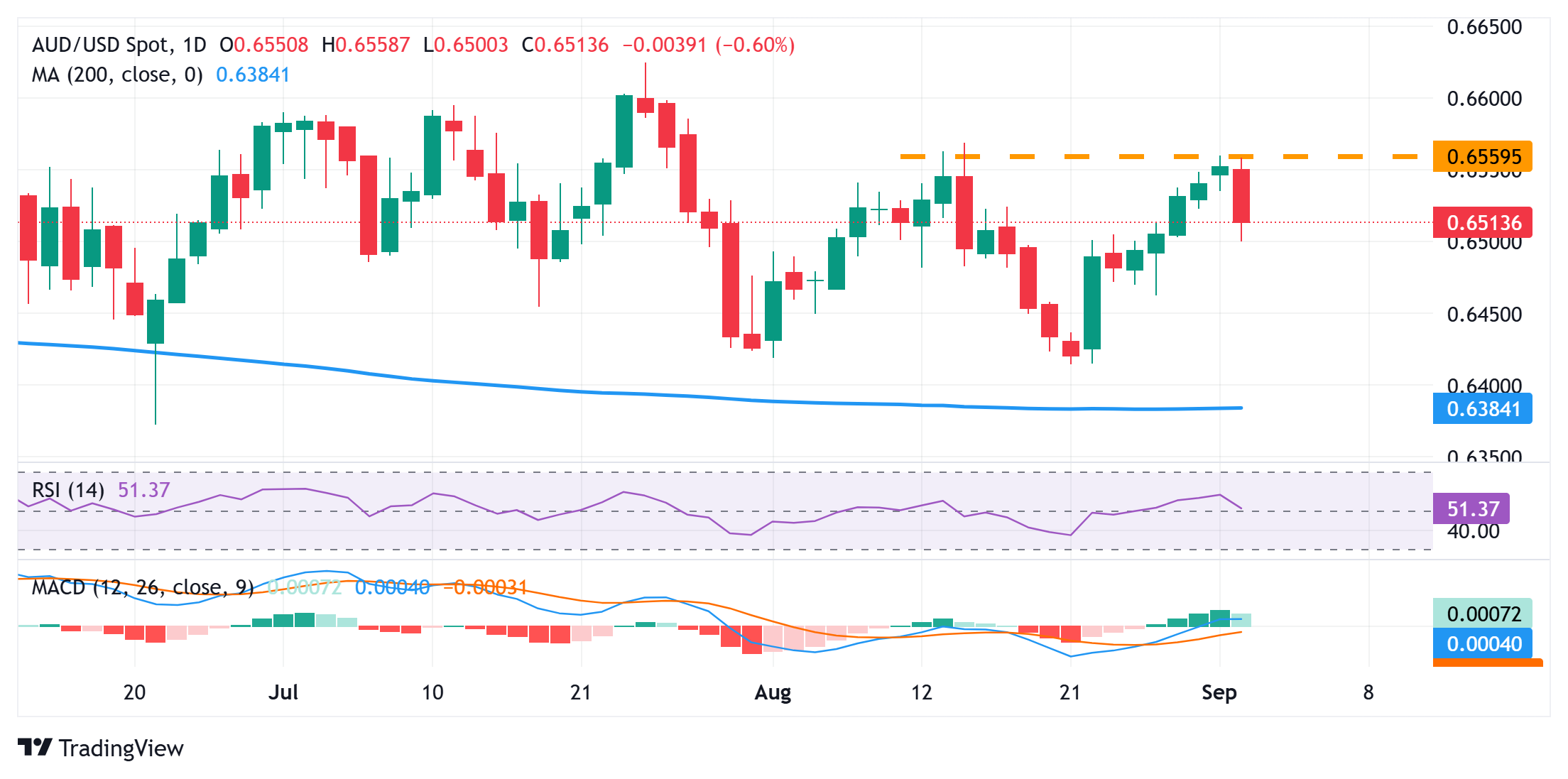
AUD/USD daily chart
Technical Outlook
The recent move up witnessed over the past two weeks or so falters near the 0.6560 horizontal barrier. The said area should now act as a key pivotal point, which, if cleared, should allow the AUD/USD pair to reclaim the 0.6600 mark amid slightly positive oscillators on the daily chart. Some follow-through buying, leading to a subsequent move beyond the year-to-date high, around the 0.6625 region touched in July, will be seen as a fresh trigger for bulls and pave the way for a further near-term appreciating move.
On the flip side, acceptance below the 0.6500 round figure might expose the 0.6420-0.6400 congestion zone, which is followed by a technically significant 200-day Simple Moving Average (SMA), around the 0.6385 region. A convincing break below the latter might shift the bias in favor of bearish traders and cause the AUD/USD pair to accelerate the fall to the 0.6355-0.6350 intermediate support before eventually dropping to test sub-0.6300 levels.
Author

Haresh Menghani
FXStreet
Haresh Menghani is a detail-oriented professional with 10+ years of extensive experience in analysing the global financial markets.














