AUD/USD Price Forecast: Another test of the YTD tops remains on the table
- AUD/USD reversed part of its recent pullback, surpassing 0.6500.
- The US Dollar further extended its weekly recovery based on trade developments.
- The RBA surprised markets by maintaining its Official Cash Rate (OCR) at 3.85%.
The Australian Dollar (AUD) managed to set aside three consecutive days of losses vs. the US Dollar (USD) on Tuesday, prompting AUD/USD to bounce off the 0.6490 region and trade with decent gains toward the 0.6560 zone.
The market uptick in the pair came as investors assessed the unexpected decision by the Reserve Bank of Australia (RBA) to keep its Official Cash Rate (OCR) unchanged at 3.85% against a broad consensus favouring a 25-basis-point cut.
China data paints mixed picture
Latest data out of China saw May industrial output, retail sales, and services activity all accelerate, and official PMI readings hovered around the expansion-contraction threshold.
While these figures underpin forecasts for roughly 5% GDP growth this year, lingering strains in China’s property sector and the gradual winding back of stimulus pose potential headwinds for Australia’s resource-dependent economy.
Will the central banks follow the same path?
Against all expectations, the RBA maintained its OCR at 3.85% at its early Tuesday event. The decision was split, with six board members voting to maintain current borrowing costs while three dissented in favour of a reduction. This underlines the central bank’s caution as it awaits further confirmation of inflation slowing.
Financial markets quickly repriced their expectations, attaching nearly 90% probability to a cut to 3.60% at the RBA's August 12 meeting and shifting their projection for the policy rate's trough from 2.85% to 3.10%.
In her press conference, Governor Michele Bullock emphasised that the board's internal disagreement was a matter of timing rather than direction and that the bank remains committed to an easing trajectory, provided inflation for the second quarter aligns broadly with forecasts.
By contrast, the Federal Reserve (Fed) maintained rates in June, even as Chair Jerome Powell cautioned that US tariffs could reignite goods inflation.
AUD speculative sentiment eased a tad
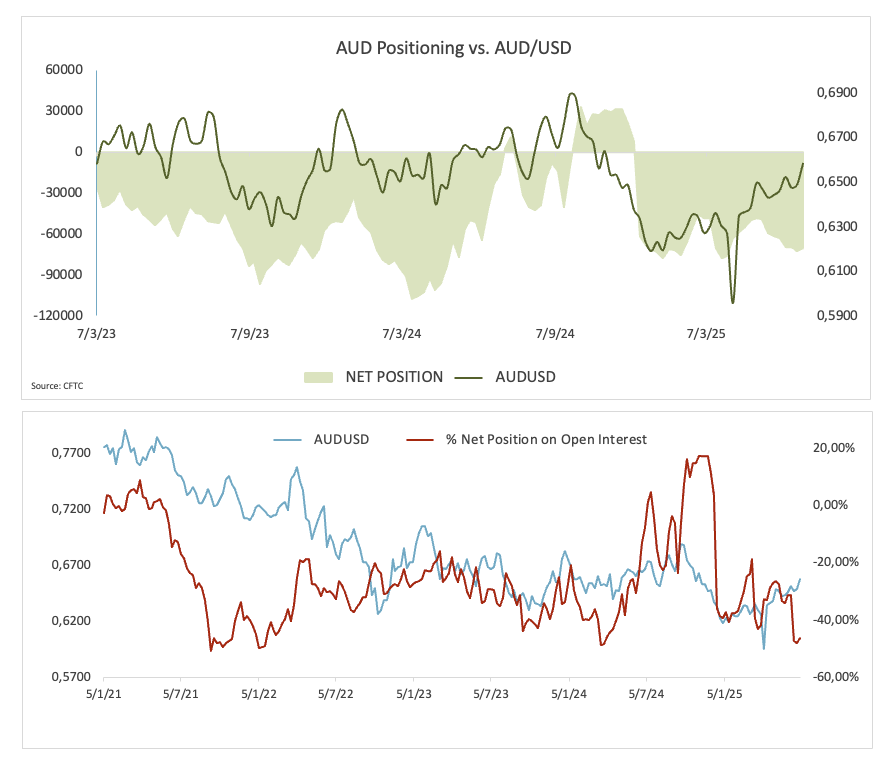
According to data through July 1 from the CFTC, non-commercial net shorts in the Australian currency shrank to just above 70K contracts, or two-week lows. The move came in tandem with the third consecutive advance in open interest, hitting around 151.4K contracts.
Technical perspective
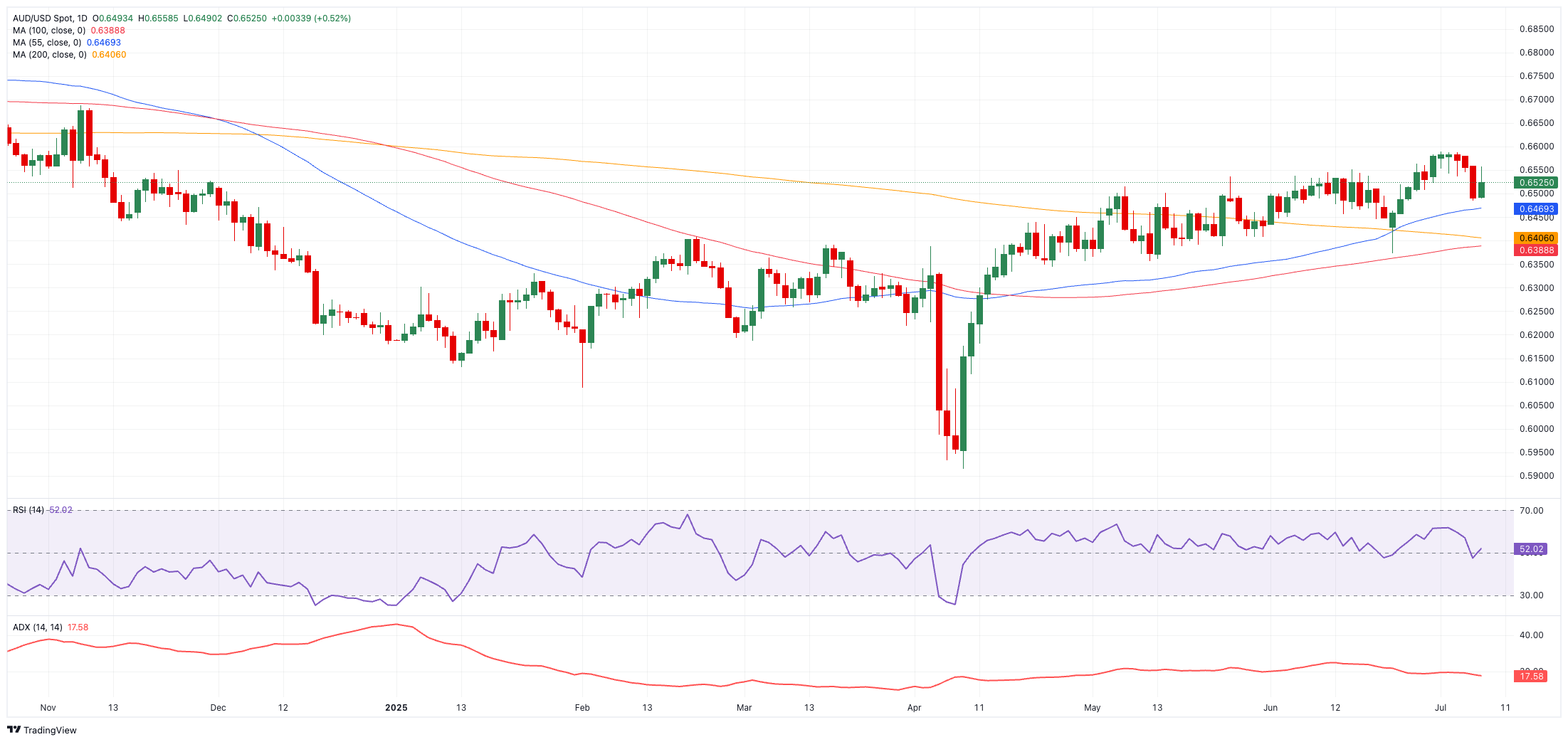
Immediate resistance is at the 2025 ceiling of 0.6590 (June 30), with the November 2024 high of 0.6687 (November 7) and the psychological 0.7000 level waiting for additional rises.
On the downside, the 200-day simple moving average (SMA) at 0.6411 provides the first support before the June trough of 0.6372 (June 23) and the May low of 0.6356 (May 12). A fall below this level might reveal the 0.6000 milestone and the 2025 bottom of 0.5913 (April 9).
Momentum indicators provide a mixed picture: the Relative Strength Index (RSI), which is above 52, points to an incipient recovery, while an Average Directional Index (ADX) of almost 20 indicates a relatively solid trend.
AUD/USD daily chart
Medium-Term outlook
AUD/USD faces the prospect of extra range-bound in the near term, barring any dramatic shifts in Beijing’s policy mix or US trade measures. With the RBA likely to move cautiously on further rate cuts and China’s recovery still patchy, the Australian Dollar may struggle to reclaim its footing above key resistance levels for now.
RBA FAQs
The Reserve Bank of Australia (RBA) sets interest rates and manages monetary policy for Australia. Decisions are made by a board of governors at 11 meetings a year and ad hoc emergency meetings as required. The RBA’s primary mandate is to maintain price stability, which means an inflation rate of 2-3%, but also “..to contribute to the stability of the currency, full employment, and the economic prosperity and welfare of the Australian people.” Its main tool for achieving this is by raising or lowering interest rates. Relatively high interest rates will strengthen the Australian Dollar (AUD) and vice versa. Other RBA tools include quantitative easing and tightening.
While inflation had always traditionally been thought of as a negative factor for currencies since it lowers the value of money in general, the opposite has actually been the case in modern times with the relaxation of cross-border capital controls. Moderately higher inflation now tends to lead central banks to put up their interest rates, which in turn has the effect of attracting more capital inflows from global investors seeking a lucrative place to keep their money. This increases demand for the local currency, which in the case of Australia is the Aussie Dollar.
Macroeconomic data gauges the health of an economy and can have an impact on the value of its currency. Investors prefer to invest their capital in economies that are safe and growing rather than precarious and shrinking. Greater capital inflows increase the aggregate demand and value of the domestic currency. Classic indicators, such as GDP, Manufacturing and Services PMIs, employment, and consumer sentiment surveys can influence AUD. A strong economy may encourage the Reserve Bank of Australia to put up interest rates, also supporting AUD.
Quantitative Easing (QE) is a tool used in extreme situations when lowering interest rates is not enough to restore the flow of credit in the economy. QE is the process by which the Reserve Bank of Australia (RBA) prints Australian Dollars (AUD) for the purpose of buying assets – usually government or corporate bonds – from financial institutions, thereby providing them with much-needed liquidity. QE usually results in a weaker AUD.
Quantitative tightening (QT) is the reverse of QE. It is undertaken after QE when an economic recovery is underway and inflation starts rising. Whilst in QE the Reserve Bank of Australia (RBA) purchases government and corporate bonds from financial institutions to provide them with liquidity, in QT the RBA stops buying more assets, and stops reinvesting the principal maturing on the bonds it already holds. It would be positive (or bullish) for the Australian Dollar.
Author

Pablo Piovano
FXStreet
Born and bred in Argentina, Pablo has been carrying on with his passion for FX markets and trading since his first college years.


![How Wall Street rigs the game [Video]](https://editorial.fxsstatic.com/images/i/market-chaos-01.jpg)