AUD/USD outlook: RBA hawkishness meets the US CPI test

The Australian dollar is entering a potentially decisive phase against the US dollar. The Reserve Bank of Australia (RBA) left its cash rate unchanged at 4.35% at its August meeting, as expected, but its message was more hawkish than the decision itself suggested. Governor Michele Bullock warned that another rate increase remains possible if inflation proves persistent, particularly as geopolitical tensions threaten to generate fresh supply shocks.
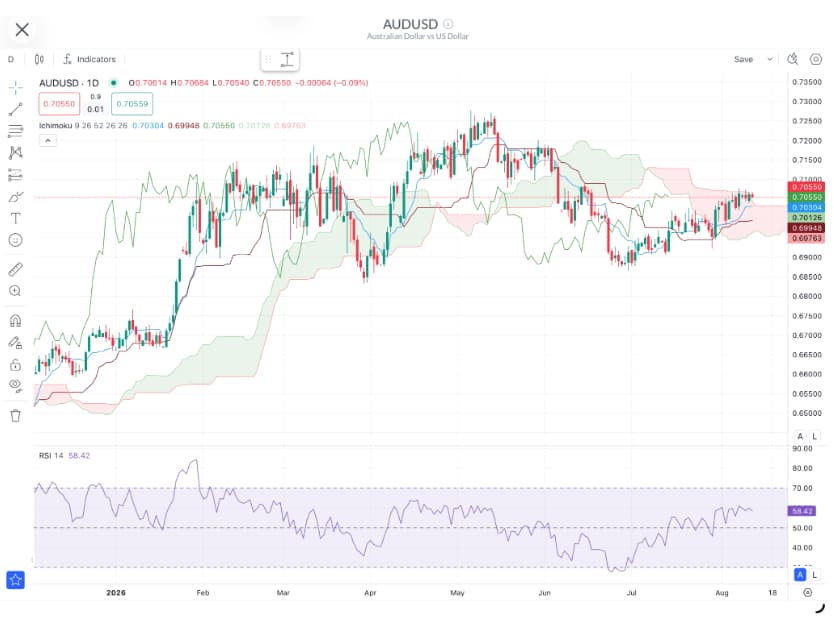
For the AUD/USD, the key question is whether this hawkish stance can support further gains. Australia’s relatively high interest rates could attract demand for the Australian dollar, but the pair’s direction will also depend on the Federal Reserve. With the US July CPI report approaching, the next move could hinge on whether American inflation strengthens expectations for easier Fed policy or instead reinforces a higher-for-longer outlook.
The RBA has paused, but the hiking cycle may not be over
The RBA’s decision to hold rates at 4.35% does not mean the inflation battle is over. The central bank is assessing the impact of three rate increases delivered earlier this year, while tighter financial conditions and a slowing economy gradually weigh on demand.
Inflation, however, remains above the RBA’s 2%-3% target range. The central bank expects headline inflation to ease to 3.6% by the end of 2026 and 2.6% by the end of 2027, while trimmed-mean inflation is projected to fall to 3.3% by year-end.
The trajectory is encouraging, but the RBA sees significant upside risks. The conflict in the Middle East could keep energy and commodity prices elevated, increasing transportation and production costs and encouraging companies to pass higher expenses on to consumers.
That is why Bullock’s comments matter. She challenged expectations that the RBA is finished tightening, saying rates could still need to rise if inflation remains too high. The result is a distinctly hawkish pause: policymakers have stopped raising rates for now but have deliberately kept the door open to further action.
For the AUD/USD, expectations may matter as much as the actual cash rate. If markets believe the RBA could resume tightening while other central banks move toward easing, the expected interest-rate differential can become a source of support for the Australian dollar.
Energy prices complicate the RBA’s outlook
The central bank expects subdued domestic demand and tighter financial conditions to bring inflation gradually back toward target. However, a prolonged Middle East conflict could keep global energy prices elevated and disrupt that process. The RBA has already warned that some businesses are experiencing higher costs and considering price increases.
Higher interest rates can weaken demand, but they cannot directly eliminate an oil supply shock. If energy prices remain elevated for long enough, however, the initial shock could spread through the economy by affecting business costs, consumer prices and inflation expectations.
This makes the RBA’s reaction function more important than the August decision itself. Stronger-than-expected inflation, renewed energy-price pressures or resilient domestic demand could revive expectations of another rate hike. Conversely, faster disinflation and a sharper economic slowdown would give policymakers more room to remain on hold.
The Australian dollar therefore has a potential monetary-policy tailwind, but whether that translates into a sustained AUD/USD rally will depend heavily on developments in the United States.
US CPI is the next major test
The July US Consumer Price Index represents the other half of the AUD/USD monetary-policy equation. Economists expected headline CPI to rise 0.1% month-on-month in July after falling 0.4% in June, with annual inflation easing to 3.4% from 3.5%. Core CPI, excluding food and energy, is expected to increase 0.2% on the month and 2.5% year-on-year.
A softer-than-expected report would strengthen the argument that US inflation is gradually moving lower despite recent supply shocks. That could encourage investors to price a less restrictive Federal Reserve, potentially pushing Treasury yields and the US dollar lower.
Such an outcome would be supportive for the AUD/USD. If Australian inflation remains persistent at the same time, investors could increasingly price a widening interest-rate differential in Australia’s favour.
The opposite scenario would pose a greater challenge to the Australian dollar. A stronger US CPI reading would suggest that inflation remains sticky and could force markets to adopt a more cautious view of Fed policy. Higher Treasury yields would then support the dollar and potentially reverse AUD/USD gains, even if the RBA maintains its hawkish stance.
The core CPI figure could prove particularly important. Energy prices can generate substantial monthly volatility, especially amid geopolitical tensions, but persistent core inflation would provide stronger evidence that underlying price pressures remain entrenched.
Inflation is also a political issue in the US
The importance of US inflation extends beyond the Federal Reserve and financial markets. The cost of living remains politically sensitive ahead of the November 2026 midterm elections, when voters will determine control of Congress.
Inflation is particularly relevant because President Donald Trump won the 2024 presidential election in part on promises to reduce the cost of living. A renewed acceleration in consumer prices could therefore create a difficult political backdrop for the administration, particularly if households continue to feel the cumulative impact of elevated prices.
A disappointing CPI report could reinforce concerns about purchasing power and make economic management an even more prominent issue for voters. Conversely, sustained disinflation could provide some relief for households and improve the administration’s economic narrative.
This does not mean the Fed will adjust monetary policy because of the elections. Its mandate remains focused on price stability and employment. However, the timing creates an additional layer of market sensitivity. The Fed meeting following September takes place only days before the midterms, potentially making the timing of any policy move more politically scrutinized.
For markets, this could make the path toward the end of the year particularly volatile. Stronger US inflation could constrain the Fed’s room to ease, while persistent Australian inflation could simultaneously keep the RBA open to further tightening.
Absolutely. I would merge the two sections into one genuine bottom-line section, rather than repeating the same bullish/bearish logic twice. The conclusion should synthesize the RBA message, the US CPI risk and the rate differential, then leave traders with the key signals to watch.
AUD/USD outlook: RBA-Fed rate differential holds the key
The outlook for the AUD/USD ultimately comes down to the direction of the monetary-policy gap between the RBA and the Federal Reserve. The RBA’s August decision has kept the door open to further tightening, while the US CPI report could determine whether expectations for Fed policy move in the opposite direction.
The most supportive environment for the Australian dollar would be one in which Australian inflation proves persistent while US price pressures continue to moderate. Such a combination would increase the likelihood that the RBA keeps rates elevated or even raises them again, while giving the Fed greater scope to ease. A widening expected rate differential in Australia’s favour could then provide the AUD/USD with further upside potential.
The risk to this scenario is a renewed acceleration in US inflation. A stronger-than-expected CPI reading, particularly in the core measure, could push Treasury yields and the dollar higher as markets scale back expectations for Fed easing. If Australian inflation were simultaneously cooling, the relative advantage of the RBA’s hawkish stance would diminish, potentially putting renewed pressure on the AUD/USD.
For traders, the key is therefore not simply whether either central bank raises or cuts rates at its next meeting, but how expectations for their respective policy paths evolve. The RBA’s hawkish pause has provided the Australian dollar with a potential monetary-policy tailwind, but the US inflation data will determine whether that advantage widens or narrows.
The next major AUD/USD move could consequently depend on whether markets begin to see Australia and the United States moving into opposite phases of their inflation and interest-rate cycles. Core CPI, Treasury yields and changes in rate expectations will be crucial signals in determining which scenario gains the upper hand.
Stay up to date with what's moving and shaking on the world's markets and never miss another important headline again! Check ActivTrades daily news and analyses here.
Author

Carolane de Palmas
ActivTrades
Carolane graduated with a Masters in Corporate Finance & Financial Markets and got the AMF Certification (Financial Markets Regulator in France). Afterward, she became an independent trader, investing mostly in European and American stocks/indices.