AUD/USD Outlook: Post-RBA slump below 0.6400 confirms bearish flag pattern breakdown
- AUD/USD plummets below 0.6400 on Tuesday and is pressured by a combination of factors.
- The disappointing Chinese PMI and RBA's on-hold decision drive flows away from the Aussie.
- Bets for one more Fed rate hike in 2023 underpin the USD and contribute to the steep decline.

The AUD/USD pair comes under heavy selling pressure on Tuesday and drops back below the 0.6400 mark heading into the European session, moving well within the striking distance of the YTD trough touched in August. The Australian Dollar (AUD) weakens in reaction to weaker Chinese data, which showed that business activity in China's services sector expanded at its slowest pace in eight months. In fact, the Caixin/S&P Global Services PMI dropped from 54.1 to 51.8 in August, registering the lowest reading since December 2022 and reviving concerns about the worsening conditions in the world's second-largest economy. Apart from this, the Reserve Bank of Australia's (RBA) on-hold decision and the emergence of some US Dollar (USD) buying contribute to the offered tone surrounding the major.
As was widely anticipated, the Australian central bank decided to stick to its wait-and-see stance and left the Official Cash Rate (OCR) unchanged at 4.10% for the third straight month. In the accompanying monetary policy statement, the RBA reiterated that some further tightening may still be needed to curb inflation, which remains on track to reach the 2-3% target range by mid-2025. In the absence of any fresh hawkish signals, the pause fuels speculations that the policy tightening cycle is over and undermines the Aussie. The USD, on the other hand, stands tall just below a three-month top touched in August and remains supported by expectations that the Federal Reserve (Fed) will keep rates higher for longer. Moreover, the markets are pricing in the possibility of one more 25 bps lift-off in 2023.
The bets were lifted following the hotter-than-expected release of inflation data from South Korea, Thailand and the Philippines. This, in turn, triggers a fresh leg up in the US Treasury bond yields and continues to act as a tailwind for the USD. Furthermore, persistent worries about an economic slowdown largely overshadow hopes for more stimulus and temper investors' appetite for riskier assets. This is evident from the cautious mood around the equity markets, which further benefits the Greenback's relative safe-haven status and exerts additional pressure on the risk-sensitive Aussie. The aforementioned fundamental backdrop seems tilted firmly in favour of bearish traders and suggests that the path of least resistance for the AUD/USD pair is to the downside amid a thin US economic docket on Tuesday.
Technical Outlook
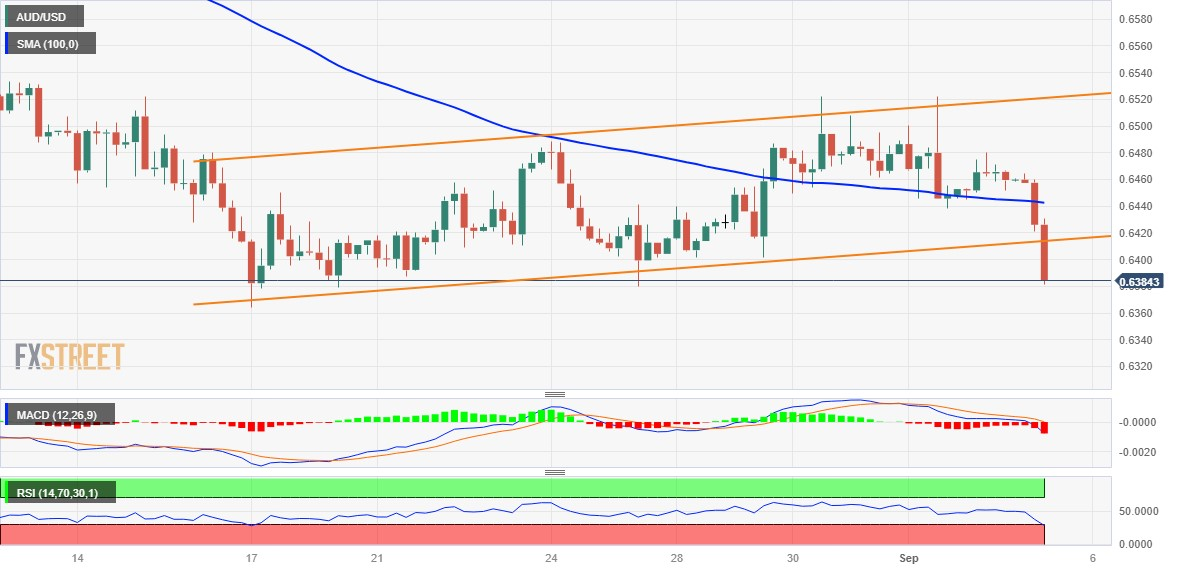
From a technical perspective, the post-RBA slump below the 0.6400 mark confirms a breakdown through a short-term ascending trend channel, which constituted the formation of a bearish flag pattern on hourly charts. This, along with the fact that oscillators on the daily chart are holding deep in the bearish territory, validates the near-term negative outlook for the AUD/USD pair. Hence, a subsequent slide below the YTD trough, around the 0.6365 region en route to the 0.6300 round figure, looks like a distinct possibility. Some follow-through selling has the potential to drag spot prices to the next relevant support near the 0.6245-0.6240 area.
On the flip side, the ascending trend-channel support breakpoint, near the 0.6400-0.6410 region, might now act as an immediate hurdle. Any subsequent move up might still be seen as a selling opportunity and runs the risk of fizzling out rather quickly near the overnight swing high, around the 0.6480 region. This is closely followed by the 0.6500 psychological mark, which if cleared decisively might trigger a short-covering rally and allow the AUD/USD pair to reclaim the 0.6600 round figure. Some follow-through buying beyond the 0.6510-0.6515 barrier might shift the bias in favour of bullish traders and pave the way for a further near-term positive move towards the 0.6700 mark en route to the next relevant hurdle near the 0.6725-0.6730 area.
Author

Haresh Menghani
FXStreet
Haresh Menghani is a detail-oriented professional with 10+ years of extensive experience in analysing the global financial markets.