|

AUD/USD Forecast: Waiting for an update on the Australian employment situation

AUD/USD Current Price: 0.7167

  • Australia expected to have lost 35,000 jobs in September amid Victoria lockdown.
  • Westpac Consumer Confidence beat expectations in October but declined from its previous reading.
  • AUD/USD is technically bearish, and the market’s sentiment favors another leg south.
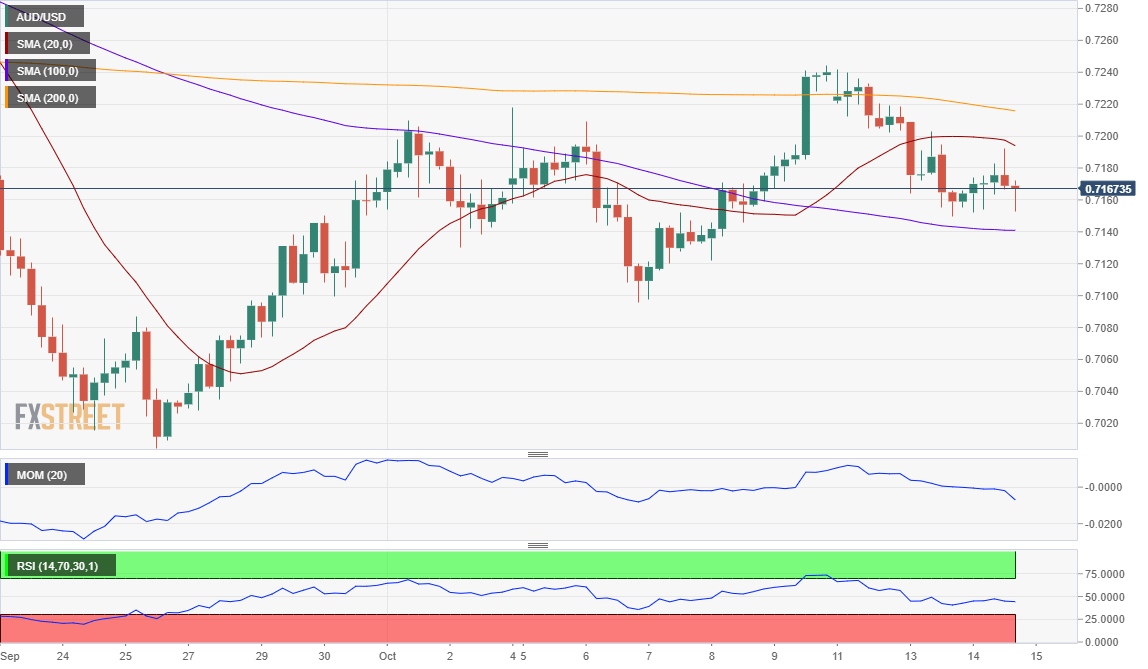
The AUD/USD pair is ending the day as it started around 0.7160, having spent it within a well-limited range. The pair advanced to 0.7190, but it changed course with Wall Street’s slump mid-US session. The Aussie remained subdued, despite Westpac Consumer Confidence resulted in 11.9% in October, better than the 9.9% forecast, although below the previous 18%.

This Thursday Australia will publish its September employment figures. The country is expected to have lost 35,000 jobs in the month, while the unemployment rate is seen at 7.1%, up from 6.8% in August. Additionally, China will publish September inflation figures, with the CPI foreseen at 1.8% YoY.

AUD/USD short-term technical outlook

The AUD/USD pair maintains its bearish stance in the short-term, although the upcoming direction will likely be dictated by the outcome of the employment report. The 4-hour chart shows that it keeps trading below its 20 SMA while above a bearish 100 SMA. Technical indicators have stabilized within negative levels, skewing the risk to the downside without confirming further declines ahead.

Support levels: 0.7130 0.7095 0.7050

Resistance levels: 0.7205 0.7240 0.7290

View Live Chart for the AUD/USD

Author

Valeria Bednarik

Valeria Bednarik was born and lives in Buenos Aires, Argentina. Her passion for math and numbers pushed her into studying economics in her younger years.


More from Valeria Bednarik
Share:

Editor's Picks

GBP/USD remains offered; bears target 1.3600

GBP/USD now leaves behind part of its recent recovery and revisits the low 1.3600s at the beginning of the week. Indeed, Cable trades with a mild downward bias amid decent gains in the Greenback as investors remain wary of upcoming US data releases and the Jackson Hole event.

EUR/USD remains sidelined above 1.1650

EUR/USD trades on the defensive following the closing bell on Wall Street on Monday, hovering around the 1.1660 region and adding to Friday’s small decline. The pair’s pullback comes in response to an acceptable rebound in the US Dollar in a context of generalised caution ahead of key US data releases and Chair Warsh’s speech in Jackson Hole.

Gold poised to extend its bullish run

Gold surrenders part of its initial advance, although it keeps its bullish pace well and sound above the $4,600 mark per troy ounce on Monday. The precious metal’s move higher comes despite slight gains in the US Dollar and a modest pullback in US Treasury yields across the curve.

XRP surged 72%, but is the rally really about XRP?
Ripple (XRP) surged more than 72% in less than a week, its strongest rally since July 2025, as cryptocurrency prices broadly broke out. But the move has a problem: it may have little to do with XRP itself. The token's near-term rally appears to have been driven largely by a broader liquidity shift after the US Treasury expanded long-end bond buybacks, pulling yields lower and lifting risk assets.
Convulsion in credit markets
The United States government just posted a $432.3 billion deficit for July, the largest monthly shortfall since March of 2021. That single burst of red ink pushed the yeartodate deficit to $1.8 trillion, with two months still remaining in fiscal 2026. At this pace, Washington will soon wax nostalgic for the “good old days” when annual deficits were only $2 trillion.
$20 billion offered, $2 billion taken: Why Treasury doubled its buyback cap

The US Treasury moved off its own calendar on Wednesday, and that is the part worth sitting with. At 12:32 GMT, the department said it would at least double the size of liquidity support buyback operations in the 10-year to 20-year and 20-year to 30-year sectors, lifting the maximum from $2 billion per operation to at least $4 billion, effective September 9 and running to November 4.














