AUD/USD Forecast: Fresh weakness comes from China
- AUD/USD flirted with four-week lows near 0.6630.
- Poor growth prospects in China and weak commodities hurt AUD.
- Next on the downside is the 200-day SMA.

AUD/USD saw its decline pick up at an unusually strong pace at the beginning of the week as investors assessed the lack of auspicious news from China in combination with further weakness in commodities and the interest rate cut by the PBoC.
That said, spot retreated for the sixth consecutive session on Monday, breaking below the 0.6700 support with decent conviction and opening the door to a deeper pullback in the short-term horizon.
Furthermore, the PBoC’s unexpected decision to cut both short- and long-term interest rates also pushed the Chinese yuan lower, impacting the Aussie dollar due to the country’s economic dependence on the Chinese market. Further selling pressure came in as the Australian current is also considered a liquid proxy for the yuan.
In addition, the weak outlook for the Chinese economy, in the absence of significant stimulus measures, has led to a decline in copper and iron prices, further weighing on AUD.
Regarding monetary policy, the Reserve Bank of Australia (RBA) appears likely to be the last G10 central bank to start lowering interest rates. In its latest meeting, the RBA maintained a hawkish stance, keeping the official cash rate at 4.35% and signalling flexibility for future decisions. The meeting minutes revealed that officials considered another rate hike to curb inflation but decided against it, partly due to concerns about a potential sharp slowdown in the labour market.
The RBA is in no rush to ease policy, expecting that it will take time for inflation to consistently fall within the 2-3% target range.
Potential Fed easing in the medium term, contrasted with the RBA’s likely prolonged restrictive stance, could support AUD/USD in the coming months. However, concerns about slow momentum in the Chinese economy might hinder a sustained recovery of the Australian currency as China continues to face post-pandemic challenges.
On the data front, flash Manufacturing and Services PMIs will be the salient data releases Down Under this week.
AUD/USD daily chart
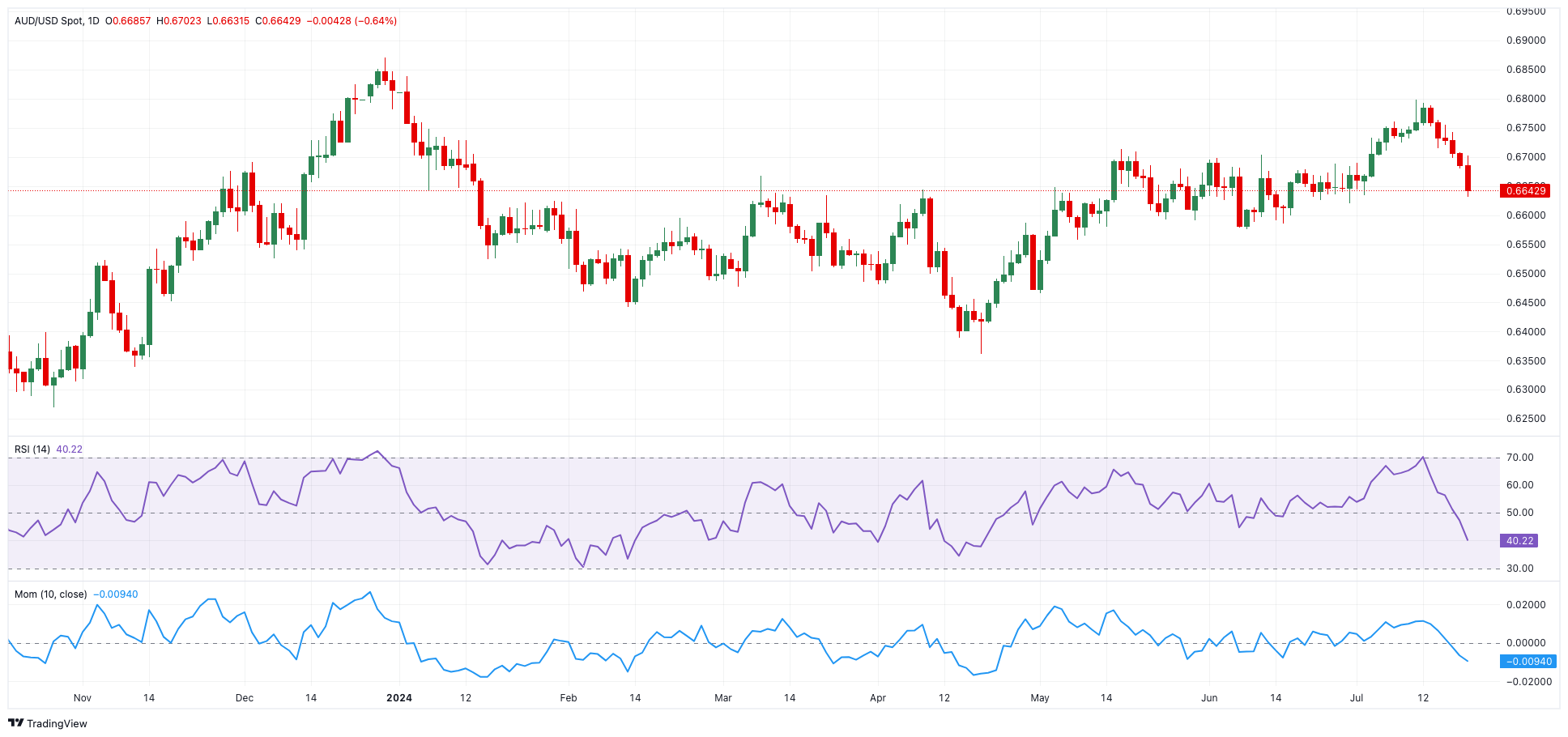
AUD/USD short-term technical outlook
Further losses in AUD/USD should find initial support at the July low of 0.6631 ahead of the 100-day SMA at 0.6605. If the pair breaks through this level, it might go for the June low of 0.6574 (June 10), which is supported by the key 200-day SMA (0.6581). From here, the May low of 0.6465 is followed by the 2024 bottom of 0.6362 (April 19).
If buyers regain their impetus, the immediate target is the July high of 0.6798 (July 8), seconded by the December 2023 top of 0.6871, the July 2023 peak of 0.6894 (July 14), and the 0.7000 yardstick.
Overall, the uptrend should continue as long as the AUD/USD is trading above the 200-day SMA.
The 4-hour chart indicates a sharp acceleration of the downward bias. Against this, the immediate support is 0.6631 ahead of 0.6619. On the upswing, the first barrier is the 200-SMA of 0.6679, which is followed by 0.6754 and finally 0.6798. The RSI fell to around 22.
Author

Pablo Piovano
FXStreet
Born and bred in Argentina, Pablo has been carrying on with his passion for FX markets and trading since his first college years.